Alfred Lord Tennyson: Life, 7 Best Works & Why the Victorian Poet Still Inspires Millions Today
Most people have never read a full Tennyson poem. Yet millions of people around the world unknowingly quote him every single day.
Phrases like “Tis better to have loved and lost” and “Knowledge comes, but wisdom lingers” — these are not modern self-help mantras. They are lines written by Alfred Lord Tennyson more than 150 years ago. They have survived wars, revolutions, and the entire digital age, and they still appear in speeches, eulogies, Instagram captions, and graduation addresses across the USA, UK, Canada, and India.
So who exactly was Alfred Lord Tennyson? Why did Queen Victoria personally call his poetry her comfort during grief? And why does the poem Ulysses — written by a 24-year-old in mourning — still move readers to tears today?
This guide answers all of that.
Key Takeaways
- Alfred Lord Tennyson (1809–1892) was the leading poet of the Victorian era and Poet Laureate of England for 42 years
- He was born the fourth of twelve children in Lincolnshire, England, and showed literary talent from the age of twelve
- His greatest works include Ulysses, In Memoriam, The Charge of the Light Brigade, The Lady of Shalott, and Idylls of the King
- The death of his closest friend Arthur Henry Hallam in 1833 shaped nearly all of his most celebrated poetry
- His poem Ulysses is considered one of the most perfect dramatic monologues in the English language — called “perfect” by T.S. Eliot
- Tennyson’s central themes — grief, perseverance, faith, mortality, and the tension between science and religion — remain deeply relevant in the 21st century
- He was the first writer in British history to be made a peer, becoming Baron Tennyson in 1884
Who Was Alfred Lord Tennyson?
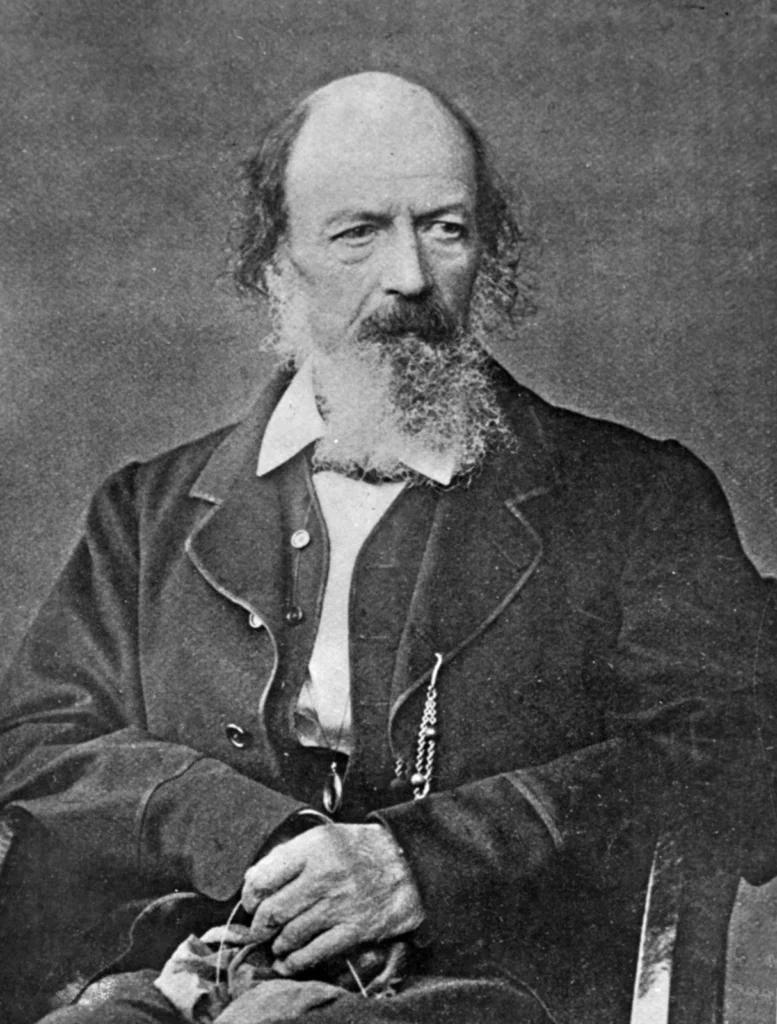
Alfred Lord Tennyson was born on August 6, 1809, in Somersby, Lincolnshire, England. He is often regarded as the chief representative of the Victorian age in poetry, a distinction he earned through decades of work that captured the anxieties, aspirations, and grief of an entire civilisation.
Tennyson was the fourth of twelve children and showed an early talent for writing. At the age of twelve, he wrote a six-thousand-line epic poem. This was not the work of a hobbyist. Even as a child, Tennyson was driven by language in a way that few writers ever are.
His early home life, however, was deeply troubled. His father began to suffer frequent mental breakdowns exacerbated by alcoholism. One of Tennyson’s brothers had violent quarrels with his father, a second was later confined to an insane asylum, and another became an opium addict. This turbulent environment left a lifelong mark on Tennyson’s psychology and, consequently, on his poetry.
Escaping to Cambridge
Tennyson escaped home in 1827 to attend Trinity College, Cambridge. There he joined a literary club called “The Apostles” — an elite intellectual circle that gave the intensely shy young man both confidence and community.
It was at Cambridge that Tennyson met Arthur Henry Hallam. The two became inseparable friends, travelling across Europe together and pushing each other’s intellectual boundaries. Hallam was also engaged to Tennyson’s sister. The friendship was, by all accounts, the most important relationship of Tennyson’s life.
In 1833, Hallam died suddenly of a fever at the age of 22. After the death of his friend, Tennyson struggled through a period of deep despair and, for many years, battled alcoholism. He barely wrote for nearly a decade. When he finally returned to poetry, the work that emerged would change English literature permanently.
Alfred Lord Tennyson’s Rise to Fame
Tennyson published his first significant collection in 1830, but it received harsh reviews. Critics called his work “affected” and “obscure.” Tennyson, deeply sensitive to criticism, went largely silent for nine years.
The turning point came in 1842 when he published a two-volume collection of Poems that included Ulysses, Locksley Hall, and Morte d’Arthur. By the time he was 41 years old, Tennyson had established himself as one of the most popular poets of his time.
Then came In Memoriam in 1850 — the long elegy written over seventeen years in grief for Arthur Hallam. Queen Victoria specifically named In Memoriam as a poem that was her comfort during her own mourning. In the same year, Tennyson was appointed Poet Laureate of England by Queen Victoria herself.
Tennyson succeeded Wordsworth as Poet Laureate in 1850 and served 42 years — the longest tenure of any Poet Laureate in British history. He became the first writer to be made a peer, becoming Alfred, Lord Tennyson.
Alfred Lord Tennyson’s 7 Greatest Works
1. Ulysses (1842)
If there is one poem that defines Alfred Lord Tennyson’s genius, it is Ulysses.
Ulysses was published in 1842 in the collection that secured Tennyson’s literary fame. It had been written nine years earlier, when he was 24, following the death of his closest friend Arthur Henry Hallam.
H3: What Is “Ulysses” About?
The poem is a dramatic monologue spoken by the aged Greek hero Odysseus (Ulysses in Latin) after he has returned home to Ithaca. Rather than settling into quiet retirement, he refuses to accept a sedentary life. He gathers his old mariners and announces his intention to sail once more into the unknown.
Tennyson’s poem Ulysses explores the themes of seeking adventure and the meaning of life. Ulysses misses his old adventurous life and feels that life without excitement is no life at all.
The most quoted lines from the poem capture this defiant spirit:
“To strive, to seek, to find, and not to yield.”
The poem garnered praise from Tennyson’s contemporaries as well as successive literary figures including T.S. Eliot, who called it a “perfect” poem.
Additionally, Tennyson himself stated that Ulysses was “more written with the feeling of Hallam’s loss upon me than many poems in In Memoriam.” This makes it simultaneously a poem about adventure and a poem about grief — about pressing forward when everything in you wants to stop.
2. In Memoriam A.H.H. (1850)
In Memoriam is Tennyson’s masterpiece. Tennyson wrote In Memoriam after he learned that his beloved friend Arthur Henry Hallam had died suddenly and unexpectedly of a fever at the age of 22.
The poem captures the torrent and pilgrimage of a soul in flux, moving from imprisoned grief to joyful memory. Comprising 133 numbered sections written over seventeen years, the poem is not a single unified argument but rather a sustained meditation on death, faith, doubt, science, and the possibility of reunion in the afterlife.
In Memoriam connects the despair Tennyson felt over the loss of his friend and the despair he felt when contemplating a godless world. In the end, the poem affirms both religious faith and faith in human progress.
It contains one of the most quoted lines in the English language:
“‘Tis better to have loved and lost / Than never to have loved at all.”
3. The Charge of the Light Brigade (1854)
Written in response to a disastrous British cavalry charge during the Crimean War, this poem is Tennyson at his most patriotic and visceral.
Historically, the fight during the Crimean War brought to light the incompetent organisation of the English army. However, the poem about the Light Brigade honoured the soldiers’ courage and heroic action.
The poem’s thundering rhythm — galloping like the horses themselves — made it one of the most widely memorised poems in Victorian England. It remains a standard text in school curricula across the United Kingdom and India.
4. The Lady of Shalott (1832, revised 1842)
The Lady of Shalott is one of Tennyson’s most beloved narrative poems. It tells the story of a mysterious woman trapped in a tower on the island of Shalott, cursed to see the world only through a mirror and weave what she sees into a tapestry.
The poem glorifies a character who embraces her destiny in life, even though that destiny ends in tragic death. When she finally turns to look directly at Sir Lancelot — breaking the curse — she accepts death with haunting dignity.
The poem is a cornerstone of Pre-Raphaelite art and inspired some of the most celebrated paintings of the 19th century, including works by William Holman Hunt and John William Waterhouse.
5. Idylls of the King (1859–1885)
In 1859, Tennyson published the first poems of Idylls of the King, which sold more than ten thousand copies in one month.
This epic work retells the legends of King Arthur and the Knights of the Round Table. It is Tennyson’s longest and most ambitious work — a meditation on the rise and fall of an ideal civilisation, the corruption of virtue, and the loss of a golden age. Many scholars read it as Tennyson’s commentary on Victorian England and its moral uncertainties.
6. Morte d’Arthur (1842)
Written as a precursor to Idylls of the King, this poem depicts the final moments of King Arthur after the Battle of Camlann. King Arthur is depicted demonstrating his courage not in the heat of battle but in his willingness to face death.
The poem’s quiet dignity and elegiac beauty made it an instant classic. It established Tennyson as a poet capable of handling large mythological canvases with psychological depth.
7. Crossing the Bar (1889)
Written when Tennyson was 80 years old, Crossing the Bar is a farewell poem — a calm, dignified meditation on death. The “sandbar” of the title is a metaphor for the threshold between life and death. Tennyson requested that this poem always be placed last in any collection of his work.
The poem ends with one of the most serene closing lines in English poetry:
“I hope to see my Pilot face to face / When I have crost the bar.”
The Central Themes of Alfred Lord Tennyson’s Poetry
Understanding Tennyson’s themes helps you read any of his poems with greater depth and insight.
Grief and the Art of Perseverance
Many of Tennyson’s poems are about the temptation to give up and fall prey to pessimism, but they also extol the virtues of optimism and discuss the importance of struggling on with life.
The death of Arthur Hallam was the defining event of Tennyson’s creative life. Consequently, grief is not merely a topic in his poetry — it is its engine.
Faith Versus Science
Tennyson’s poetry dealt often with the doubts and difficulties of an age in which traditional religious beliefs about human nature and destiny were increasingly called into question by science and modern progress.
Darwin published On the Origin of Species in 1859 — the same year as the first instalment of Idylls of the King. Tennyson wrestled publicly with what science was doing to faith, and his poems became a communal space where Victorian readers could work through their own doubts.
Heroism and the Passage of Time
From Ulysses sailing into the unknown in old age to King Arthur accepting death with grace, Tennyson was preoccupied with what heroism looks like when youth is gone. Moreover, his heroes do not rage against time — they meet it with dignity and resolve.
The Role of Art and the Artist
The Lady of Shalott can be read as a meditation on the artist’s relationship to reality. The Lady weaves the world from a distance but yearns for direct experience. When she reaches for real life, she dies — suggesting that art and lived experience are in permanent, tragic tension.
Why Alfred Lord Tennyson Still Matters in 2026
His Language Shaped Modern English
Tennyson is one of the most quoted poets in English literature and several of his phrases have become commonly used in the English language. Phrases you use today — without knowing their origin — were coined by Tennyson.
His Themes Are Universal
Grief, the search for meaning, the fear of becoming irrelevant, the conflict between faith and doubt — these are not Victorian concerns. They are human concerns. Consequently, Tennyson speaks directly across centuries to readers in Mumbai, New York, London, and Toronto.
He Modelled How to Keep Going
Perhaps the most important thing Alfred Lord Tennyson offers a modern reader is not a poem but an example. He faced a devastating loss at 24, battled depression and alcoholism, endured years of critical rejection, lost money, lost love — and still produced work that the Queen of England called her personal comfort.
Ulysses puts it most plainly: “We are not now that strength which in old days / Moved earth and heaven; that which we are, we are.”
Pro Tips: How to Start Reading Alfred Lord Tennyson
If you are new to Tennyson, here is the ideal reading order:
Step 1: Begin with Ulysses — 70 lines, free online, takes 5 minutes to read and a lifetime to fully understand.
Step 2: Read The Charge of the Light Brigade — short, rhythmically powerful, immediately accessible.
Step 3: Move to The Lady of Shalott — beautiful narrative, easy to follow, richly symbolic.
Step 4: Sample In Memoriam — read sections 1, 27 (“‘Tis better to have loved and lost”), 54, 95, and 131. You do not need to read all 133 sections on your first encounter.
Step 5: Finish with Crossing the Bar — four stanzas of quiet perfection that will stay with you.
Frequently Asked Questions About Alfred Lord Tennyson
Who was Alfred Lord Tennyson and why is he important?
What is Alfred Lord Tennyson’s most famous poem?
What is the poem Ulysses by Tennyson about?
When was Alfred Lord Tennyson appointed Poet Laureate?
Final Thoughts: The Enduring Legacy of Alfred Lord Tennyson
Alfred Lord Tennyson lived through personal tragedy, public rejection, financial crisis, and the collapse of certainties that had defined Western civilisation for centuries. Additionally, he wrote through all of it.
He did not offer easy answers. What he offered was something far more valuable — the honest account of a mind refusing to give up, a voice insisting that even in grief and doubt, the act of striving still has meaning.
That is why Ulysses ends where it does: not with arrival, not with victory, but with departure. With the act of setting out. With the decision to keep moving.
“To strive, to seek, to find, and not to yield.”
If that single line does not make you want to read more Tennyson immediately, nothing will.
Start your reading today. Begin with Ulysses — it takes five minutes to read and may be the most important five minutes you invest in literature this year. Share this article with a student, a colleague, or anyone who thinks poetry is not for them. Tennyson will prove them wrong.
Disclaimer: This article is intended for educational and informational purposes only. All biographical information is based on well-documented historical sources including Encyclopaedia Britannica, the Academy of American Poets, and established literary scholarship. Quotes from Tennyson’s poetry are used for educational analysis under fair use principles. For academic citation purposes, please refer to primary scholarly sources.