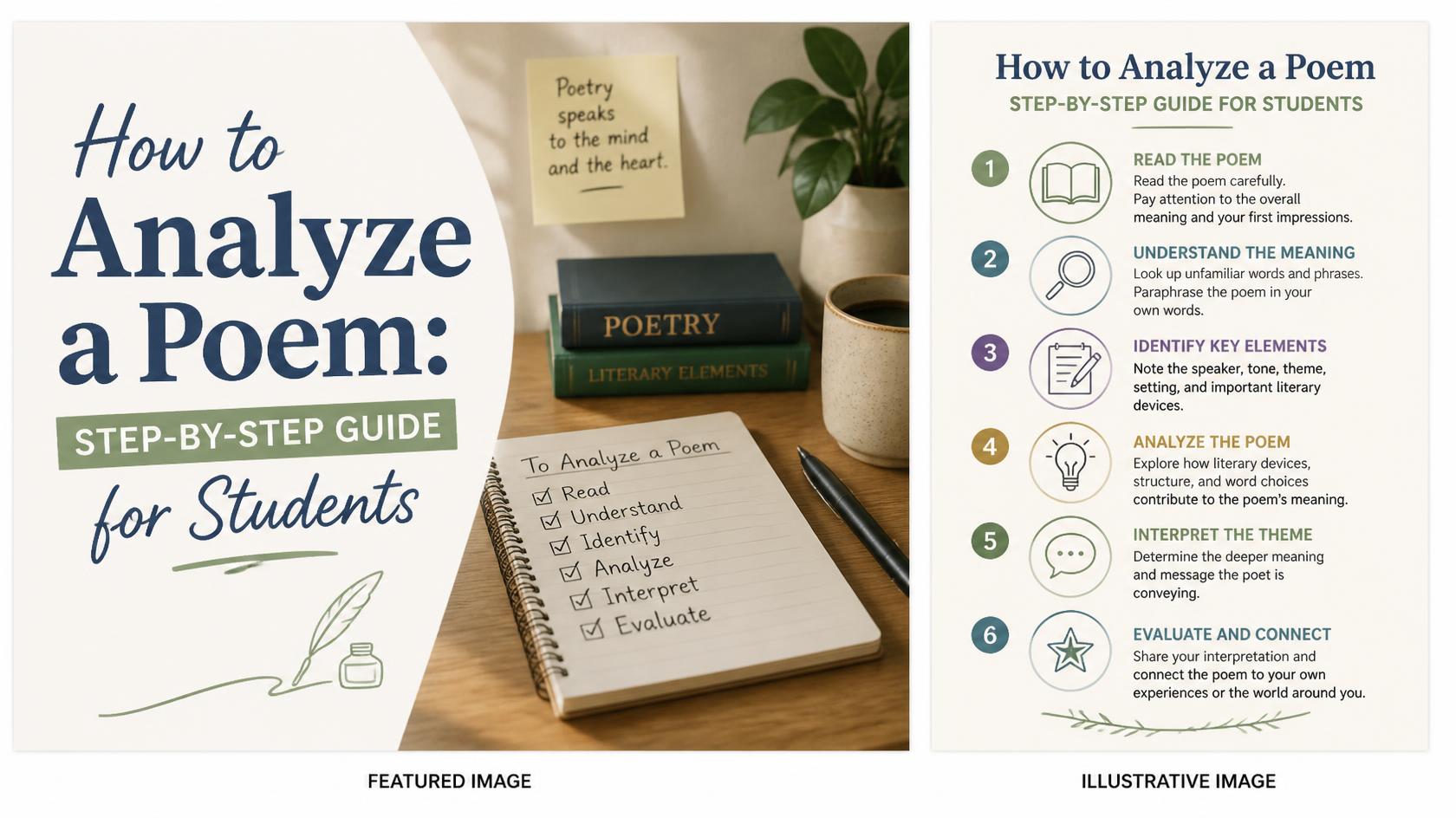
Introduction
Poetry has a way of stopping you mid-sentence. A line lands, and you feel something before you understand it. That experience — the feeling before the understanding — is exactly why analyzing a poem matters. Analysis is not about breaking that feeling. It is about tracing it back to its source.
Knowing how to analyze a poem is one of the most important skills in English literature, whether you are preparing for a board exam, writing a university essay, or simply trying to read a poem closely without feeling lost. Yet most students approach poetry with a kind of anxious speed — reading it once, shrugging, and hoping the explanation appears somewhere.
This guide gives you a structured, repeatable method for analyzing any poem, along with concrete examples, common errors students make, and exam-specific advice. By the end, you will have a clear framework you can actually use the next time you sit down with an unfamiliar poem.
Quick Answer: What Is Poem Analysis?
Poem analysis is the process of carefully examining a poem’s language, structure, imagery, tone, and literary devices to understand how the poet constructs meaning. It goes beyond summarizing what a poem says and asks how and why it says it that way. A good analysis connects the poet’s choices to the poem’s overall effect and theme.
Table of Contents
Why Poem Analysis Feels Hard (and Why It Doesn’t Have to Be)
The real difficulty with poetry is not complexity — it is unfamiliarity. Poems do not work the way prose does. They compress language, rearrange syntax, interrupt logical sequence with sound and rhythm. A poem does in twelve lines what a paragraph might do in three pages.
Most students struggle with poetry for one of three reasons:
- They try to find a single correct meaning and panic when they cannot.
- They summarize instead of analyze.
- They do not know which elements to look at, or in what order.
None of these problems is permanent. Analysis is a skill, and like any skill, it gets easier with a method and practice.
The most important thing to understand before you begin: poems rarely have one fixed meaning. What they have is a central effect — an emotional and intellectual experience the poet carefully constructed. Your job as an analyst is to show how the poem creates that experience.
Before You Begin: Read the Poem Right
This sounds obvious, but it changes everything. Most students read a poem once, quickly and silently, and then try to analyze it. This is the wrong order.
Read the poem aloud at least twice before writing a single note.
Poetry is a spoken art form. Rhyme, rhythm, pauses, and sound patterns only reveal themselves when you hear the words. A poem that looks obscure on the page can feel entirely clear once you hear its rhythm. Reading aloud also slows you down and forces you to notice individual words rather than scanning for the gist.
After the second reading, write a sentence or two about your immediate impression. Not what the poem means — what it made you feel, and what you noticed first. This is your starting point, not your conclusion.
Related Reading on Lingua Litera: The 12 Tenses in English Grammar — understanding tense is important in poetry too, particularly in how shifts in tense signal changes in perspective or time.

Step 1 — Start with the Title
The title is the first piece of meaning a poet gives you. Students often skip past it, but the title can transform your reading of an entire poem.
Ask yourself:
- What does this title suggest at first glance?
- Does it name the subject directly, or hint at it indirectly?
- After reading the poem, does the title mean something different?
Consider the William Blake poem The Tyger. Before you read a single line, the title signals the subject — but also something else. The unusual spelling “Tyger” suggests the poem is doing something beyond describing an animal. It signals a more archaic, incantatory register. The word itself becomes strange.
Always return to the title at the end of your analysis. It often carries a double meaning that only becomes clear once you understand the poem’s full argument.
Step 2 — Identify the Speaker and Situation
Every poem has a speaker — a voice narrating the poem. That speaker is not always the poet. This is one of the most important distinctions in literary analysis, and students conflate them constantly.
Ask:
- Who is speaking in this poem? Is it a person, a character, a collective voice?
- Who are they speaking to? (The addressee could be another person, nature, God, the reader, or even an object.)
- What is the situation? Is something happening? Has something just happened?
A concrete example: In John Keats’ Ode to a Nightingale, the speaker is a poet listening to a bird and experiencing both longing and a kind of grief. The bird becomes a symbol of beauty and immortality that the poet cannot reach. Understanding the speaker’s position — isolated, mortal, yearning — is essential to everything else in the poem.
Getting the speaker and situation right before you analyze anything else prevents a very common error: attributing the speaker’s feelings directly to the poet, as if the poem were a diary entry.
Step 3 — Understand the Structure and Form
Structure refers to how a poem is organized. Form refers to whether it follows an established poetic pattern. Both are meaningful.
Structure — questions to ask:
- How many stanzas are there, and are they regular or irregular in length?
- Are the lines long or short? Do they vary significantly?
- Where are the natural pauses? Do sentences end at the end of lines, or do they run over?
- Is there repetition — of lines, phrases, or entire stanzas?
Form — what to look for:
| Form | Characteristics |
|---|---|
| Sonnet | 14 lines, typically rhyming; Petrarchan (ABBAABBA CDECDE) or Shakespearean (three quatrains + couplet) |
| Ode | Long lyric poem, elevated tone, often addresses a subject directly |
| Elegy | Poem of lamentation, mourning a death or loss |
| Ballad | Narrative poem with a regular rhythm, often with a refrain |
| Free Verse | No fixed rhyme scheme or metrical pattern |
| Villanelle | 19-line poem with specific repeating lines (e.g., Dylan Thomas’ “Do Not Go Gentle”) |
| Haiku | Three-line poem: 5-7-5 syllables; originating from Japanese tradition |
Structure is never just cosmetic. When a poem shifts from regular stanzas to a broken, short final stanza, that structural change almost always signals an emotional shift. When lines are enjambed — running over into the next without punctuation — the sense of continuity or breathlessness is deliberate.
Enjambment example:
“Because I could not stop for Death – He kindly stopped for me –” — Emily Dickinson
The dash here is not random punctuation. It creates a pause mid-thought, mimicking a kind of suspension — the moment before death arrives. That is structure doing work.
Step 4 — Analyze the Language and Literary Devices
This is often the part students find most mechanical — spotting literary devices and listing them. That is not analysis. Analysis asks what the device does, not just what it is.
The key devices to look for in most poems:
Metaphor and Simile Metaphors create identity between two things (“the moon is a silver sickle”). Similes compare them (“the moon hangs like a silver sickle”). Both compress complex ideas into images. Always ask: what does this comparison reveal that plain description would not?
Personification Giving human qualities to non-human things. When Keats describes Autumn as someone who “sits careless on a granary floor,” he transforms a season into a person — unhurried, abundant, unaware of its own end. That choice shifts the poem’s emotional register entirely.
Alliteration and Assonance The repetition of consonant sounds (alliteration) or vowel sounds (assonance) creates rhythm, emphasis, and mood. In Wilfred Owen’s war poetry, hard consonant sounds create harshness. Long, open vowels create a dreaming quality in Romantic poetry. Sound is always doing something.
Repetition When a poet repeats a word, phrase, or line, they are forcing the reader to dwell on it. Repetition builds emphasis, urgency, incantation, or grief, depending on context.
Irony Irony means the surface meaning and the intended meaning diverge. Identifying irony in poetry requires you to hold both meanings in mind simultaneously.
The Rule for Device Analysis: Do not say “the poet uses alliteration.” Say “the repeated ‘w’ sounds in ‘weary, worn, and weak’ create a dragging rhythm that mirrors the physical exhaustion of the speaker.” Always connect the device to its effect.
Step 5 — Examine Imagery and Sensory Detail
Imagery refers to the language that creates sensory experience in the reader’s mind. It is how a poem makes you see, hear, smell, taste, or feel something through words alone.
Types of imagery and what they commonly signal:
| Imagery Type | Example | Possible Effect |
|---|---|---|
| Visual | “The blood-dimmed tide” (Yeats) | Violence, chaos, apocalypse |
| Auditory | “The murmuring of innumerable bees” (Tennyson) | Peace, torpor, the sound of summer |
| Tactile | “The cold, pale hand of death” | Dread, finality, chill of grief |
| Olfactory | “The smell of apples, wood-smoke, earth” | Nostalgia, home, autumn |
| Gustatory | “The bitter taste of smoke on his tongue” | War, disillusionment, loss of innocence |
When analyzing imagery, go beyond identification. Ask:
- What emotion or idea does this image reinforce?
- Does this image appear once, or does it form a pattern?
- Does the poem’s imagery shift from one sensory register to another? What does that shift suggest?
A cluster of dark, cold, tactile images in a war poem confirms what the poem’s subject suggests. But when those images appear in a poem that appears to be about something else entirely, the contrast becomes the meaning.
Step 6 — Identify the Tone and Mood
Tone and mood are different things, and students commonly confuse them.
Tone is the attitude of the speaker toward the subject. It is the emotional quality of the voice narrating the poem. Tone might be celebratory, melancholic, ironic, reverent, bitter, playful, or contemplative.
Mood is the emotional atmosphere the poem creates in the reader. Mood is what you feel while reading.
Tone is about the speaker. Mood is about the reader’s experience.
A poem about death written with a tone of calm acceptance (as in Keats’ When I Have Fears) creates a very different mood from a poem about death written with a tone of rage (as in Dylan Thomas’ Do Not Go Gentle Into That Good Night). The subject is the same. The tone is opposite. The reading experience is completely different.
To identify tone, look at word choice above all else. Words carry connotations — emotional associations beyond their literal meaning. A speaker who describes the sea as “treacherous” has a very different relationship with it than one who describes it as “magnificent.”
Step 7 — Explore the Theme
Theme is the poem’s central idea or insight — the larger truth it reaches toward. It is not the same as subject.
Subject: What the poem is about on the surface. Theme: What the poem is really saying about human experience.
A poem about a bird in a cage might have as its theme the suppression of freedom, the psychology of captivity, or the human need for beauty even in confinement. The bird is the subject. The theme is what the bird represents in the context of the poem’s full argument.
To find the theme:
- Identify the subject.
- Ask what the poem is saying about that subject — what idea does it explore?
- Consider whether the poem resolves that idea, complicates it, or leaves it open.
- Connect the theme to the poem’s imagery, tone, and structure. If those elements are consistent with your proposed theme, you are likely on the right track.
A common student mistake: stating the theme too narrowly. “This poem is about love” is not a theme. “This poem explores how love can simultaneously sustain and diminish the self” is a theme. Push toward the idea behind the subject.
Related Reading on Lingua Litera: Subject-Verb Agreement: 20 Advanced Rules Every Exam Aspirant Must Know — precision in written analysis depends on grammatical accuracy, including in complex analytical sentences.

Step 8 — Put It All Together
Once you have worked through the individual elements, your final task is synthesis. This means showing how the elements work together to create the poem’s overall meaning and effect.
A weak analysis looks like a checklist: “There is alliteration in line 3. There is a metaphor in line 7. The tone is sad.” None of these observations connect to each other or to the poem’s larger meaning.
A strong analysis moves from element to element while maintaining a central argument. Every observation you make should serve your overall interpretation of the poem.
Ask yourself: “If I had to make one claim about what this poem does and how it does it, what would that claim be?” That claim is your thesis. Everything else in your analysis should support it.
Two Proven Frameworks: SMILE and TPCASTT
If you want a structured checklist to guide your initial reading, two widely used frameworks can help.
The SMILE Method
SMILE is particularly popular in school settings and works well as a quick revision framework:
| Letter | Element | What to Examine |
|---|---|---|
| S | Structure | Stanza form, line length, rhyme scheme, enjambment |
| M | Meaning | Central subject, underlying theme |
| I | Imagery | Sensory details, figurative language |
| L | Language | Word choice, connotation, literary devices |
| E | Effect | Overall impact on the reader; emotional resonance |
SMILE is not a formula — it is a checklist. Work through it in whichever order makes sense for the poem you are reading. Some poems demand you start with imagery; others make structure the most obvious entry point.
The TPCASTT Method
TPCASTT is more common in higher secondary and university-level contexts:
| Letter | Element |
|---|---|
| T | Title (first impression — before reading) |
| P | Paraphrase (what is literally happening in the poem) |
| C | Connotation (figurative language, devices, deeper associations) |
| A | Attitude / Tone (the speaker’s voice and emotional register) |
| S | Shifts (changes in tone, speaker, setting, or perspective within the poem) |
| T | Title (revisit — does your understanding of the title change?) |
| T | Theme (the poem’s central idea) |
The key strength of TPCASTT is that it forces you to revisit the title at the end, after full analysis. This often produces the most insightful observations because you now read the title against everything the poem has revealed.
Neither framework replaces genuine thinking. They are entry points, not destinations. Once you have gathered your observations through SMILE or TPCASTT, you still need to synthesize them into a coherent analytical argument.
Common Mistakes in Poetry Analysis
1. Summarizing instead of analyzing
Retelling what happens in a poem is not analysis. “The speaker describes a woman sitting in a garden” is a summary. “The speaker’s description of the woman as ‘rooted’ in the garden introduces the poem’s central tension between natural stillness and restless desire” is analysis.
2. Saying the poet “uses” a device without explaining why
Every observation about a literary device must connect to meaning. The word “uses” is a red flag — it signals a list is coming rather than an argument.
3. Treating the speaker as the poet
A speaker in a dramatic monologue, a sonnet, or a lyric poem may hold views completely different from the poet’s own. Keats’ speaker in Ode to a Nightingale is not Keats keeping a diary entry.
4. Looking for a single correct meaning
Poems are not riddles with one right answer. A poem can sustain multiple readings simultaneously. What matters is that your interpretation is supported by evidence from the text.
5. Ignoring the ending
Poets often place their most significant insight — or most deliberate ambiguity — in the final lines. Many students spend most of their analysis on the opening stanzas and rush through the end. The ending deserves at least as much attention as the opening.
Exam Tips: How to Write a Poem Analysis Answer
For board exams (CBSE, ICSE) and university assessments, these strategies improve scores consistently:
1. Always quote from the poem. Never make a claim about a poem’s language or imagery without quoting the relevant line or phrase. Unsubstantiated observations earn no credit in most marking schemes.
2. Embed your quotations. Integrate quotations naturally into your sentences: “The speaker describes the landscape as ‘vast, grey, and indifferent,’ a phrase that encapsulates the poem’s tone of cosmic loneliness.” Do not block-quote and then separately analyze if you can embed.
3. Use analytical connectives. Words and phrases like “this suggests,” “the effect of this is,” “this reinforces,” and “by contrast” signal to the examiner that you are analyzing rather than describing.
4. Address both form and content. Examiners expect you to say something about how the poem is structured, not only what it means. Even one or two well-placed observations about enjambment, rhyme scheme, or stanza length can separate a B answer from an A answer.
5. Organize your response around a central argument. The strongest poetry analysis answers have a clear thesis in the opening paragraph and return to it at the close. This creates the impression of analytical control rather than random observation.
Related Reading on Lingua Litera: How to Crack IELTS: A Real, Section-by-Section Guide to Scoring Band 7 or Higher — advanced reading and analysis skills directly support your performance in IELTS reading and writing sections.
Key Takeaways
Read the poem aloud before analyzing it. Sound reveals what silent reading misses.
Always connect a literary device to its effect. Identification without explanation is not analysis.
Distinguish between speaker and poet. The voice in the poem is a construction, not a diary entry.
Theme is not subject. Push past what the poem is about to what it is saying about that subject.
Structure is meaning. Every formal choice — stanza length, line breaks, punctuation — carries weight.
SMILE and TPCASTT are entry points, not answers. Use frameworks to gather observations, then synthesize them into an argument.

Glossary of Poetry Analysis Terms
A quick reference for students and exam aspirants. These definitions are written for clarity of understanding, not as dictionary citations.
Alliteration The repetition of the same consonant sound at the beginning of closely connected words (“sinister, silent, slow”). It creates rhythm, emphasis, and sound-based mood effects.
Assonance The repetition of vowel sounds within nearby words (“the moon bloomed in the cool room”). Often creates a musical or dreamlike quality.
Caesura A deliberate pause within a line of poetry, often marked by punctuation. It can slow the pace of reading, create suspense, or signal an emotional break.
Connotation The emotional associations a word carries beyond its literal definition. “Home” means a dwelling, but its connotations include warmth, safety, belonging, and childhood.
Dramatic Monologue A poem in which a fictional speaker addresses an implied audience, revealing character through speech. Robert Browning’s My Last Duchess is a classic example.
Elegy A poem of lamentation, mourning a person, event, or loss. The elegy typically moves through grief toward some form of consolation.
Enjambment When a sentence or phrase runs from one line of a poem into the next without a pause or punctuation break. Creates a sense of continuity, breathlessness, or forward momentum.
Free Verse Poetry that does not follow a fixed rhyme scheme or meter. It is not “unstructured” — it creates its own internal rhythms and patterns.
Iambic Pentameter A metrical pattern of five iambic feet per line (ten syllables: unstressed-STRESSED, unstressed-STRESSED). The dominant meter of Shakespeare’s plays and sonnets.
Imagery Language that appeals to the senses — sight, sound, taste, touch, smell. Imagery makes abstract ideas concrete and emotional experiences vivid.
Metaphor A direct comparison that treats one thing as if it were another, without using “like” or “as.” It creates identity rather than similarity.
Meter The rhythmic pattern of stressed and unstressed syllables in a line of poetry. Meter creates the musical quality of formal verse.
Ode A formal lyric poem of elevated tone, typically addressing a specific subject — a person, object, idea, or quality — with admiration or meditation.
Persona The character or speaker adopted by a poet in a poem. It is the “I” of the poem, distinct from the poet’s own identity.
Rhyme Scheme The pattern of end rhymes in a poem. Assigned by letter: ABAB means alternate lines rhyme; AABB means couplets rhyme.
Simile A comparison between two things using “like” or “as.” It highlights similarity rather than identity.
Stanza A group of lines in a poem, separated by a blank line from the next group. The poetic equivalent of a paragraph.
Symbol An object, person, place, or event that represents something beyond its literal meaning. A rose might symbolize love; a cage might symbolize imprisonment.
Tone The attitude of the speaker toward the subject of the poem. Detectable through word choice, imagery, and the emotional register of the language.
Volta The “turn” in a sonnet — the shift in thought, argument, or perspective that typically occurs at the 9th line of a Petrarchan sonnet or the final couplet of a Shakespearean sonnet.
Frequently Asked Questions
How do I start analyzing a poem I have never seen before?
Start by reading it aloud twice. Then ask four questions in order: Who is speaking? What is happening? What mood does the language create? What might the theme be? These questions give you an entry point before you begin examining individual devices.
What is the difference between tone and mood in poetry?
Tone is the speaker’s attitude toward the subject of the poem — the emotional quality of the voice. Mood is the emotional atmosphere the poem creates in the reader. A poem can have a calm, measured tone while creating a deeply unsettling mood in the reader.
Do I need to identify every literary device in a poem?
No. Exhaustive device-hunting often weakens analysis. Identify the devices that do significant work in the poem — the ones that connect clearly to theme, tone, or emotional effect. Three well-analyzed devices are worth more than twelve listed ones.
What is enjambment and why does it matter in analysis?
Enjambment is when a sentence runs over from one line to the next without a pause. It is the opposite of an end-stopped line. Enjambment creates momentum, a sense of ideas spilling forward, or breathlessness. When a poet uses it deliberately, it shapes the pace and rhythm of reading — which is itself part of meaning.
Can a poem have more than one theme?
Yes, and many great poems do. A poem might explore the relationship between nature and human longing, and simultaneously raise questions about mortality and beauty. These themes often reinforce each other. What matters is that your identification of theme is supported by the text.
How is poetry analysis different in an exam versus a university essay?
In an exam, you are expected to work quickly, quote selectively, and demonstrate clear close-reading skills across all key elements. In a university essay, the expectation is a developed argument, secondary reading, awareness of critical perspectives, and sustained analysis rather than coverage of all elements.
What does “close reading” mean in poetry analysis?
Close reading means focusing on the specific language of the text rather than making general claims. It means looking at individual words, phrases, punctuation, and sounds and asking what each contributes. Close reading is the foundation of all literary analysis.
Is free verse harder to analyze than rhyming poetry?
Not necessarily — it is different. Rhyming poetry gives you patterns to analyze: the rhyme scheme, metrical regularity, how rhyme creates closure. Free verse requires you to pay closer attention to rhythmic patterns the poet creates through other means: line length, repetition, syntax, and caesura.
Conclusion
Poetry does not yield meaning to speed. It requires patience, attention, and the willingness to sit with a line and ask what it is doing before moving on.
The steps in this guide are not a rigid formula. They are a way of training your attention to notice the right things and ask the right questions. Over time, that process becomes instinctive. You will find yourself, mid-reading, automatically noting a shift in tone or pausing to unpack an unusual image — not because you are following a checklist, but because close reading has become a habit.
Learning how to analyze a poem is ultimately about learning to read more carefully in general. That skill transfers far beyond the English classroom.
External Reference Suggestions
- Wikipedia — Poetry Analysis: https://en.wikipedia.org/wiki/Poetry_analysis — academic overview of analytical frameworks
- Encyclopaedia Britannica — Poetry: https://www.britannica.com/art/poetry — authoritative definitions of poetic forms
- Cambridge Dictionary — Literary Terms: https://dictionary.cambridge.org — for precise definitions of literary concepts