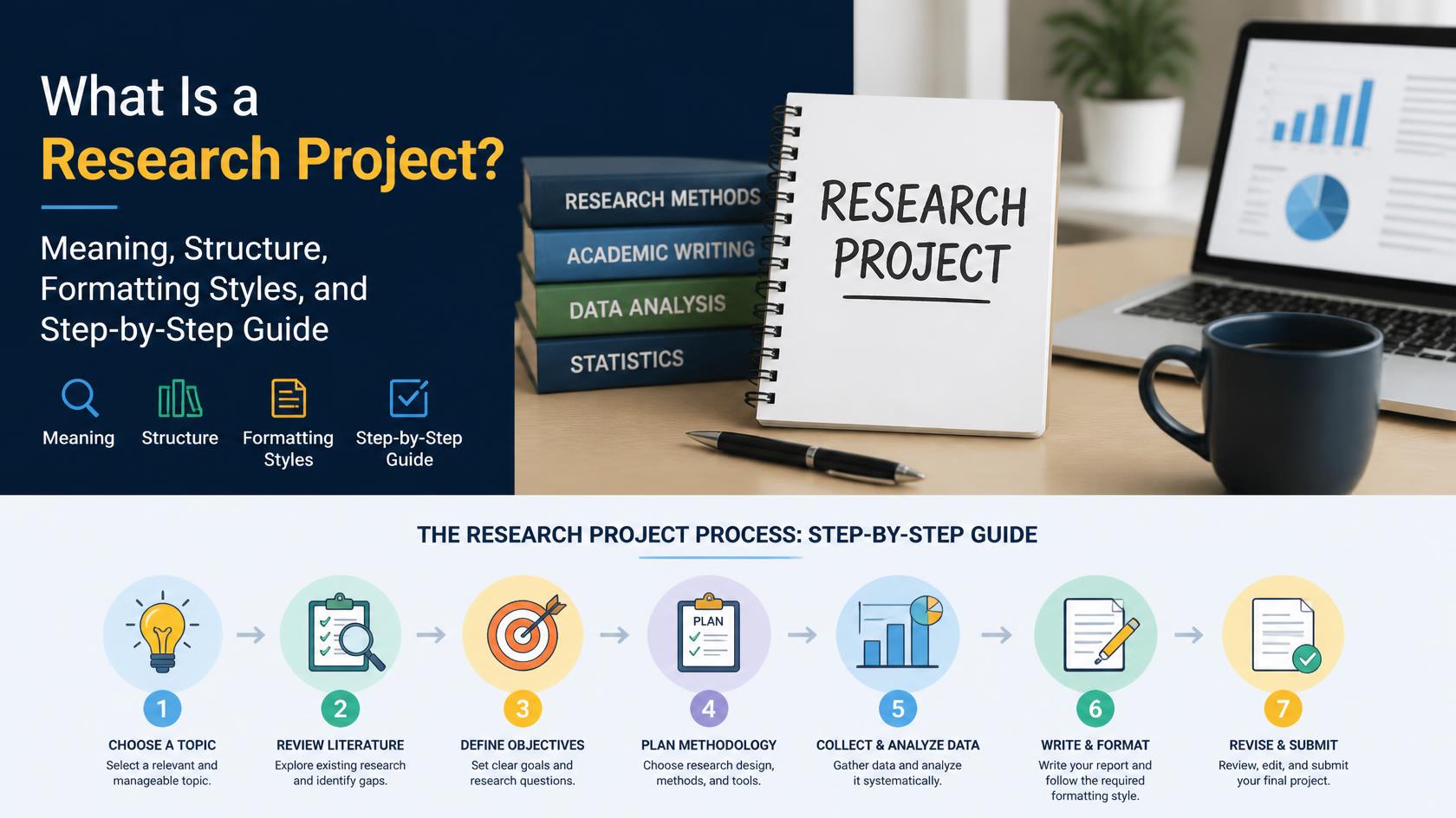
Most students hear the words “research project” and immediately feel something between confusion and quiet dread. It sounds formal, large, and somehow unfamiliar, even if you have been writing essays your whole academic life.
A research project is not as distant from your existing skills as it seems. At its core, it is structured thinking on paper, an organized attempt to ask a question, search for reliable answers, and present what you find in a form others can read and verify.
This guide explains what a research project actually is, breaks down its components one by one, walks you through the three major formatting styles, and gives you a realistic picture of how to start, structure, and complete one from scratch.
Quick Overview
What is a research project? A research project is a systematic, structured academic or professional study designed to investigate a specific question or problem. It follows a defined process, from choosing a topic and reviewing existing literature to collecting evidence, analyzing findings, and presenting conclusions in a standardized written format.
Table of Contents
What Is a Research Project?
A research project is an academic, scientific, or professional study that uses a structured method to investigate a question, solve a problem, or explore a topic in depth.
The word “research” comes from the Old French recercher, meaning “to search again.” That etymology is useful because it captures what research actually involves: not just reading what already exists, but going back, looking again, and building something new from what you find.
Unlike a regular essay, a research project is not simply your opinion organized into paragraphs. It requires evidence. You gather information from reliable sources, analyze it, and draw conclusions that you can support with what you found. The reader should be able to check your sources and trace your reasoning.
For students at the undergraduate and postgraduate level, a research project is often the largest, most substantial piece of work they produce in a semester. In Indian universities, research projects and dissertations frequently form a significant portion of the final assessment in courses across English, social sciences, education, and science disciplines.
Why Research Projects Matter for Students
A research project does several things at once that regular class assignments cannot.
It trains you to ask precise questions. Vague topics produce vague writing. The discipline of framing a clear research question teaches you to think sharply about what you actually want to know.
It builds critical reading habits. Going through journals, books, and academic sources forces you to evaluate what is reliable and what is not. That skill is useful far beyond academia.
It develops independent thinking. A research project is, at its best, your original contribution to a conversation. You are not just summarizing others. You are engaging with ideas and adding your voice.
And from a purely practical standpoint, research and writing skills are among the most portable professional abilities you can develop. They matter in law, journalism, teaching, public policy, business, and any field that requires clear communication.
Types of Research Projects
Research projects are not one-size-fits-all. Depending on your discipline, your topic, and your institution’s requirements, you might be working on a very different kind of project from the student at the next desk.
Here are the main types you will encounter:
Qualitative Research This type focuses on non-numerical data: interviews, observations, texts, lived experiences. A study exploring how students from rural backgrounds experience English-medium education would be qualitative.
Quantitative Research This uses numbers, statistics, and measurable data. A study analyzing exam scores across different school types is quantitative.
Descriptive Research It describes a subject, situation, or phenomenon as it exists. No variables are manipulated. Census-style studies and social surveys often fall into this category.
Exploratory Research When little is known about a topic, exploratory research opens the initial questions. It is often the first step before a more formal study follows.
Historical Research This examines past events using documented evidence. Particularly relevant in subjects like English literature, history, and cultural studies.
Applied Research This aims to solve a specific, practical problem. It is driven by usefulness rather than theory alone.
| Research Type | Focus | Common in |
|---|---|---|
| Qualitative | Meaning, experience, language | Humanities, Social Sciences |
| Quantitative | Numbers, statistics, data | Sciences, Psychology, Education |
| Descriptive | Describing what exists | Social Studies, Linguistics |
| Exploratory | Opening new questions | Any field with limited prior work |
| Historical | Past events and records | History, Literature, Sociology |
| Applied | Practical problem-solving | Education, Engineering, Health |
The Core Structure of a Research Project
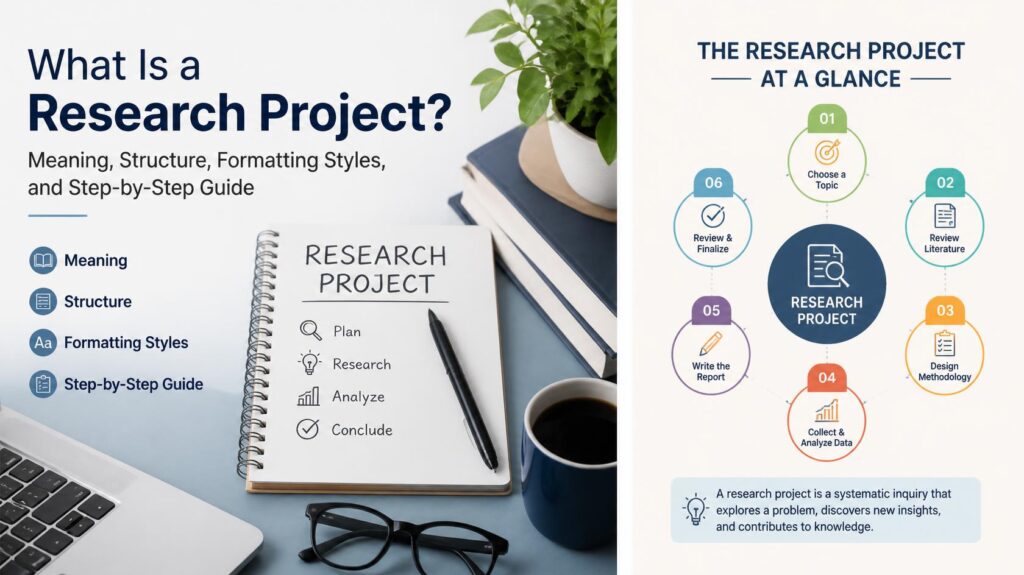
Regardless of subject or formatting style, almost every research project follows the same underlying skeleton. The sections may be named slightly differently depending on your institution, but the logic is the same.
1. Title Clear, specific, and informative. A good research title tells the reader the subject, the scope, and sometimes the approach. Avoid vague titles like “A Study on Education.” Something like “The Effect of English-Medium Instruction on Reading Comprehension in Rural Secondary Schools in West Bengal” tells you exactly what to expect.
2. Abstract A compressed summary of the entire project: what you studied, how, and what you found. Usually 150 to 300 words. It is often written last, even though it appears first.
3. Introduction This section does three things: it introduces the topic, explains why the research is necessary, and states the research question or objective. A strong introduction creates a clear sense of purpose.
4. Literature Review Here you survey what has already been written about your topic. The goal is not to list everything ever written. It is to show that you understand the existing conversation and to identify the gap your research addresses.
5. Research Methodology This explains how you conducted your study. What methods did you use? Surveys, interviews, close reading of texts, data analysis? Why did you choose these methods? What are their limitations?
6. Findings / Results Present what you discovered, without interpretation. Let the data or evidence speak first.
7. Discussion / Analysis This is where you interpret your findings. What do the results mean? How do they relate to your research question? Do they confirm or challenge the existing literature?
8. Conclusion Summarize your key findings, acknowledge the limitations of your study, and suggest directions for future research. Avoid introducing new arguments here.
9. References / Bibliography A complete, formatted list of every source you used, arranged according to the citation style required.
10. Appendices (if needed) Survey questionnaires, raw data tables, additional supporting material that would interrupt the flow of the main text.
Research Paper Formatting Styles Explained
This is where most students feel lost. The content of a research project is challenging enough. Then someone tells you it must be in APA or MLA format, and suddenly you are spending hours arguing with citation rules instead of thinking about ideas.
The three major formatting styles used in academic writing are APA, MLA, and Chicago. They each exist for a reason, serve different disciplines, and have specific rules for citations, headings, page layout, and font.
Here is the straightforward version.
APA Format: Rules and Examples
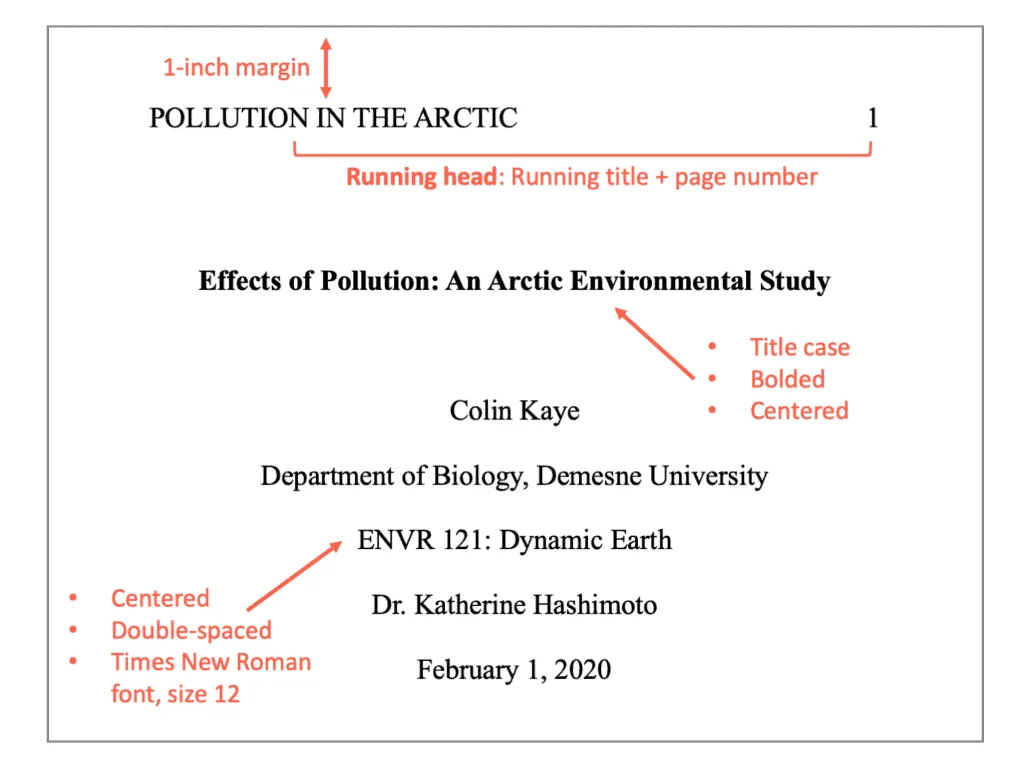
APA stands for American Psychological Association. It was developed to bring consistency to social science research publications, where the date of a study is extremely important because the field changes rapidly.
Where it is used: Psychology, sociology, education, nursing, business, and most social science disciplines. If you are an education major in an Indian university using an internationally aligned syllabus, APA is likely the format your professors prefer.
Core APA Rules (7th Edition):
- Font: 12pt Times New Roman or 11pt Calibri
- Margins: 1 inch on all sides
- Line spacing: Double-spaced throughout
- Title page: Required (student version includes your name, course name, instructor name, institution, date)
- Page numbers: Top right corner of every page
- Running head: Not required for student papers; required for manuscripts being submitted for publication
APA In-Text Citation Format:
You cite sources using the author’s last name and year of publication: (Crystal, 2003).
If you are quoting directly, add the page number: (Crystal, 2003, p. 59).
APA Reference List:
The References page appears at the end of the paper. Each entry uses a hanging indent (the second line and beyond are indented 0.5 inch).
Journal article example: Crystal, D. (2003). English as a global language (2nd ed.). Cambridge University Press.
Example heading structure in APA:
- Level 1: Centered, Bold, Title Case
- Level 2: Left-aligned, Bold, Title Case
- Level 3: Left-aligned, Bold, Italic, Title Case
The key thing to remember about APA: It prioritizes the date of publication because, in social sciences, the year a study was conducted matters enormously. A psychology paper from 2002 and one from 2022 may reach opposite conclusions.
MLA Format: Rules and Examples
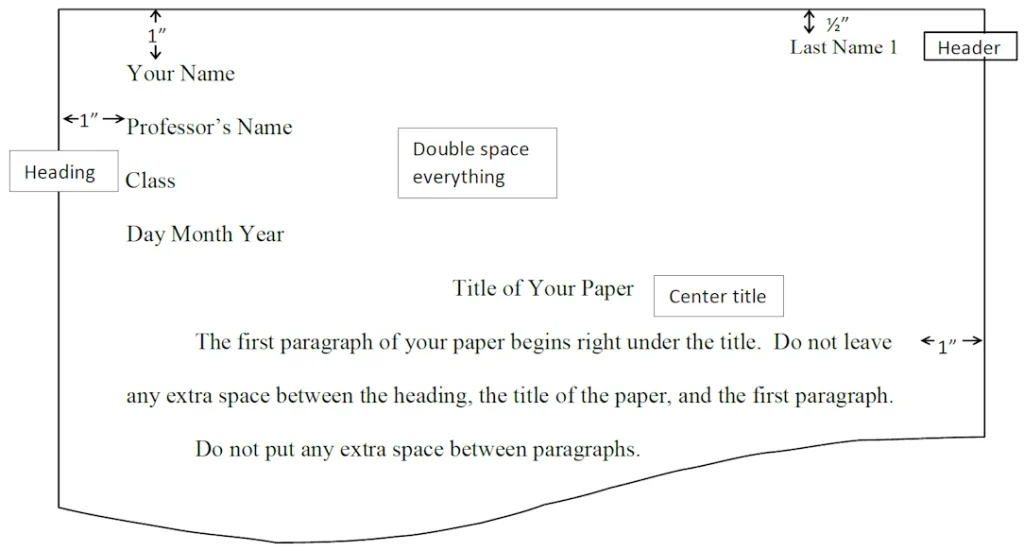
MLA stands for Modern Language Association. It was developed by and for scholars in literature, language, and the humanities, where the focus is on what was said and who said it, not when.
Where it is used: English literature, language studies, cultural studies, philosophy, and arts. As an English major at Kalyani University or any Indian university with a humanities focus, you will likely encounter MLA in your English and literature courses.
Core MLA Rules (9th Edition):
- Font: 12pt Times New Roman
- Margins: 1 inch on all sides
- Line spacing: Double-spaced throughout
- Title page: NOT required. Instead, a header block on the first page (top-left) includes your name, your instructor’s name, course name/number, and date in this order.
- Page numbers: Header, top-right, with your last name before the number (e.g., Sharma 3)
- No Abstract required
MLA Header Example (top-left, first page):
Priya Sharma
Professor R. Ghosh
English Literature 301
12 September 2026
MLA In-Text Citation: MLA uses the author’s last name and page number (no comma, no year): (Crystal 59).
MLA Works Cited: The list of sources is titled “Works Cited,” not “Bibliography” or “References.”
Book example: Crystal, David. English as a Global Language. 2nd ed., Cambridge UP, 2003.
The key thing to remember about MLA: It prioritizes author and page location because, in literary studies, which edition you used and the exact place in the text matters more than when the book was published.
Chicago Style: Rules and Examples
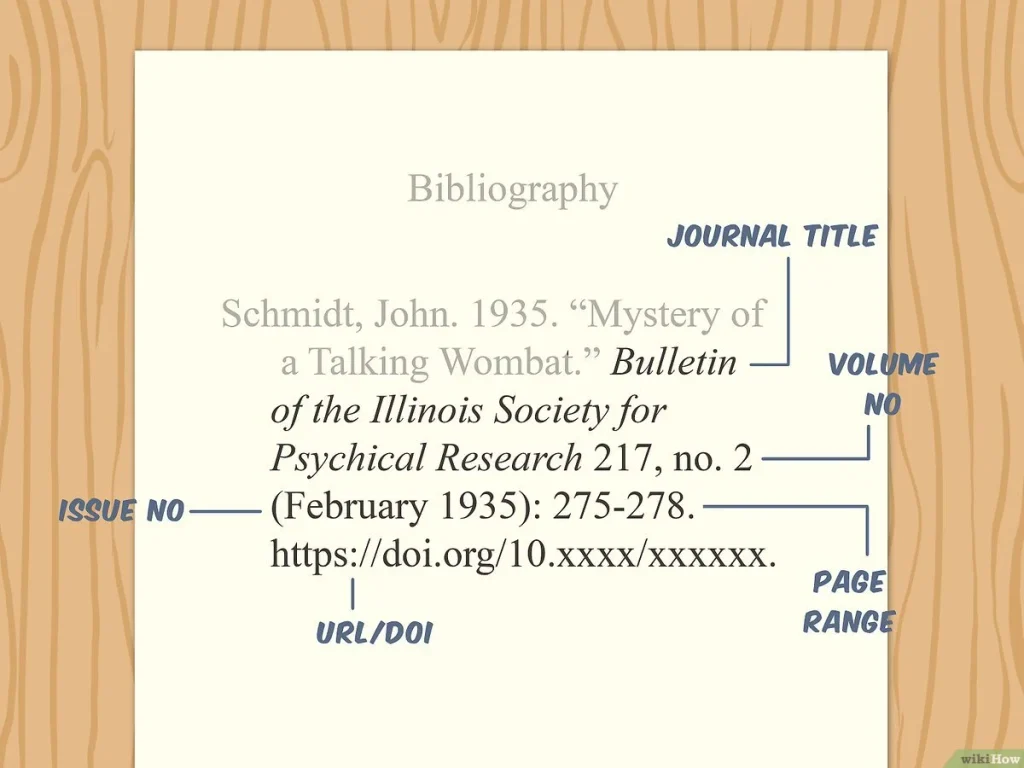
Chicago style comes from the University of Chicago Press. It is flexible and serves both humanities and sciences. It offers two systems: Notes and Bibliography (popular in history and arts) and Author-Date (similar to APA, used in sciences and social sciences).
Where it is used: History, fine arts, philosophy, religion, and sometimes literary studies. Chicago is also common in publishing and journalism.
Core Chicago Rules:
- Font: 12pt Times New Roman
- Margins: 1 inch on all sides
- Line spacing: Double-spaced (except footnotes and block quotations, which may be single-spaced)
- Title page: Required
- Page numbers: Bottom center, or top right, starting from the first page of text
Notes and Bibliography system: Instead of in-text parenthetical citations, Chicago uses footnotes (at the bottom of the page) or endnotes (at the end of the document).
Footnote example: ¹ David Crystal, English as a Global Language, 2nd ed. (Cambridge: Cambridge University Press, 2003), 59.
Bibliography entry: Crystal, David. English as a Global Language. 2nd ed. Cambridge: Cambridge University Press, 2003.
The key thing to remember about Chicago: It is the most flexible of the three styles. History students particularly love it because footnotes allow you to add commentary and contextual notes without breaking the flow of the main text.
APA vs MLA vs Chicago: Side-by-Side Comparison
| Feature | APA (7th Ed.) | MLA (9th Ed.) | Chicago (Notes & Bib.) |
|---|---|---|---|
| Developed by | American Psychological Assoc. | Modern Language Association | University of Chicago Press |
| Used in | Social sciences, education | Humanities, literature | History, arts, publishing |
| Title page | Required | Not required | Required |
| Abstract | Required | Not required | Optional |
| In-text citation | (Author, Year) | (Author Page) | Footnotes/Endnotes |
| Reference list title | References | Works Cited | Bibliography |
| Date placement | After author name | At end of entry | At end of entry |
| Heading levels | 5 formal levels | Flexible | Flexible |
| Running head | Publication only | Last name + page | Page number only |
How to Choose the Right Formatting Style
Your institution, your department, or your professor will usually tell you which style to use. If they do not, here is a practical guide:
- If you are in English, Literature, Language, or Humanities: use MLA
- If you are in Psychology, Education, Sociology, Social Work, or Business: use APA
- If you are in History, Fine Arts, or Philosophy, or writing for publication: use Chicago
When no instructions are given and the subject is English Literature, MLA is almost always the safe choice.
A note for students at Indian universities: some institutions use their own internal format guidelines, or they may ask for Harvard referencing, which is similar to APA. Always check your department’s handbook or ask your supervisor before you begin.
Common Mistakes Students Make in Research Projects
These are the errors that appear over and over, across every discipline and level.
Choosing too broad a topic. “Climate Change” is not a research topic. “The Effect of Rising Monsoon Unpredictability on Farmer Mental Health in West Bengal (2015–2025)” is. The narrower your question, the more focused and convincing your answer.
Mixing citation styles. Using APA for some citations and MLA for others within the same paper is a serious formatting error. Pick one style and apply it consistently from the first source to the last.
Treating the literature review as a summary. Many students list what other researchers said without engaging with it. A literature review should show how different studies connect, contradict, or build on each other, and where your research fits into that map.
Writing the abstract first. The abstract summarizes the whole paper. You cannot write it accurately until the paper is finished. Write it last.
Ignoring the methodology section. Students often skip past methodology because explaining how you did the research feels less interesting than what you found. But methodology is where readers evaluate whether your findings are trustworthy. Explain your choices clearly.
Using unreliable sources. Wikipedia is a starting point, not a source. Academic journals, university press books, peer-reviewed studies, government publications, and recognized organizations are appropriate. Random blogs and unverified websites are not.
A Teacher’s Method: How to Approach a Research Project Step by Step
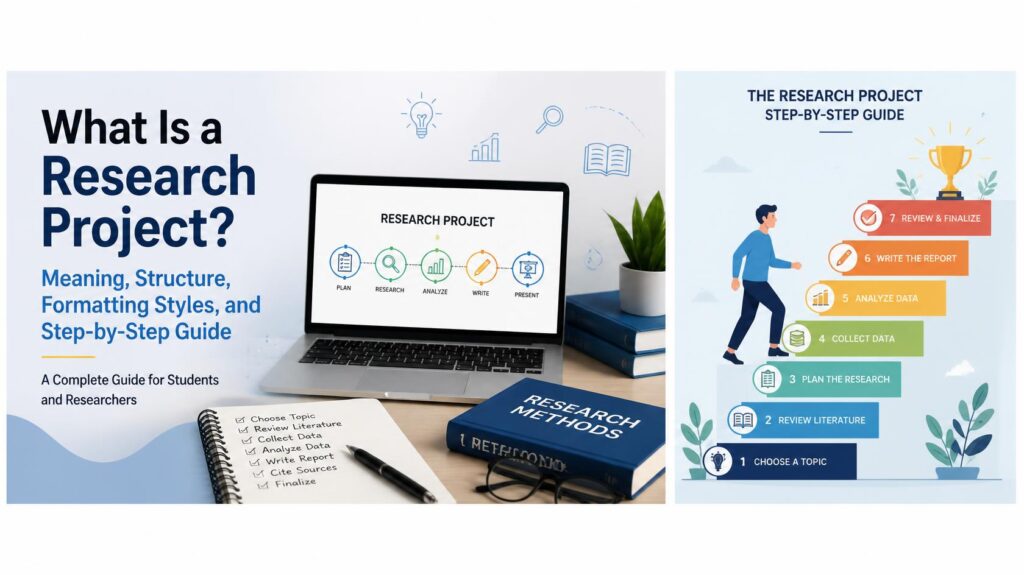
This is the approach that most students find useful once someone actually walks them through it sequentially.
Step 1: Choose a specific, manageable topic Start with your general area of interest, then narrow it down until you have a question you can realistically answer within your word limit and time frame.
Step 2: Frame your research question Turn your topic into a question. “I want to write about Shakespeare” is a topic. “How does Shakespeare use dramatic irony to create audience sympathy in Othello?” is a research question.
Step 3: Review existing literature Before you write a word of your own analysis, read what others have said. Take notes. Identify what positions exist, what they agree on, and what is disputed or unexplored.
Step 4: Choose your methodology Decide how you will gather your evidence. Primary research (interviews, surveys, original texts, field observation) or secondary research (analysis of published studies and sources)? Or both?
Step 5: Collect and organize your evidence Gather your sources, keep careful notes of bibliographic details (author, title, publisher, date, page numbers), and begin organizing your findings by theme or argument.
Step 6: Write a first draft Write with the structure in mind: introduction, literature review, methodology, findings, discussion, conclusion. Do not try to write it perfectly the first time. Get the ideas down first.
Step 7: Format and cite Apply your required formatting style (APA, MLA, or Chicago) consistently throughout. This is easier to do during revision than to retrofit at the end.
Step 8: Revise and proofread Read the paper from beginning to end as a reader, not as the writer. Look for gaps in logic, unclear sentences, missing citations, and any claim that is not supported by evidence.
Step 9: Write the abstract last Once the paper is complete, write a 150-300 word summary of the whole thing: what you studied, why, how, what you found, and what it means.
Step 10: Check your references list Every in-text citation must have a corresponding entry in your References / Works Cited / Bibliography. Every entry must match the citation style exactly.
Key Takeaways
A research project is a structured, evidence-based investigation into a specific question or problem, produced in a standardized written format.
The core structure includes a title, abstract, introduction, literature review, methodology, findings, discussion, conclusion, and references.
Three main formatting styles exist: APA (social sciences), MLA (humanities), and Chicago (history and arts).
Your institution will usually specify which style to use. When in doubt, match the style to your discipline.
The most common student mistakes are choosing too broad a topic, mixing citation styles, and writing the abstract first.
Writing a strong research project is a skill built gradually. The process becomes faster and more natural with every paper you complete.
Glossary of Research Terms
These terms appear frequently in research writing and academic study. Understanding them clearly makes research methodology far less intimidating.
Research Question The specific question your research project is designed to answer. A good research question is focused, researchable, and significant. It is more precise than a topic. “What is Shakespeare?” is not a research question. “How does Shakespeare use soliloquy to reveal Hamlet’s moral conflict?” is.
Literature Review The section of a research project that surveys and evaluates existing academic work on your topic. Its purpose is to show that you understand the existing scholarly conversation and to identify the gap or issue your research addresses.
Research Methodology The overall strategy and design of your research: what methods you chose, why, and how you used them to gather evidence. It is different from “research methods,” which refers to the specific tools (surveys, interviews, textual analysis) you use.
Thesis Statement A clear, arguable claim that states the central argument of your research paper. It appears near the end of your introduction and guides the entire paper.
In-Text Citation A brief reference placed within the body of your text, directly after a quotation or paraphrased idea, that identifies the source. It leads the reader to the full entry in your reference list.
Plagiarism Presenting another person’s words, ideas, data, or structure as your own, whether intentionally or accidentally. It is a serious academic offence. Proper citation is the tool that prevents it.
Abstract A short summary (typically 150-300 words) of your entire research project: the topic, method, findings, and conclusion. It is read first but written last.
Bibliography / Works Cited / References These three terms all refer to the formatted list of sources at the end of your research paper. The name depends on the style: APA uses “References,” MLA uses “Works Cited,” and Chicago uses “Bibliography.”
Primary Source An original, first-hand source: a poem, a novel, an interview, a historical document, raw survey data, a laboratory result. In literature studies, the literary text you are analyzing is your primary source.
Secondary Source A source that analyzes, interprets, or discusses a primary source. A journal article analyzing Shakespeare’s use of imagery is a secondary source. These are your support material in a literature review.
Citation Style A standardized system of formatting used to acknowledge sources in academic writing. The three most common are APA, MLA, and Chicago. Each has rules for how citations appear within the text and how sources are listed at the end.
Annotated Bibliography A bibliography in which each reference entry is followed by a brief paragraph summarizing and evaluating the source. Often assigned before a research project begins, as it forces students to engage with sources carefully.
Internal Links from Lingua Litera
- Voice Change in English Grammar: Active and Passive Voice Explained — Research writing uses passive voice extensively; understanding when and how is essential for formal academic writing.
- The 12 Tenses in English Grammar: A Complete Structural and Conceptual Guide — Choosing the correct tense in each section of a research paper (present for literature review, past for methodology, present for discussion) is a common source of errors.
- Articles in English: The Complete Guide to A, An, and The — Academic writing demands precise grammar; articles are among the most frequent errors in student research writing.
- 50 Common Errors in English Grammar — With Corrections and Explanations — A practical companion for proofreading a research draft before submission.
- Subject-Verb Agreement: 20 Advanced Rules Every Exam Aspirant Must Know — Research writing requires careful attention to subject-verb agreement, especially in complex, multi-clause academic sentences.
Frequently Asked Questions
1. What is the meaning of a research project?
A research project is a structured academic or professional study designed to investigate a specific question using a defined methodology. It goes beyond a regular essay by requiring the collection and analysis of evidence from reliable sources. Research projects form a core part of undergraduate and postgraduate assessment across most disciplines, including English, education, social sciences, and the sciences.
What is the difference between a research project and a research paper?
A research paper is a written document presenting your argument and evidence on a topic. A research project is broader: it includes the entire process of investigation, from choosing the topic and designing the methodology to gathering evidence, analyzing it, and producing the written paper. A research paper is often the final output of a research project.
What are the three main research paper formatting styles?
The three major academic formatting styles are APA (American Psychological Association), MLA (Modern Language Association), and Chicago. APA is used in social sciences and education. MLA is standard in English literature and humanities. Chicago is used in history, arts, and publishing. Each has distinct rules for citations, title pages, headings, and reference lists.
Which formatting style should I use for an English literature paper?
MLA (Modern Language Association) format is the standard for English literature and humanities. It uses author-page in-text citations (Smith 45), a Works Cited page at the end, and a header block (not a title page) on the first page. If your institution specifies a different style, always follow their instructions.
What should a research project include?
A complete research project typically includes: a title, an abstract, an introduction, a literature review, a methodology section, findings or results, a discussion or analysis, a conclusion, and a formatted references or bibliography page. Some projects also include appendices with supporting materials like questionnaires or raw data.
How do I choose a research topic?
Start with a broad area of interest in your subject, then narrow it down to a specific, answerable question. Ask yourself: Is this question focused enough? Can it be researched within my word limit? Is there enough reliable material available? A good research topic is specific, relevant to your field, and contributes something to existing knowledge, even if modestly.
What is a literature review in a research project?
A literature review is the section of a research project that surveys and evaluates existing academic work on your topic. It is not simply a summary of what others have written. It maps the existing scholarly conversation, identifies what is agreed upon, what is disputed, and what remains unexplored, and shows where your research fits within that landscape.
Conclusion
A research project is one of the most demanding things a student is asked to produce, but it is also one of the most valuable. The skills it builds — asking precise questions, reading critically, organizing evidence, writing with clarity — are the foundation of serious academic and professional work.
The formatting styles, whether APA, MLA, or Chicago, are not arbitrary bureaucracy. They exist so that readers anywhere in the world can locate your sources, verify your evidence, and trust the integrity of your work. Once you understand what each style is trying to achieve, the rules become far more logical and much easier to remember.
Start with a clear question. Build your structure carefully. Cite everything. And write for the reader who knows nothing about your topic yet — because making something difficult genuinely understandable is what research writing is really for.
External Sources and Recommended References
- APA Style Official Website — apastyle.apa.org — The authoritative source for APA 7th edition guidelines
- MLA Handbook (9th Edition) — mla.org — Official MLA guidelines from the Modern Language Association
- The Chicago Manual of Style Online — chicagomanualofstyle.org — The complete reference for Chicago formatting
- Purdue OWL (Online Writing Lab) — owl.purdue.edu — One of the most comprehensive free resources for APA, MLA, and Chicago formatting guidance