
Introduction
Every great story, poem, or play is built from invisible architecture. You feel it when a line sends a chill down your spine, when a novel’s ending feels inevitable in hindsight, or when a character’s silence speaks louder than dialogue. That architecture has a name — and it lives inside the world of literary terms in English literature.
Knowing these terms is not just an academic exercise. It changes how you read, how you write, and how you think about language. A student analyzing Shakespeare benefits from understanding dramatic irony. A writer crafting a thriller needs to know how foreshadowing builds tension. A reader appreciating Toni Morrison understands her power better when they recognize her use of stream of consciousness and symbolism.
This guide covers the most important literary terms, from foundational concepts to advanced devices, with clear definitions, real examples, and the context you need to actually use them.
Quick View
What are literary terms in English literature? Literary terms are the specialized vocabulary used to describe, analyze, and discuss written works. They cover narrative elements (plot, character, setting), poetic devices (metaphor, alliteration, enjambment), rhetorical techniques (irony, hyperbole, allusion), and structural forms (sonnet, tragedy, elegy). Every term gives readers a precise tool for understanding how literature works.
What Are Literary Terms in English Literature?
Literary terms are the shared vocabulary that writers, readers, scholars, and critics use to talk about written texts. They describe what a piece of writing does, how it does it, and why those choices matter.
Think of them as a toolkit. A carpenter can describe a chair without knowing the word “mortise joint,” but knowing the term makes the conversation faster, more precise, and more useful.
Literary terms work the same way. You can say “the author hints at what happens later,” or you can say “the author uses foreshadowing.” The second version opens a richer conversation.
Why Literary Terms Matter
For students: Literary terms are essential for exams, essays, and close reading tasks. Understanding them converts a vague feeling about a text into a supported argument.
For writers: Knowing what a technique is called helps you deploy it deliberately. Professionals do not stumble into good prose — they craft it with intention.
For readers: Recognizing literary devices transforms passive reading into active engagement. You begin to notice how a story creates its effects, not just what happens.
For researchers: Academic literary criticism relies on precise terminology. Without it, analysis becomes impressionistic rather than evidence-based.
Foundational Literary Elements
These are the building blocks of every work of fiction and most non-fiction narrative. Understanding them is the starting point for any literary analysis.
Plot
Plot is the sequence of events in a narrative. It is not just “what happens” but how events are arranged and connected.
The classic plot structure, often called Freytag’s Pyramid (developed by 19th-century German playwright Gustav Freytag), breaks plot into five stages:
| Stage | Definition | Example |
|---|---|---|
| Exposition | Introduction of characters, setting, and initial situation | Opening chapters of Jane Eyre establishing Thornfield Hall |
| Rising Action | Events that build conflict and tension | Romeo and Juliet’s secret marriage |
| Climax | The moment of highest tension or turning point | Macbeth’s murder of Duncan |
| Falling Action | Consequences unfold after the climax | The witches’ prophecies unraveling |
| Resolution (Denouement) | Conflict is resolved; story concludes | The final settling in Pride and Prejudice |
Character
Characters are the people (or beings) who populate a narrative. Key character types include:
- Protagonist: The central character; the story follows their journey.
- Antagonist: The force or character opposing the protagonist.
- Foil: A character whose contrasting traits highlight another character’s qualities. Watson is Sherlock Holmes’s foil.
- Round character: Complex, multi-dimensional, capable of change.
- Flat character: One-dimensional; defined by a single trait or role.
- Stock character: A familiar, predictable type (the wise mentor, the bumbling sidekick).
Setting
Setting is where and when a story takes place. It is never merely decorative. In Emily Brontë’s Wuthering Heights, the Yorkshire moors are inseparable from the novel’s emotional violence. Setting shapes mood, reflects character psychology, and can itself become a symbolic force.
Theme
Theme is the central idea or meaning that a literary work explores. It is rarely stated outright — it emerges through accumulated events, character choices, and language.
Themes differ from topics. “War” is a topic. “War strips individuals of humanity” is a theme.
Common literary themes include: identity, power and corruption, love and loss, freedom, justice, mortality, the conflict between tradition and change.
Point of View (Narrative Perspective)
Who tells the story — and from what position — shapes everything the reader knows and feels.
| Point of View | Description | Example |
|---|---|---|
| First Person | Narrator is a character; uses “I” | The Great Gatsby (Nick Carraway) |
| Second Person | Addresses the reader as “you” | Bright Lights, Big City by Jay McInerney |
| Third Person Limited | Narrator outside story; follows one character’s thoughts | Harry Potter series |
| Third Person Omniscient | Narrator knows all characters’ inner lives | War and Peace by Tolstoy |
| Unreliable Narrator | Narrator whose account cannot be fully trusted | Gone Girl by Gillian Flynn |
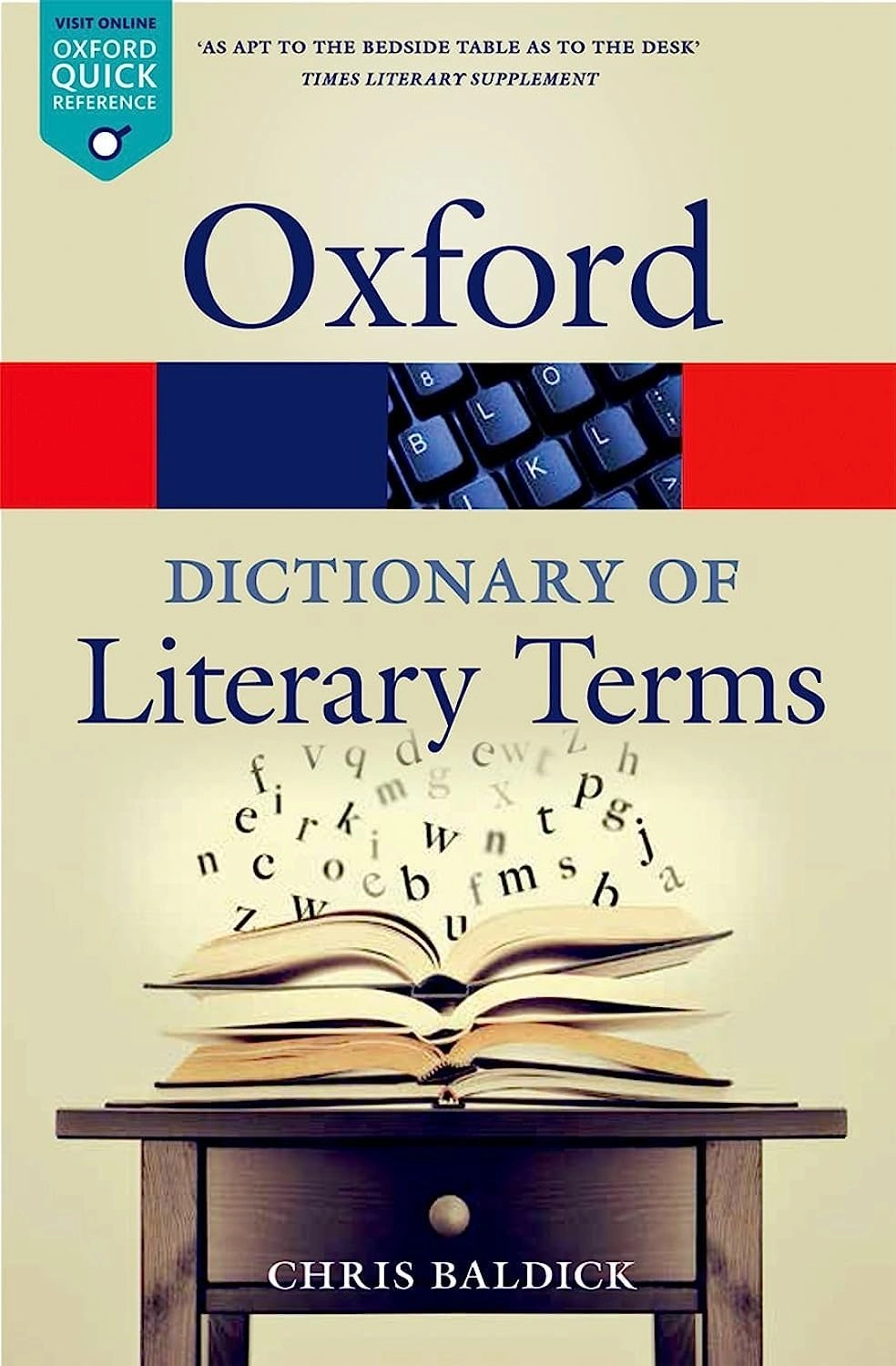
The bestselling Oxford Dictionary of Literary Terms provides clear and concise definitions of the most troublesome literary terms, from abjection to zeugma.
Figurative Language and Figures of Speech
Figurative language says one thing to mean another. It makes the abstract concrete, the unfamiliar familiar, and the ordinary remarkable.
Metaphor
A metaphor directly identifies one thing as another, without using “like” or “as.”
“All the world’s a stage, and all the men and women merely players.” — Shakespeare, As You Like It
The world is not literally a stage, but the comparison reveals something true about human existence.
Simile
A simile compares two things using “like” or “as.” It signals comparison more openly than a metaphor.
“My love is like a red, red rose.” — Robert Burns
Personification
Personification gives human qualities to non-human things or abstract concepts.
“The wind whispered through the trees.” “Death, be not proud.” — John Donne
Hyperbole
Hyperbole is deliberate exaggeration for emphasis or dramatic effect. It is not meant to be taken literally.
“I’ve told you a million times.” “I could sleep for a year.”
Oxymoron
An oxymoron pairs two contradictory terms to create a paradoxical effect.
“Parting is such sweet sorrow.” — Shakespeare, Romeo and Juliet “Deafening silence.” “Living death.”
Synecdoche
Synecdoche uses a part to represent the whole, or the whole to represent a part.
“All hands on deck.” (hands = sailors) “The pen is mightier than the sword.” (pen = writing; sword = military force)
Metonymy
Metonymy substitutes the name of something closely associated with a concept for the concept itself.
“The White House announced today…” (White House = the U.S. presidency) “The crown has spoken.” (crown = the monarch)
Narrative Techniques and Devices
Foreshadowing
Foreshadowing plants hints or clues about future events. It creates anticipation and, in retrospect, makes a story feel inevitable.
In Of Mice and Men, Lennie’s accidental killing of the puppy foreshadows the tragic ending.
Flashback (Analepsis)
A flashback interrupts the present narrative to show events that happened earlier. It builds backstory, reveals character motivation, and adds depth to present events.
Flashforward (Prolepsis)
The opposite of flashback — the narrative jumps ahead to a future event before returning to the present. Toni Morrison uses this technique masterfully in Beloved.
In Medias Res
Latin for “into the middle of things.” The story begins in the middle of the action rather than at the beginning.
Homer’s Iliad and Odyssey both open this way. Many modern novels and films use this device to hook readers immediately.
Stream of Consciousness
A narrative technique that represents the continuous, unfiltered flow of a character’s thoughts and perceptions. James Joyce’s Ulysses and Virginia Woolf’s Mrs Dalloway are canonical examples.
Dramatic Irony
Dramatic irony occurs when the audience knows something that one or more characters do not.
In Oedipus Rex, the audience knows Oedipus is the killer he is searching for — a tension Sophocles sustains across the entire play.
Conflict
Conflict is the central struggle driving a narrative. The traditional categories are:
- Man vs. Man — character against character
- Man vs. Nature — character against the natural world (The Old Man and the Sea)
- Man vs. Society — character against social structures (1984)
- Man vs. Self — internal psychological conflict (Hamlet)
- Man vs. Fate/Supernatural — character against destiny or forces beyond human control
Poetic Devices and Forms
Alliteration
The repetition of the same consonant sound at the beginning of closely placed words.
“Peter Piper picked a peck of pickled peppers.” “The fair breeze blew, the white foam flew.” — Coleridge
Assonance
The repetition of vowel sounds within nearby words. It creates internal rhyme and musicality.
“The rain in Spain stays mainly in the plain.”
Consonance
The repetition of consonant sounds within or at the end of words (not just the beginning).
“And all the air a solemn stillness holds.” — Thomas Gray
Onomatopoeia
Words whose sound imitates what they describe.
buzz, crash, sizzle, murmur, thump, hiss
Enjambment
In poetry, enjambment occurs when a sentence or phrase runs past the end of a line without a pause, continuing into the next line. It creates momentum and can create unexpected meanings at line breaks.
Caesura
A pause or break within a line of poetry, often marked by punctuation.
“To be, or not to be: that is the question.”
The colon creates a caesura that gives the line its philosophical weight.
Meter and Rhythm
Meter is the pattern of stressed and unstressed syllables in poetry. Common meters include:
| Meter | Pattern | Example |
|---|---|---|
| Iambic Pentameter | da-DUM x5 | Shakespeare’s sonnets |
| Trochaic Tetrameter | DUM-da x4 | “Double, double, toil and trouble” |
| Dactylic Hexameter | DUM-da-da x6 | Homer’s epics (in translation) |
| Anapestic Tetrameter | da-da-DUM x4 | “Twas the Night Before Christmas” |
Stanza Forms
| Form | Lines | Rhyme | Example |
|---|---|---|---|
| Couplet | 2 | AA | Pope’s Rape of the Lock |
| Tercet | 3 | Various | Dante’s Divine Comedy (terza rima) |
| Quatrain | 4 | ABAB or ABBA | Most ballads |
| Sonnet | 14 | Petrarchan or Shakespearean | Shakespeare’s Sonnets |
| Villanelle | 19 | Two rhymes throughout | Dylan Thomas’s Do not go gentle |
Rhetorical Devices in Literature
Allusion
An allusion is an indirect reference to a person, place, event, or text outside the work — typically something the intended audience is expected to recognize.
“He was a real Romeo with the women.” (allusion to Shakespeare) T.S. Eliot’s The Waste Land is a dense web of literary, historical, and mythological allusions.
Irony
Irony involves a gap between surface meaning and deeper meaning, or between expectation and reality.
- Verbal irony: Saying the opposite of what you mean (“Oh, great, another Monday.”)
- Situational irony: An outcome that contradicts what was expected (a fire station burns down)
- Dramatic irony: The audience knows more than the characters (see above)
Paradox
A paradox is a statement that appears self-contradictory but contains a deeper truth.
“I must be cruel only to be kind.” — Hamlet “The child is father of the man.” — Wordsworth
Anaphora
The repetition of a word or phrase at the beginning of successive clauses.
“We shall fight on the beaches, we shall fight on the landing grounds, we shall fight in the fields…” — Churchill
Euphemism
A mild or indirect expression substituted for something harsh or blunt.
“Passed away” instead of “died.” “Let go” instead of “fired.”
Euphemism in literature can reveal power structures, expose social hypocrisy, or soften difficult truths.
Allegory
An allegory is an extended narrative in which characters, events, and settings represent abstract ideas or moral qualities.
George Orwell’s Animal Farm is an allegory for Stalinist Soviet Union. John Bunyan’s The Pilgrim’s Progress is a religious allegory.
Genre and Form Terms
| Term | Definition | Example |
|---|---|---|
| Tragedy | Drama ending in the protagonist’s downfall, often through a fatal flaw | Macbeth, Hamlet |
| Comedy | Drama ending in resolution and often marriage; broader: any humorous work | A Midsummer Night’s Dream |
| Elegy | A poem of mourning for the dead | In Memoriam by Tennyson |
| Ode | A lyric poem praising a person, place, thing, or concept | Keats’s Ode to a Nightingale |
| Ballad | A narrative poem or song, often about love or adventure | The Rime of the Ancient Mariner |
| Epic | A long narrative poem following a hero’s journey | Paradise Lost, The Odyssey |
| Satire | A genre using wit, irony, and humor to expose and critique human folly | Gulliver’s Travels, Catch-22 |
| Gothic | A genre combining horror, romance, and the supernatural | Frankenstein, Dracula |
| Bildungsroman | A coming-of-age novel tracing a character’s development | David Copperfield, Jane Eyre |
| Dystopia | A society marked by suffering and oppression, often as a warning | 1984, The Handmaid’s Tale |
Advanced Literary Concepts
Motif
A motif is a recurring element — image, symbol, phrase, or idea — that develops or reinforces the work’s themes.
The motif of blood in Macbeth (guilt, violence, consequences) recurs from the first murder to Lady Macbeth’s sleepwalking scene.
Symbol
A symbol is an object, person, place, or event that carries meaning beyond its literal significance.
- The green light in The Great Gatsby = the American Dream, unattainable desire
- The conch in Lord of the Flies = order, civilization, democratic authority
- The scarlet letter in The Scarlet Letter = sin, identity, social judgment
Archetype
An archetype is a universal character type, image, or narrative pattern that recurs across cultures and literary traditions. Carl Jung’s theory of the collective unconscious underlies much archetypal criticism.
Common archetypes: The Hero, The Shadow, The Mentor, The Trickster, The Threshold Guardian.
Deus ex Machina
Latin for “god from the machine.” Originally a theatrical device in ancient Greek drama where a god was mechanically lowered onto the stage to resolve an unsolvable plot. Now it refers to any sudden, unlikely plot resolution.
It is generally considered a weakness in narrative craft.
Catharsis
Aristotle defined catharsis as the emotional purification and relief an audience feels after witnessing a tragedy. A great tragedy does not simply make you feel sad — it cleanses those emotions through structured, meaningful representation.
Hamartia
The fatal flaw or error of judgment that leads to a tragic hero’s downfall. Aristotle identified this as a defining feature of tragedy.
- Macbeth’s hamartia: unchecked ambition
- Othello’s hamartia: jealousy and credulity
- Oedipus’s hamartia: pride and the pursuit of knowledge at all costs
Hubris
A specific form of hamartia — excessive pride or confidence that leads a character to overstep moral or divine limits. Hubris is particularly common in Greek tragedy.
Common Mistakes Students Make
Mistake 1: Confusing theme with topic Topic is what the story is about; theme is what it says about that topic. Do not write “the theme is love.” Write “the theme is that love cannot survive without honesty.”
Mistake 2: Calling every comparison a metaphor A simile uses “like” or “as.” A metaphor does not. They are related but distinct.
Mistake 3: Treating symbol and motif as synonyms A motif is a repeated element. A symbol is a single element carrying additional meaning. A motif can include a symbol, but a motif need not be symbolic in itself.
Mistake 4: Describing irony as anything surprising Irony is specifically about a gap between what is expected/said and what is true/delivered. Not every plot twist is irony.
Mistake 5: Ignoring form as a literary element Why a poem is a sonnet, why a novel uses epistolary form, why a play is in five acts — these structural choices are as meaningful as any line of dialogue.
Expert Tips for Learning Literary Terms
Tip 1: Learn terms in context, not isolation Do not memorize definitions from a list. Find each device in actual texts. Seeing alliteration in Gerard Manley Hopkins, or stream of consciousness in Virginia Woolf, makes the concept permanent.
Tip 2: Group related terms together Learn metaphor, simile, personification, and synecdoche as a family of figurative language devices. Grouping reveals relationships and reduces confusion.
Tip 3: Apply terms when you read Make a habit of noticing and naming devices as you read. This turns passive consumption into active critical practice.
Tip 4: Write with the devices you are learning Nothing internalizes a literary term faster than using it yourself. Try writing a paragraph that uses foreshadowing, or a poem with deliberate caesura.
Tip 5: Use primary texts, not just definitions The best literary dictionaries — M.H. Abrams’s A Glossary of Literary Terms, Chris Baldick’s Oxford Dictionary of Literary Terms — draw from real literature. Use these over generic summary sites.
Recommended External References
- Purdue OWL (owl.purdue.edu) — authoritative guide to literary terms and writing in literature
- British Library (bl.uk) — literary history, manuscripts, and scholarly resources
- Oxford Reference (oxfordreference.com) — Oxford Dictionary of Literary Terms by Chris Baldick
Frequently Asked Questions
-
What are the most important literary terms to know for school exams?
For most school-level exams (CBSE, ICSE, IGCSE, A-levels), the most frequently tested literary terms include: metaphor, simile, personification, irony (verbal, dramatic, situational), foreshadowing, symbolism, theme, conflict, point of view, alliteration, and tone. Understanding these in context — not just as definitions — is what exam markers look for in literary response answers.
-
What is the difference between a literary device and a literary element?
Literary elements are the fundamental components of a narrative: plot, character, setting, theme, tone, and point of view. Literary devices are techniques an author uses to develop those elements: foreshadowing, flashback, dramatic irony, symbolism, and so on. Elements are the “what”; devices are the “how.” Both categories fall under the broader term “literary terms.”
-
What is the difference between irony and sarcasm?
Sarcasm is a form of verbal irony, but not all verbal irony is sarcasm. Sarcasm is ironic language with an intent to mock or wound — it has an aggressive edge. Verbal irony simply means saying something other than what you mean, without necessarily being cruel. A character saying “What a lovely day” in a storm may be ironic without being sarcastic.
-
How do literary terms in English literature differ from rhetorical devices?
The distinction is partly historical. Rhetoric was originally the art of persuasion in speech; literary devices developed from the analysis of written texts. In practice, the terms overlap considerably — allusion, hyperbole, anaphora, and irony appear in both categories. The key difference is context: rhetorical devices emphasize effect on an audience; literary devices emphasize meaning within a text.
-
What is the difference between a motif and a symbol?
A symbol is a specific object, person, or image that carries meaning beyond its literal self. A motif is a recurring element — which may include a symbol — that develops across a work. The color red might be a motif in a novel; a specific red door might be a symbol within that motif. Motifs pattern; symbols signify.
-
What does “foil” mean in literary terms?
A foil is a character whose traits and choices contrast with another character’s — usually the protagonist — to highlight qualities in both. The contrast makes each character’s defining features clearer. Classic foils include Laertes and Hamlet (both sons responding to fathers’ deaths), Sancho Panza and Don Quixote, and Lennie and George in Of Mice and Men.
Conclusion
The study of literary terms in English literature is ultimately the study of how language becomes art. Each term in this guide is not an end in itself — it is a door into a deeper conversation about a text, a tradition, or a human truth.
The best readers do not collect terms the way others collect stamps. They use them as lenses — adjusting focus to see what a work is actually doing, how it achieves its effects, and why those effects matter. When you recognize a volta in a Keats sonnet, or trace a motif of water through a Morrison novel, you are not completing an exercise. You are engaging with one of the most complex and rewarding things human beings have ever done with language.
Start with the terms that feel most alive to you. Return to the glossary when you encounter something unfamiliar. Read widely, write carefully, and the vocabulary will follow.
Related Post
- Parts of Speech (in English Grammar): Easily Detailed Explained
- Voice Change in English Grammar: Active and Passive Voice Explained


1 comment
[…] July 22, 2026 […]