Introduction
Every organisation, from a two-person startup to a multinational corporation, runs on one thing above everything else: the ability of its people to share information clearly and purposefully. Yet most of us never stop to examine what that actually means or why it so often goes wrong.
Business communication is the structured exchange of information, ideas, and meaning between people within or connected to an organisation. The word “structured” is the key. It is what separates a productive meeting from one where everyone leaves confused, or a well-written email from one that causes a three-day misunderstanding.
This guide explains what business communication is, how it works in practice, the forms it takes, and why organisations that invest in it outperform those that do not. It covers everything a student studying the subject, a professional trying to improve, or a researcher looking for a thorough treatment would want to find in one place.
Quick Answer
What is business communication in simple words? Business communication is the purposeful exchange of information, ideas, or instructions between people within an organisation or between an organisation and its external stakeholders. It can be spoken, written, or non-verbal. Its defining characteristic is that it is goal-directed, meaning every message exists to achieve a specific professional outcome.
What Is Business Communication?
Business communication is the process through which people within an organisation, or between an organisation and the world outside it, share information in order to reach a professional goal.
That definition sounds simple. In practice, it covers an enormous range of activities: the morning briefing a manager gives their team, the proposal a sales executive sends to a potential client, the annual report that a company publishes for its shareholders, and the conversation that resolves a dispute between two departments.
What makes something “business communication” rather than just communication is not the setting. It is the intent. Business communication exists to move something forward: a decision, a project, a relationship, an outcome.
Unlike personal conversation, which can afford to be vague, emotionally exploratory, or open-ended, business communication is measured by whether it produced the intended result. Did the client understand the proposal? Did the employee act on the instruction? Did the team leave the meeting aligned?
The Business Communication Process Explained
Communication does not happen in a single moment. It travels through a series of steps, and anything that disrupts those steps creates a breakdown.
| Stage | What Happens | What Can Go Wrong |
|---|---|---|
| Sender | The person who has a message to convey | Unclear thinking, wrong assumptions about the audience |
| Encoding | Converting the message into words, visuals, or signals | Poor word choice, jargon the receiver will not understand |
| Channel | The medium used to send the message | Wrong channel for the context (e.g., a sensitive issue sent by mass email) |
| Receiver | The person who receives the message | Distraction, language gap, lack of context |
| Decoding | The receiver interpreting the message | Cultural differences, assumed knowledge, noise |
| Feedback | The receiver’s response | No response, misaligned response, delayed acknowledgement |
| Noise | Anything that distorts the message at any stage | Technical problems, emotional state, environment |
Understanding this process matters because most communication failures do not happen at the speaking or writing stage. They happen at the channel, decoding, or feedback stage, well after the sender believes the message has been delivered.
Types of Business Communication
Business communication takes four broad directions, each with its own dynamics and expectations.
Internal Downward Communication
This flows from senior levels to junior levels of an organisation. It includes instructions from managers to teams, policy announcements from leadership, performance feedback, and training guidance.
The main risk here is over-simplification or over-complication. Information passed down through multiple management layers can arrive distorted. Leaders who communicate directly and frequently with frontline staff reduce this distortion significantly.
Example: A company director sends a department-wide update about a change in the leave policy.
Internal Upward Communication
This travels from employees or teams toward management or leadership. Reports, suggestions, escalations, survey responses, and performance updates all qualify.
Upward communication is often the most suppressed type in organisations with hierarchical cultures. If employees do not feel safe communicating problems to leadership, leadership makes decisions based on incomplete information. That is a structural risk.
Example: A junior analyst flags a data inconsistency in a monthly report before it reaches the board.
Internal Lateral (Horizontal) Communication
This happens between people or teams at the same level in the organisation. Cross-departmental collaboration, peer feedback, and project coordination all fall into this category.
Poor lateral communication is one of the biggest hidden inefficiencies in large organisations. When the marketing team does not know what the product team has changed, or when two departments duplicate each other’s work, the cause is almost always a failure of lateral communication.
Example: The design team and the content team coordinate on a product launch campaign brief.
External Communication
This crosses the boundary between the organisation and the outside world. It includes communication with customers, suppliers, government bodies, media, investors, and the general public.
External communication is where reputation is built or damaged. A poorly worded press statement, a confusing terms-of-service update, or a delayed response to a customer complaint all have consequences that internal communication rarely does.
Example: A company issues a public statement following a product recall.
Channels of Business Communication
The channel is the medium through which a message travels. Choosing the wrong channel for a message is one of the most overlooked causes of miscommunication in professional settings.
| Channel | Best For | Limitations |
|---|---|---|
| Face-to-face | Complex discussions, sensitive topics, negotiations | Requires physical presence or scheduling |
| Formal records, detailed information, non-urgent updates | No tone, easy to misread, can create overload | |
| Video conferencing | Remote meetings, presentations, team check-ins | Technical issues, fatigue, less natural than in-person |
| Phone call | Urgent matters, quick clarifications, relationship-building | No visual cues, no written record |
| Instant messaging | Quick updates, informal team coordination | Too casual for formal matters, creates notification overload |
| Written reports | Data sharing, documentation, performance records | Time-consuming to write and read, easily archived without action |
| Presentations | Training, strategy communication, client pitches | Preparation-intensive, one-directional if poorly designed |
| Notice boards / Intranet | Company-wide announcements, policy updates | Low engagement if not well-designed or maintained |
The choice of channel signals something about the seriousness, urgency, and nature of the message. Telling someone their contract is not being renewed over a chat message is not just tactless. It is a channel mismatch that communicates disrespect regardless of the wording used.
Why Business Communication Matters More Than Most People Realise
People tend to treat communication as a supporting function, something that happens alongside the “real work.” Research consistently shows that this framing is wrong.
A study referenced across multiple business communication contexts found that poor communication costs organisations an estimated $12,506 per employee per year in lost productivity and miscommunication errors. For a company of 500 employees, that is a $6.25 million annual drag, created entirely by the way people exchange information.
The consequences of poor business communication show up in specific, measurable ways:
- Projects run over deadline because teams received conflicting instructions
- Clients leave because they felt uninformed or ignored
- Talented employees quit because they felt their voices were not heard
- Deals collapse because proposals lacked clarity or the wrong tone was struck
- Legal and compliance issues arise from poorly documented decisions
On the other side, organisations with strong communication cultures make faster decisions, have lower employee turnover, resolve conflicts before they escalate, and build deeper client trust. Communication is not soft. It is structural.
Formal vs. Informal Business Communication
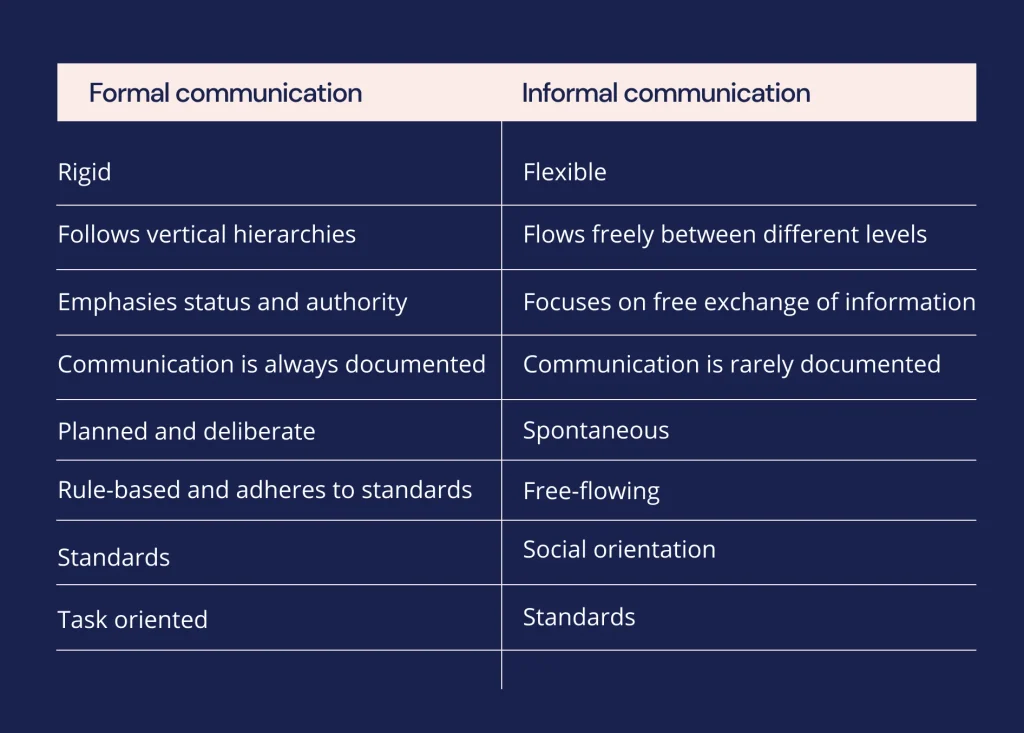
Not all business communication follows the same register. Understanding the difference between formal and informal communication is critical for anyone navigating a professional environment.
| Feature | Formal Communication | Informal Communication |
|---|---|---|
| Tone | Professional, measured, structured | Casual, conversational, flexible |
| Channels | Official letters, reports, board memos, presentations | Chats, informal meetings, corridor conversations |
| Documentation | Usually recorded or archived | Rarely documented |
| Audience | Clients, leadership, regulators, public | Colleagues, teammates, peers |
| Risk | Misrepresentation if poorly written | Misunderstanding if taken out of context |
| Example | “Pursuant to our discussion, please find attached…” | “Hey, just wanted to check in on that thing we discussed.” |
A common error is using formal language in informal settings (which sounds stiff and unapproachable) or informal language in formal contexts (which damages credibility). The professional skill is matching register to context, not picking one and applying it everywhere.
Barriers to Effective Business Communication
Understanding what goes wrong is as important as understanding what goes right. Communication barriers fall into five broad categories.
Physical Barriers include distance, poor technology, background noise, and time zone differences. Two colleagues in different countries communicating across a seven-hour time gap are working against a structural disadvantage that no amount of email skill alone can fix.
Language Barriers arise from vocabulary gaps, jargon overuse, regional idioms, and grammatical errors that obscure meaning. A technical specialist who explains a problem using domain-specific language to a non-specialist audience has failed to communicate, even if every word they used was technically correct.
Cultural Barriers reflect differences in how people from different backgrounds interpret directness, hierarchy, silence, disagreement, and humour in professional settings. What reads as confidence in one culture reads as arrogance in another. What reads as politeness in one culture reads as evasiveness in another.
Psychological Barriers include assumptions, stress, personal bias, and emotional state. A manager who delivers feedback while visibly frustrated communicates their frustration more loudly than their words. A receiver who assumed a message would be negative will interpret it negatively regardless of the actual content.
Organisational Barriers are structural. Overly hierarchical systems where information only flows top-down, departments that do not share data, or organisations without established feedback mechanisms all create systemic communication failures that no individual can solve on their own.
What Makes Business Communication Effective?
Effectiveness in business communication is not about eloquence. It is about outcome. A message is effective when the receiver understands it correctly, acts on it appropriately, and feels respected by the interaction.
Seven characteristics define effective business communication:
- Clarity – The message says exactly what it means, without ambiguity or unnecessary complexity.
- Conciseness – The message uses only as many words as the content requires. Nothing more.
- Correctness – The information is accurate, and the grammar is sound enough not to undermine credibility.
- Completeness – The receiver has everything they need to take the intended action, without having to ask follow-up questions.
- Consideration – The message accounts for the receiver’s perspective, needs, and level of knowledge.
- Concreteness – Specific details and evidence are used rather than vague generalisations. “Sales rose 18% in Q3” is more effective than “Sales improved recently.”
- Courtesy – The tone respects the receiver’s time and dignity, even in negative or difficult messages.
These seven Cs, as they are known in business communication scholarship, apply equally to emails, reports, presentations, and spoken conversation. They are not stylistic preferences. They are structural requirements for communication that actually works.
Business Communication in the Age of Remote Work
The shift toward hybrid and remote work models has changed the practical landscape of business communication more sharply than any development in the previous fifty years.
When most communication happens through screens rather than in shared physical spaces, certain things break down naturally. The informal corridor conversation that used to catch a problem early no longer happens. The non-verbal signals that tell a manager a team member is struggling are no longer visible. The spontaneous collaboration that used to produce unexpected solutions requires deliberate engineering.
Organisations that navigated this shift well did three things consistently. They over-communicated during transitions, setting explicit expectations about response times, meeting cadences, and written versus spoken norms. They invested in asynchronous communication practices, recognising that not everything requires a meeting. And they protected psychological safety so that remote employees felt as able to raise problems and share ideas as their in-office counterparts.
The organisations that struggled treated remote communication as simply “the same as before, but on video.” It is not. Remote work rewards written communication skill, structural clarity, and intentional relationship-building in ways that in-person environments do not demand to the same degree.
Common Mistakes in Business Communication
Mistake 1: Assuming understanding without confirming it Saying something once and assuming it was understood is one of the most expensive mistakes in professional communication. Important messages need explicit confirmation, whether through a follow-up email summarising a verbal discussion, a question that prompts the receiver to paraphrase back, or a clear next-step request that can only be fulfilled if the message was understood.
Mistake 2: Choosing convenience over appropriateness Sending a complex sensitive issue over email because it is easier than scheduling a call is a convenience choice that carries a relationship cost. The right channel for the message matters as much as the words themselves.
Mistake 3: Writing to impress rather than to inform Long sentences, jargon, and unnecessarily complex vocabulary are often attempts to sound authoritative. They usually achieve the opposite: the reader loses the thread, skims the message, and misses the point. Write to be understood, not to be admired.
Mistake 4: Forgetting that tone does not survive text Sarcasm, humour, and irony that land perfectly in a face-to-face conversation routinely cause offence in written form. Text strips tone. Write messages assuming the reader cannot hear your voice, because they cannot.
Mistake 5: Sending emotional responses immediately The message written in frustration, defensiveness, or excitement should be saved as a draft and reviewed thirty minutes later. Business communication requires emotional regulation, not emotional suppression, but it does require enough separation from strong feeling to check whether the message serves the professional outcome.
Expert Tips for Better Business Communication
Start with the outcome, not the information. Before you write anything or open your mouth, ask: what do I want this communication to produce? A decision? An action? A feeling of being informed? Work backwards from the outcome to the message.
Write shorter emails, not longer ones. The instinct when communicating something complex is to write more. The professional discipline is to write less. If an email cannot be scanned in thirty seconds and understood in two minutes, it needs editing. Most emails are twice as long as they need to be.
Separate facts from interpretations. “The project is three days behind schedule” is a fact. “The team is not taking this seriously” is an interpretation. Effective business communicators lead with facts and keep interpretations clearly labeled as such.
Build in feedback loops. Every important communication, whether a project brief, a client proposal, or an organisational change announcement, should have a mechanism for the receiver to respond. One-way communication is announcement, not communication.
Learn to say less in meetings. The professional who speaks least in a meeting but says the most useful things when they do speak carries more authority over time than the one who fills every silence. Quality of contribution matters more than volume.
Key Takeaways
Business communication is purposeful, structured information exchange that drives professional outcomes.
- It flows in four directions: downward, upward, lateral, and external.
- Channel selection matters as much as message content.
- The seven Cs of business communication (clarity, conciseness, correctness, completeness, consideration, concreteness, courtesy) apply to every format.
- Communication barriers are physical, linguistic, cultural, psychological, and organisational.
- Remote work has restructured communication demands, rewarding written clarity and asynchronous skills.
- The most common mistake is assuming understanding without confirming it.
Glossary of Business Communication Terms
The terms below are key concepts in business communication studies and practice. This glossary is presented as a reference tool. These terms appear throughout the academic and professional literature on the subject and are worth knowing at their precise definitions, not just their casual meanings. Please note: the glossary from the related article on Spoken English for Business Communication covers a separate and complementary set of terms including active listening, hedging language, signposting, and turn-taking.
Asynchronous Communication Communication where the sender and receiver do not interact in real time. Email, recorded video messages, written reports, and shared documents are all asynchronous. Asynchronous communication allows the receiver to process and respond on their own schedule. In remote and global work environments, it has become the dominant mode of professional information exchange. Its primary challenge is the lack of immediate feedback, which makes clarity of writing critically important.
Business Communication Audit A systematic assessment of how effectively an organisation communicates, both internally and externally. An audit examines communication channels, message clarity, response times, information flow across departments, and employee perception of how well leadership communicates. Organisations use communication audits to identify structural failures before they become operational crises. Unlike casual feedback processes, an audit produces documented findings and recommendations.
Downward Communication The formal flow of information from senior to junior levels within an organisation’s hierarchy. Policy updates, performance standards, strategic direction, and operational instructions all travel downward. The risk specific to downward communication is distortion through layers of management. A directive that passes through five management levels before reaching frontline staff can arrive significantly altered from its original intent.
Dyadic Communication A communication exchange between exactly two people. One-on-one meetings, performance reviews, client calls, and direct message exchanges are all dyadic. Dyadic communication allows for a level of candour, personalisation, and responsiveness that group communication does not. It is often the most efficient format for complex, sensitive, or individual-specific messages.
Gatekeeper A person or system that controls the flow of information within an organisation or between an organisation and its audience. A communications manager who reviews all press releases before they are sent is a gatekeeper. In digital environments, algorithms that determine which content employees see in their intranet feed are also gatekeepers. Gatekeepers can protect an organisation from communication errors, but they can also create bottlenecks and information silos if the role is not well-managed.
Information Overload The state in which a person receives more information than they can process effectively, leading to reduced decision quality, missed messages, and increased stress. Information overload is a documented occupational phenomenon, particularly in organisations that rely heavily on email as their primary communication channel. Studies have found that knowledge workers receive an average of over 120 emails per day, far exceeding what can be thoughtfully processed alongside their other responsibilities.
Lateral Communication The exchange of information between people or departments at the same hierarchical level within an organisation. Also called horizontal communication. Effective lateral communication reduces duplication of effort, accelerates cross-functional project work, and creates the shared context that allows teams to collaborate without relying on management as an intermediary at every stage.
Media Richness Theory A theoretical framework in communication studies that ranks communication channels by their capacity to convey nuance, complexity, and relational information. Face-to-face communication is the richest medium because it carries verbal content, tone, facial expression, gesture, and real-time feedback simultaneously. Plain text email is among the leanest. The theory predicts that complex or ambiguous messages are best handled through rich media (in-person or video), while routine, well-understood messages can travel effectively through lean media (email, text, notice boards).
Noise (Communication) In communication theory, noise refers to anything that distorts or interferes with a message between the sender and the receiver. It includes literal noise (a loud open-plan office), psychological noise (the receiver is preoccupied with unrelated concerns), semantic noise (the sender uses words the receiver interprets differently), and technical noise (a poor internet connection disrupting a video call). Reducing noise is a primary goal of channel selection and message design in professional communication.
Proxemics The study of how physical space and distance affect communication. In business settings, proxemics shapes meeting room design, desk arrangements, and the spatial dynamics of presentations and negotiations. Research by anthropologist Edward Hall identified four spatial zones: intimate, personal, social, and public. Professional interaction typically occurs in the social zone (roughly 1.2 to 3.6 metres). Understanding proxemics helps explain why some office layouts facilitate open communication while others suppress it.
Upward Communication The flow of information from lower to higher levels in an organisational hierarchy. Upward communication includes employee feedback, performance reports, problem escalations, and suggestions from frontline staff. It is widely recognised as the most structurally suppressed form of internal communication. Organisations with strong upward communication cultures make better decisions because leadership operates with more complete information. Psychological safety, the belief that one can speak up without fear of punishment, is the primary condition that enables effective upward communication.
Written Communication Fidelity The degree to which a written message accurately conveys the sender’s intended meaning to the receiver. High-fidelity written communication leaves no ambiguity about what action is required, who is responsible, by when, and to what standard. Low-fidelity written communication is vague, relies on assumed knowledge, or uses language that the receiver interprets differently from the sender’s intent. Increasing written communication fidelity is one of the fastest ways to reduce operational errors in professional settings.
Articles might help:
Place these internal links at the points indicated within the article body:
- Spoken English for Business Communication: The Complete Professional Guide
- 100 Modern C1 Vocabulary Words You Should Use Every Day
- Subject-Verb Agreement: 20 Advanced Rules Every Exam Aspirant Must Know
- Voice Change in English Grammar: Active and Passive Voice Explained
- The 12 Tenses in English Grammar: A Complete Structural and Conceptual Guide
Frequently Asked Questions
What is business communication in simple terms?
Business communication is the exchange of information between people in a professional or organisational context, with the aim of achieving a specific goal. It covers everything from a manager’s verbal instruction to a team, to a company’s published annual report. What makes it “business” communication is its purposefulness: every message exists to produce a professional outcome, not just to fill conversational space.
What are the main types of business communication?
The four main directional types are: downward communication (from leaders to teams), upward communication (from employees to leaders), lateral communication (between peers or departments), and external communication (between the organisation and outside parties such as clients, suppliers, or regulators). These directions are crossed by format types: verbal, written, non-verbal, and visual communication.
What is the importance of business communication for students?
For students, especially those studying commerce, management, English, or any professional field, business communication is foundational. It governs how you write academic reports, give presentations, correspond with institutions, and eventually enter the workforce. Students who build strong business communication skills before graduation enter the job market with a measurable advantage over those who treat it as secondary to technical or theoretical knowledge.
What is the difference between business communication and general communication?
The key difference is purpose and structure. General communication is primarily social and expressive; its success is measured by whether connection and understanding occurred. Business communication is goal-driven and outcome-oriented; its success is measured by whether the intended professional result was achieved. Business communication also carries higher stakes for error, requires formal register in many contexts, and demands documented records in ways that everyday conversation does not.
What are the most common barriers to business communication?
The five main categories of barriers are: physical barriers (distance, technical failures, environmental noise), language barriers (vocabulary gaps, jargon, grammar errors), cultural barriers (different interpretations of directness, hierarchy, or silence), psychological barriers (stress, bias, emotional state), and organisational barriers (rigid hierarchies, siloed departments, absent feedback systems). Most real-world communication breakdowns involve more than one of these categories operating simultaneously.
How does business communication affect organisational performance?
Research consistently links communication quality to organisational outcomes. Organisations with effective internal communication have lower employee turnover, faster decision-making, fewer operational errors, and stronger client relationships. The reverse is equally documented: poor communication costs organisations measurably through lost productivity, duplicated effort, missed deadlines, and damaged external reputation. Communication is not peripheral to organisational performance. It is one of its primary drivers.
Is non-verbal communication part of business communication?
Yes. Non-verbal communication, which includes facial expression, body posture, eye contact, gesture, tone of voice, and use of physical space (proxemics), forms a significant part of face-to-face and video-based professional interaction. Research in communication psychology suggests that in interpersonal communication, non-verbal signals frequently carry more weight than the words themselves. A manager who says “good work” while avoiding eye contact communicates something very different from one who says the same phrase with direct engagement and a genuine tone.
What skills are needed for effective business communication?
The core skills are clarity of expression (spoken and written), active listening, appropriate tone and register selection, channel awareness, emotional regulation, and the ability to give and receive feedback constructively. Beyond these, the soft skills that accelerate communication effectiveness include empathy, cultural intelligence, and the discipline to confirm understanding rather than assume it. None of these skills are fixed traits. All of them respond to deliberate practice.
What is the role of technology in modern business communication?
Technology has expanded the range of available communication channels, accelerated the speed of exchange, and made global communication accessible at minimal cost. It has also introduced new failure modes: information overload from email and messaging platforms, the loss of non-verbal cues in text-based communication, and the pressure of always-on availability that blurs professional and personal boundaries. The organisations that use technology most effectively treat it as a tool that serves communication goals, rather than an environment that replaces thoughtful communication judgment.
How is business communication taught in academic settings?
Business communication is a core subject in most commerce, management, and English language programs at the undergraduate level and beyond. Academic syllabi typically cover written business communication (letters, reports, proposals, emails), oral communication (presentations, group discussions, interviews), and the theoretical frameworks underlying communication processes. Examination formats vary from essay-based assessments to practical tasks such as drafting formal letters or conducting mock interviews. In India, it is a standard first or second-year paper across BBA, BCom, MBA, and many English Honours programs.
Conclusion
Business communication is not a module to study and move on from. It is a living discipline that touches every part of professional life, from the first email you send in a job application to the boardroom presentation delivered twenty years into a career.
Understanding what is business communication at a conceptual level is only the beginning. The more useful project is building communication as a working habit: choosing channels deliberately, writing with outcome in mind, listening with the same attention you give to speaking, and treating feedback not as a formality but as the actual engine of improvement.
Organisations are, in the end, made of conversations. The ones that hold together, grow, and do remarkable things are the ones where those conversations are clear, honest, and purposeful.
Recommended External References
- Harvard Business Review (hbr.org) – Research and practitioner articles on workplace communication
- MIT Sloan Management Review (sloanreview.mit.edu) – Evidence-based management communication research
- Purdue OWL Online Writing Lab (owl.purdue.edu) – Business writing and communication guidelines
- British Council Business English (britishcouncil.org) – Professional English resources
- National Communication Association (natcom.org) – Academic research in communication studies