
Introduction
Most students know what a literary research paper should argue. They have the thesis, the secondary sources, the textual evidence. But the paper still falls apart, not in the body, but at the edges. The introduction reads like a warming-up exercise, and the conclusion sounds like a summary copied from the abstract. Examiners and professors notice this immediately.
Knowing how to write a literary research paper with a powerful opening and a resonant close is not about following a formula. It is about understanding what those two sections actually do. The introduction sets a contract with the reader. The conclusion honors that contract and then goes further. Get those two sections right, and even a modest argument will carry authority.
This guide is built specifically for literary research, not general academic writing. The demands are different here. You are working with texts that hold meaning at multiple levels, authors who wrote within specific historical and cultural pressures, and readers who expect intellectual engagement, not just information delivery.
By the end of this guide, you will know how to construct a literary research introduction that positions your argument confidently, and a conclusion that does not simply repeat what you already said.
Quick Answer
How do you write a strong literary research paper introduction? Open with a specific literary or critical context, not a broad generalization. Establish the text, author, and the gap your argument fills. State your thesis in the final sentence of the introduction. A good literary introduction shows the reader why this argument matters right now, not just what the paper covers.
Why Introductions and Conclusions Are the Hardest Parts to Write?
There is a reason most writers skip the introduction first and come back to it later. The introduction asks you to explain your entire argument before you have fully worked it out. The conclusion asks you to say something new without actually introducing new material. Both tasks require a mental clarity that the middle of a paper, with all its evidence and analysis, simply does not demand in the same way.
In literary research specifically, the difficulty runs deeper. You are not reporting data. You are making a claim about how meaning operates in a text, and that claim needs to be framed in a way that is both intellectually precise and worth reading for its own sake. Literary scholars write for an audience that cares about language. Your introduction is the first piece of writing they judge you on.
The conclusion carries a different kind of pressure. It must give the reader a sense of arrival without feeling like you slammed the door on the conversation. In literary studies, a great conclusion opens a window precisely at the moment it appears to be closing one.
How to Write a Literary Research Paper Introduction: The Framework
Before you write a single sentence of your introduction, answer these three questions on a separate sheet of paper:
- What is the critical conversation my paper enters?
- What has been missed, overlooked, or oversimplified in that conversation?
- What does my thesis contribute to filling that gap?
Those answers are the skeleton of your introduction. You do not need to invent drama or start with a sweeping statement about human nature. You just need to situate your argument inside a conversation that already exists, and then show where your voice fits.
The Inverted Pyramid Approach for Literary Papers
Most literary research introductions work best with a narrowing structure:
Broad Context (1-2 sentences) > The Text and Its Critical History (2-3 sentences) > The Gap or Problem (1-2 sentences) > Your Thesis (1 sentence)
This structure is sometimes called the inverted pyramid because you begin wide and narrow to a point. The thesis is that point.
Here is what this looks like in practice:
“Victorian domestic fiction has long been read as a site of ideological containment, a space where bourgeois values are rehearsed and reinforced. Yet critical attention to Wilkie Collins has tended to focus on sensation and plot mechanics, leaving the domestic interiors of his novels undertheorized as architectural argument. This paper reads the locked room in The Woman in White not as Gothic convention but as a structural claim about legal personhood and the limits of female testimony in mid-Victorian jurisprudence. Collins uses physical enclosure to map a legal enclosure that criticism has not yet fully named.”
Notice what that introduction does not do: it does not start with “Throughout history, literature has reflected society.” It does not quote the dictionary. It enters a specific conversation, identifies a gap, and makes a specific claim.
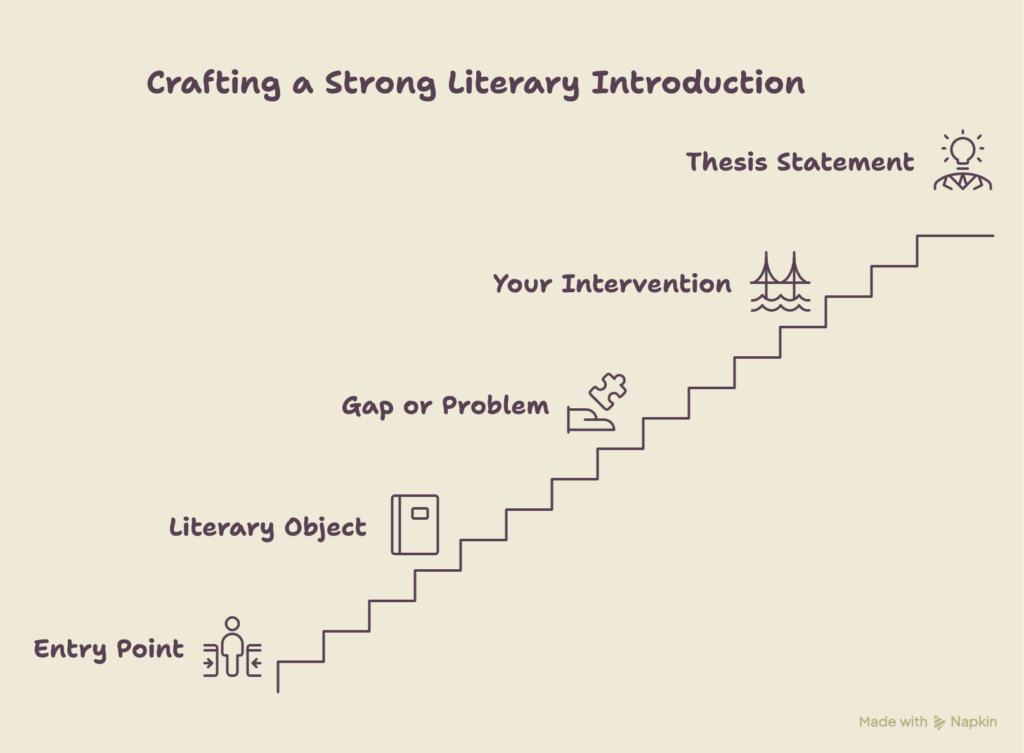
The Five Elements of a Strong Literary Introduction
Every effective literary research paper introduction contains these five components. The order can vary slightly, but all five must be present.
1. The Entry Point: This is where you join the existing critical conversation. Reference the body of scholarship or the accepted reading of the text you intend to challenge, refine, or extend. You do not need to name every critic here; a phrase like “dominant readings of X have emphasized…” is sufficient.
2. The Literary Object: Name your primary text or texts clearly. State the author, the title, and any relevant publication or historical context that bears on your argument. Do not bury this information in the third paragraph.
3. The Gap or Problem This is the engine of your paper. What does the existing scholarship get wrong, overlook, or leave incomplete? The gap must be genuine. It should feel like something worth filling.
4. Your Intervention:n This is a bridge sentence that positions your approach. It shows the reader what lens, method, or framework you are using. Are you reading through a postcolonial frame? A feminist materialist approach? A close reading focused on syntax? State it here.
5. The Thesis Statement:nt One sentence. A specific, arguable claim about the text that your paper will prove. Not a question. Not a description. A claim.
Direct and Indirect Characterization: The Writer’s Secret to Building Unforgettable Characters
Common Introduction Mistakes in Literary Research (And How to Fix Them)
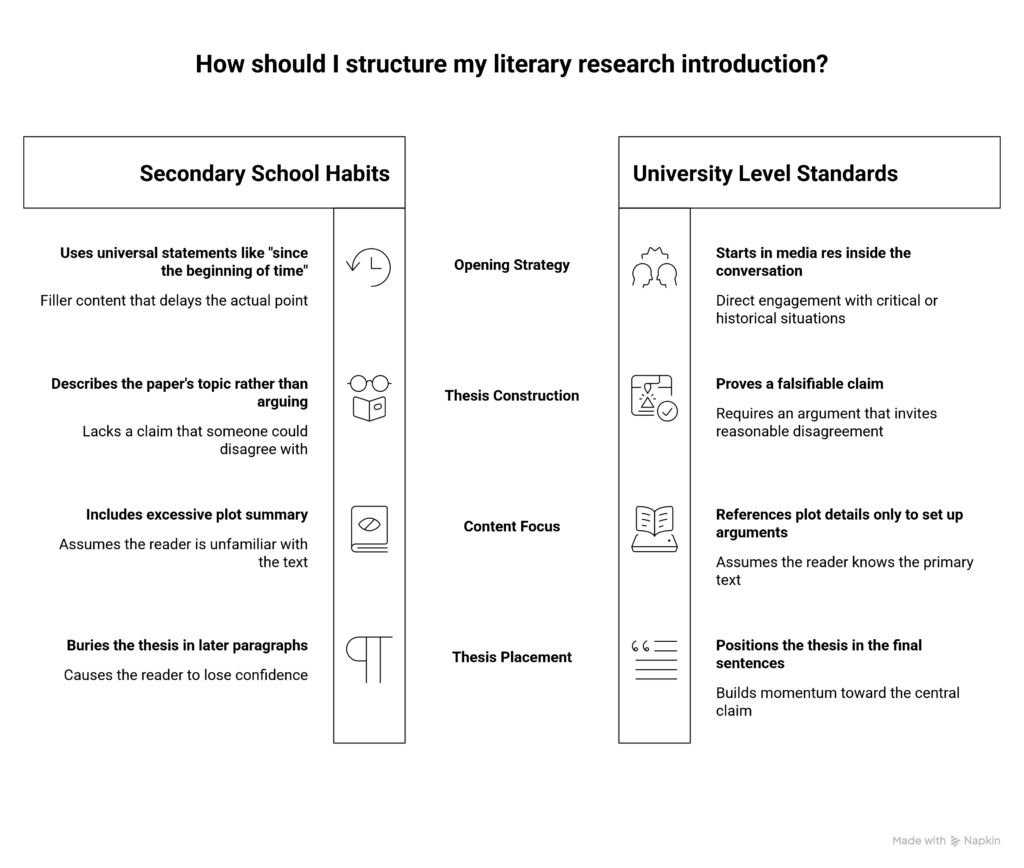
Many introductions in literary papers fail not because the student lacks insight, but because they follow habits picked up in secondary school that simply do not survive at university or postgraduate level.
Mistake 1: Opening with a Universal Statement. Sentences like “Since the beginning of time, humans have told stories” or “Literature has always explored the human condition” are not arguments. They are filler. They delay the point and signal to the reader that you have not found a specific entry into the problem.
Fix: Open with the critical or historical situation your paper addresses directly. Start in media res, inside the conversation.
Mistake 2: Writing the Introduction First. Most experienced literary scholars write the introduction last, or at least revise it substantially after the body is complete. Writing it first often means you write an introduction to a paper you have not yet written.
Fix: Write a placeholder introduction, complete the body, then return and rewrite the introduction to match the argument you actually made.
Mistake 3: A Thesis That Describes Rather Than Argues:s “This paper will examine the role of nature in Romantic poetry” is a description, not an argument. It tells the reader what you will look at, not what you will claim.
Fix: Ask yourself, “What does my paper prove that someone could reasonably disagree with?” That answer is your thesis. It should be falsifiable. “Wordsworth’s treatment of nature in The Prelude functions less as pastoral idealization than as an epistemological argument for the primacy of sensory memory over abstract reason” is an argument.
Mistake 4: Too Much Plot Summary. ry Plot summary in a literary introduction suggests that you are not sure whether your reader knows the text. At research level, assume they do.
Fix: Reference plot details only where they directly set up your argument. One sentence of context is usually enough.
Mistake 5: Burying the Thesis. If your thesis appears in the fourth paragraph, the reader has already lost confidence in the paper.
Fix: The thesis belongs in the final two or three sentences of the introduction. Every sentence before it should build toward it.
Subject-Verb Agreement: 20 Advanced Rules Every Exam Aspirant Must Know
How to Write a Conclusion for a Literary Research Paper
The conclusion is where most literary papers go quiet when they should be getting more interesting. Students summarize the body, restate the thesis, and stop. The result feels less like a conclusion and more like a receipt.
A strong literary research conclusion does three things that a summary cannot:
It synthesizes, not summarizes. Synthesis means showing how all the pieces of your argument fit together to produce something larger than their sum. Summary just lists the pieces again.
It raises the stakes. What does your argument mean beyond this paper? What does your reading of this text suggest about broader questions of literary history, critical method, or cultural significance?
It opens outward. The best literary conclusions leave the reader thinking rather than closing down. They point toward questions the paper itself has generated, implications worth pursuing, or connections worth making.
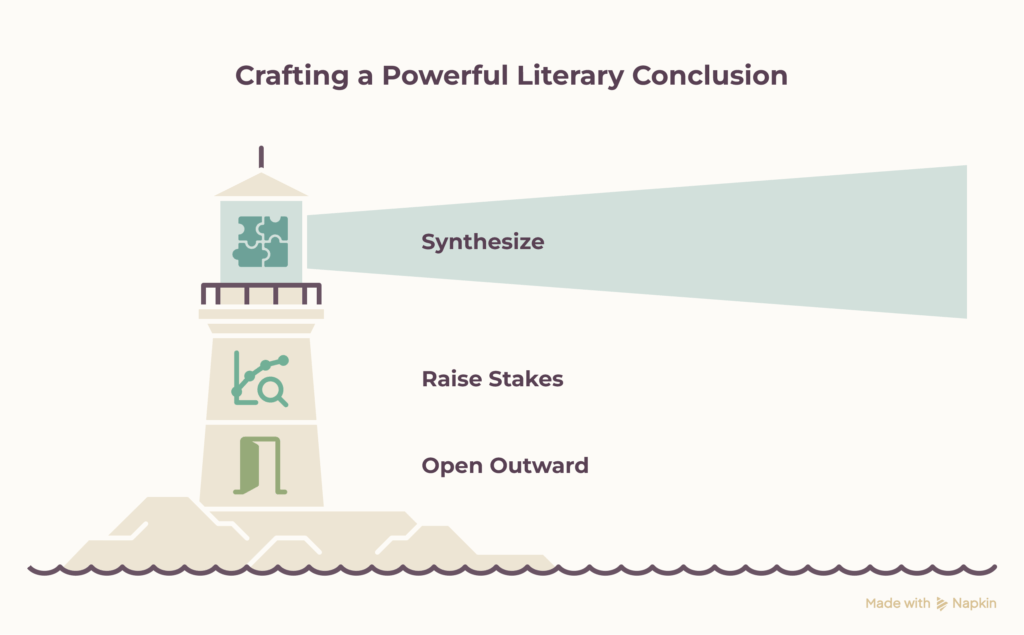
The Anatomy of a High-Impact Literary Conclusion
A literary research conclusion works best in three movements. Think of it like the final movement of a piece of music: it recalls themes, builds toward a resolution, and then extends into silence with intention.
Movement 1: The Synthetic Return (2-3 sentences)
Return to your core argument, but do not repeat it verbatim. Show how the analysis in the body has demonstrated or complicated the claim you made in the introduction. Use different language. This is not the thesis restated; it is the thesis proven and deepened.
Movement 2: The Stakes Paragraph (3-4 sentences)
Ask the “so what?” question honestly. What does this reading matter? Does it revise how we understand the author’s larger body of work? Does it expose a gap in a critical methodology? Does it suggest that the period’s cultural assumptions operated differently from what scholars have assumed? Answer that question directly.
Movement 3: The Aperture (1-2 sentences)
End with a sentence or two that gestures outward without opening a new argument. This could be a quotation from the text that your analysis has recontextualized, a question the paper has raised but cannot fully answer, or a connection to a neighboring critical problem. The aperture is not a loose thread; it is a deliberate opening.
Hamartia in Oedipus Rex and Macbeth: A Deep Comparative Study of the Tragic Flaw
The “Circular Return” Technique: Linking Your Conclusion Back to the Introduction
One of the most effective and underused techniques in literary research writing is the circular return: ending your conclusion with a direct callback to your introduction’s opening moment.
If your introduction opens with a specific line from the text, close with a reread of that same line in light of your argument. If your introduction references a specific critical debate, close by showing what that debate looks like after your intervention. The circle does not mean repetition. It means the reader ends in a different place than where they began, even though they are looking at the same thing.
Here is an example of a circular return in action:
Introduction: “Critics have long praised the final chapter of Great Expectations for its ambiguity, reading Pip’s revised ending as Dickens’s uncertainty about Victorian optimism.”
Conclusion: “What this reading has proposed is that Dickens’s ‘uncertainty’ is not hesitation but design. The ambiguity of the final chapter is the argument. In a novel where social ascent is finally shown to be a performance without a stable ground, an unresolved ending is the only honest one Dickens could have written.”
The reader returns to the same critical conversation but sees it differently now. That is the effect of a well-executed circular return.
Ulysses vs My Last Duchess: Two Dramatic Monologues, Two Faces of Victorian Manhood
Comparison Table: Weak vs. Strong Openings and Closings
| Element | Weak Version | Strong Version |
|---|---|---|
| Opening sentence | “Literature has always reflected human society.” | “Postcolonial readings of Heart of Darkness have centered on Kurtz, but the figure of Marlow as unreliable transmitter has received far less structural attention.” |
| Thesis | “This paper will explore symbolism in Hamlet.” | “Hamlet’s compulsive language games are not symptoms of indecision but the only form of agency available to a man who knows his testimony will never be legally sufficient.” |
| Thesis placement | Buried in paragraph four | Final sentence of the introduction |
| Conclusion opener | “In summary, this paper has argued…” | “What emerges from this reading is not simply a revised portrait of X, but a rethinking of how the period understood the relationship between Y and Z.” |
| Stakes | Not addressed | Explicitly connects the argument to broader critical or cultural questions |
| Final sentence | “In conclusion, this paper has shown that…” | A reread of the opening moment or a deliberate outward gesture |
| Tone | Apologetic or vague | Confident without overclaiming |
Expert Tips for Polishing Both Sections
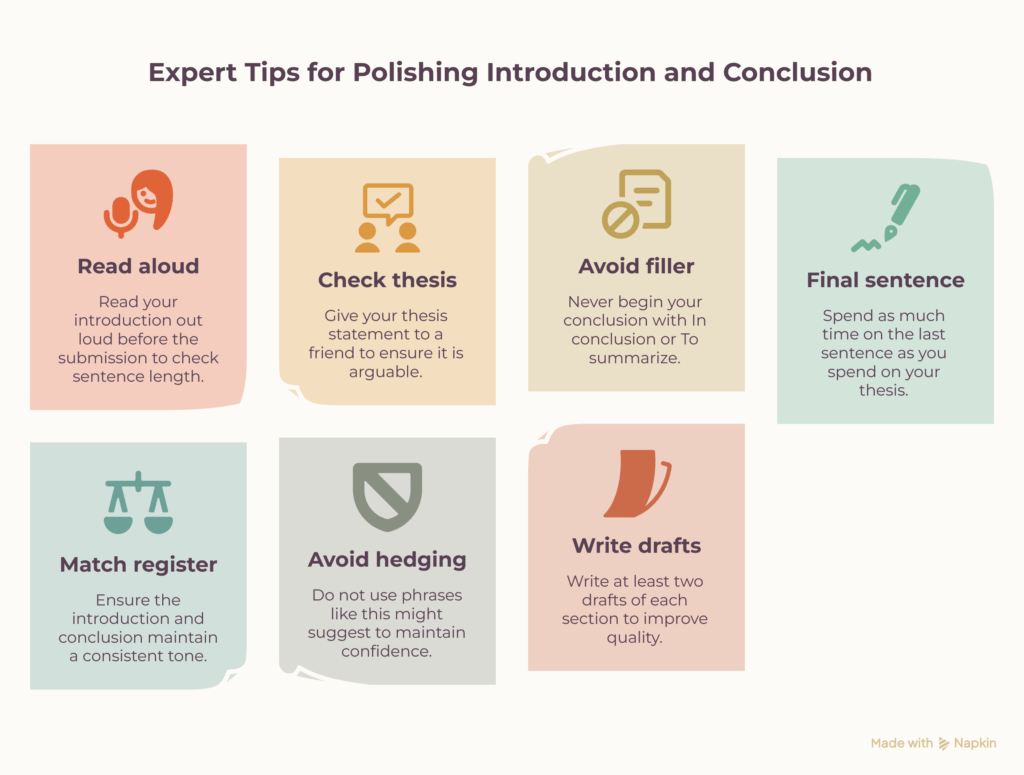
Read your introduction out loud before the submission. If you run out of breath before getting to the thesis, the sentences are too long or too indirect. Trim them.
Check the thesis for arguability. Give your thesis statement to a friend or classmate. If they immediately say “yes, of course,” it is too obvious. If they look confused, it is too vague. If they say “really? I’d want to see how you’d argue that,” it is working.
Never begin your conclusion with “In conclusion” or “To summarize.” These phrases signal to the reader that you have nothing left to say and are just wrapping up. Find a sentence that enters the conclusion with momentum.
The last sentence of your conclusion is the last thing the reader reads. Spend as much time on that single sentence as you spend on your thesis. It should be memorable, precise, and satisfying.
Match the register of introduction and conclusion. If your introduction is formal and precise, your conclusion should not suddenly become conversational. Inconsistency in register undermines authority.
Avoid hedging language at the end. Phrases like “this might suggest” or “it could perhaps be argued” in a conclusion undo the confidence the body of the paper built. If you have made the argument, claim it.
Write at least two drafts of each section. The first draft of an introduction is almost always thinking-through. The second draft, written after the body is complete, is the one worth keeping.
Frequently Asked Questions
How do you write a literary research paper introduction for beginners?
Start by identifying the text you are analyzing, the critical conversation it belongs to, and the specific argument you want to make. Do not open with a broad philosophical statement. Instead, name your literary object, point to a gap in how scholars have read it, and close your introduction with a specific, arguable thesis. Keep the introduction between 150 and 250 words for most undergraduate papers.
How long should a literary research paper introduction be?
For a 2,000 to 3,000-word paper, your introduction should be around 150 to 250 words. For a dissertation chapter or a 7,000-word journal article, introductions can run 400 to 600 words. The length should be proportional to the complexity of the argument you need to set up, not padded to seem thorough.
What should a conclusion for a literary research paper include?
A literary conclusion should include a synthetic return to the thesis (not a copy of it), a stakes paragraph that explains why the argument matters beyond the paper itself, and an outward gesture that leaves the reader with something to think about. Avoid using “In conclusion” as an opener. The conclusion should feel like an arrival, not a receipt.
What is the difference between a summary and a synthesis in a conclusion?
A summary lists the points the paper made. A synthesis shows how those points fit together to produce something the reader could not have understood from any single section alone. Synthesis is what separates a professional literary conclusion from a student’s recap. Think of it as the difference between listing ingredients and describing a flavor.
Can I use a quotation to open a literary research paper?
Yes, but with caution. A quotation from your primary text can be powerful if it is the specific moment your argument hinges on. A quotation from a secondary source or a dictionary is almost always a weak opening in literary research. The question to ask is whether the quotation does work or just decorates the page.
Should the thesis appear in the conclusion as well?
Not verbatim. Your conclusion should return to the claim you made in the thesis, but in language that reflects the depth the paper has built. If your conclusion restates the thesis in the same words as the introduction, it signals that the paper did not develop the argument; it just repeated it.
What is the “so what?” question in literary research?
The “so what?” question asks why your argument matters. It forces you to move from the particular (what this text does) to the general (what that tells us about literature, history, culture, or critical method). Answering the “so what?” is the primary job of the conclusion’s stakes paragraph. If you cannot answer it, the paper may be descriptive rather than analytical.
How do I avoid sounding repetitive in my introduction and conclusion?
Use different vocabulary to discuss the same ideas. If your thesis uses the word “surveillance,” your conclusion’s synthetic return might use “monitoring,” “visibility,” or “the observed subject.” Varied language is not just stylistic: it shows that you have genuinely processed the argument rather than cut and pasted it. Also ensure that the conclusion adds the intellectual weight of the body’s analysis rather than ignoring it.
Is it acceptable to ask a question at the end of a literary conclusion?
It depends on the question’s function. A question that opens genuine critical territory without feeling evasive can work beautifully as an aperture. But a question that simply retreats from making a claim (“Could this tell us something important about gender?”) is too vague to be useful. If you end with a question, make it one that your argument has actually earned the right to ask.
How is a literary research paper different from a literature review?
A literary research paper makes an original argument about a text or texts, using secondary sources as part of an analytical framework. A literature review surveys the existing scholarship on a topic without necessarily advancing a new argument of its own. The introduction and conclusion of a literary paper are thesis-driven; those of a literature review are field-mapping and summary-oriented. The skills overlap, but the goal differs significantly.
Closing Thoughts
Knowing how to write a literary research paper well is really knowing how to think at its edges. The body of a paper is where most of the analytical work happens. But the introduction is where you tell the reader why that work is worth doing, and the conclusion is where you show them what it produced.
A literary introduction that enters a real critical conversation and delivers a specific, arguable thesis does more than just set up the paper. It makes a reader want to keep reading. A conclusion that synthesizes, raises the stakes, and closes with intention leaves a reader with something they did not have before.
Both sections deserve more time than most writers give them. The argument in the middle only lands as hard as the frame around it.
Recommended External References
- UNC Writing Center — “Literature Reviews”: writingcenter.unc.edu
- Purdue OWL — “Writing a Literature Review”: owl.purdue.edu
- UC San Diego Psychology Department — “Read More



1 comment
[…] Read More: How to Write a Literary Research Paper […]