Introduction
Most IELTS guides tell you the same things. Practice every day. Build your vocabulary. Take mock tests. That advice is not wrong, but it is incomplete. Thousands of candidates follow exactly that advice and still fall short of their target band by half a point.
How to crack IELTS is not really about studying more. It is about studying the right things in the right order, understanding what examiners actually look for, and knowing which mistakes quietly cost you marks even when your English is solid.
This guide is built differently. Instead of recycling generic tips, it goes inside each section and explains the specific decisions that separate a Band 6.5 answer from a Band 7.5 one. You will also find a realistic study plan, a comparison of Academic vs. General Training, honest talk about what the band descriptors really mean, and a Wikipedia-style glossary at the end that covers every IELTS term you will come across.
If you read this and apply it, you will not need another IELTS preparation article. That is the goal.
Quick Answer
How can I crack IELTS fast? Understand the exam format first, then diagnose your weakest section. Study that section intensively for two weeks before moving on. Take timed full mock tests weekly, review every mistake by category, and practice Speaking aloud every single day. Most candidates improve by 0.5 to 1 band within six weeks of structured practice.
Table of Contents
What Is IELTS and Why Does It Matter?
IELTS stands for the International English Language Testing System. It is jointly owned and administered by the British Council, IDP: IELTS Australia, and Cambridge Assessment English — three of the most recognized names in English language education.
The test exists because universities, immigration departments, and employers across the world need a standardized way to verify a person’s English proficiency. A Band 7 in IELTS is globally understood, whether you are applying to a university in Canada, a job in Australia, or residency in the UK.
More than 3.5 million IELTS tests are taken every year, making it one of the most widely taken English language tests on the planet. That popularity is partly because IELTS is accepted by over 11,000 organizations globally, including top universities like Oxford, MIT, and the University of Toronto.
Related Guide: Spoken English for Business Communication — Lingua Litera

Academic vs. General Training: Which One Do You Need?
This is one of the first decisions you make, and getting it wrong wastes months of preparation.
| Feature | Academic | General Training |
|---|---|---|
| Purpose | University admission, professional registration | Work visa, migration, secondary education |
| Reading difficulty | Higher (dense academic texts) | Moderate (workplace/everyday texts) |
| Writing Task 1 | Describe a graph, chart, or diagram | Write a formal or informal letter |
| Writing Task 2 | Same format (essay) | Same format (essay) |
| Listening | Identical for both | Identical for both |
| Speaking | Identical for both | Identical for both |
| Minimum band required | Usually 6.5 to 7.5 | Often 5.0 to 6.5 |
The only rule: check your specific requirement before choosing. A university requirement of “Academic IELTS Band 6.5” cannot be substituted with General Training, even if you score a 7.5 on the latter.
Understanding the IELTS Band Score System
IELTS scores run on a 9-band scale. Each band represents a defined level of English proficiency. You do not pass or fail IELTS; you receive a score.
| Band | Description |
|---|---|
| 9 | Expert user — complete command of the language |
| 8 | Very good user — rare errors, handles complex language |
| 7 | Good user — occasional inaccuracies, handles most situations |
| 6 | Competent user — noticeable imperfections, copes in familiar situations |
| 5 | Modest user — partial command, some errors in complex tasks |
| 4 | Limited user — basic competence, frequent problems |
| Below 4 | Extremely limited to non-user |
Your overall band is the average of the four section scores, rounded to the nearest 0.5. So if you score 7.0 in Listening, 6.0 in Reading, 7.0 in Writing, and 7.0 in Speaking, your overall is 6.75, which rounds to 7.0.
This rounding matters enormously. A single low score in Reading can drag a 7.5 Speaking performance down to an overall 6.5.
How to Crack IELTS Listening
What the Listening Test Actually Is
The Listening section lasts about 30 minutes, with 10 extra minutes to transfer your answers to the answer sheet (paper-based test only). There are 40 questions across 4 sections, each section longer and more complex than the last.
- Section 1: A conversation in a social setting (e.g., booking a hotel room)
- Section 2: A monologue in a social/educational context (e.g., a community announcement)
- Section 3: A conversation among up to 4 people in an academic setting
- Section 4: A lecture or academic talk, with no break
What Most Candidates Get Wrong
The most common error is listening for the exact words in the question. IELTS Listening almost never uses the same words as the question; it paraphrases them. If the question says “accommodation,” the recording might say “place to stay.” If it says “expensive,” the speaker might say “costs a lot more than expected.”
Train your ear to follow ideas, not words.
Section-Specific Strategies
For completion tasks: Read the questions before the audio plays. The blank tells you what type of answer to expect (a name, a number, a place). Write the answer as you hear it; do not wait.
For multiple choice: Eliminate options as you listen, not after. The recording often mentions all three options but only confirms one.
For map/diagram labeling: Orient yourself before the audio starts. Know which direction is north, where the entrance is, and which labels are blank.
For matching tasks: Learn all the options in List A and List B before the audio. The recording follows the sequence of List A questions.
The Accent Problem
IELTS uses British, Australian, Canadian, and American accents — sometimes in the same section. Many candidates from India, South Asia, and Southeast Asia primarily hear American accents. Expose yourself to BBC podcasts, ABC Australia news radio, and Canadian talk shows before your exam. Two to three weeks of daily exposure makes an enormous difference.
Score benchmarks:
- Band 7: approximately 30 correct out of 40
- Band 8: approximately 35 correct out of 40
How to Crack IELTS Reading
The Real Challenge in Reading
The Reading section is 60 minutes long with 40 questions across three passages. The Academic version uses texts from journals, newspapers, and books. The General Training version uses workplace notices, advertisements, and instructional materials for the first two passages, with a longer academic-style text for the third.
Time, not comprehension, is what kills most candidates here. You have exactly 60 minutes and no extra transfer time. Many people spend 25 minutes on Passage 1 and run out of time for Passage 3.
The fix is mechanical: spend no more than 20 minutes per passage. If a question is taking longer than 90 seconds, mark it and move on.
Skim Before You Read
Read the title, headings, and first sentence of every paragraph before looking at any question. This takes 60 to 90 seconds and gives you a mental map of where information lives. Then read the questions, identify keywords, and scan for those keywords in the passage.
Never read the full passage first. It wastes time you do not have.
True/False/Not Given vs. Yes/No/Not Given
This distinction confuses people constantly.
- True/False/Not Given (in factual passages): Is this statement confirmed, contradicted, or absent from the passage?
- Yes/No/Not Given (in opinion-based passages): Does the writer agree, disagree, or not give a view?
The difference between False and Not Given is critical. False means the passage directly contradicts the statement. Not Given means the topic is not addressed. Students often mark “Not Given” as “False” because they assume absence implies contradiction. It does not.
Question Types and Their Tricks
| Question Type | Key Strategy |
|---|---|
| Matching Headings | Read paragraph summaries, not full text. Match the dominant idea, not one detail. |
| Sentence Completion | The answer is usually a word from the passage, not a paraphrase. |
| Short Answer | Answers are brief and factual. Never exceed the word limit. |
| Matching Information | Questions are not in order. Scan all paragraphs for each item. |
| Summary Completion | Treat blanks as vocabulary gaps. The surrounding text gives you the word class needed. |
Related Guide: Subject-Verb Agreement: 20 Advanced Rules — accuracy in grammar helps you parse dense reading passages faster.
How to Crack IELTS Writing
Writing is usually where the biggest gap between target band and actual score lives. Many candidates with strong English consistently score 0.5 to 1 band below their target in Writing. The reason: they do not understand the four band descriptors that examiners use.
The Four Band Descriptors
Every IELTS Writing task is marked on four equally weighted criteria:
- Task Achievement/Response — Did you actually answer the question or describe what was asked?
- Coherence and Cohesion — Is your writing logically organized? Do you use linking words effectively?
- Lexical Resource — Do you use a varied vocabulary? Do you use words accurately?
- Grammatical Range and Accuracy — Do you use a variety of sentence structures? Are there many errors?
Most people focus almost entirely on vocabulary and grammar, while ignoring Task Achievement. A Band 7 essay that answers the wrong question can receive as low as Band 5.
Task 1 Academic: Describing Visual Data
Task 1 gives you a graph, chart, diagram, map, or process. You must write at least 150 words in about 20 minutes.
The most important structural rule: always include an overview paragraph immediately after your introduction. The overview summarizes the most significant features of the data at a glance. Examiners look for this, and its absence holds you at Band 5 for Task Achievement, regardless of language quality.
Good overview structure:
“Overall, it is clear that [main trend], while [secondary trend].”
Do not begin with “In conclusion.” The overview belongs in the second paragraph of Task 1, not the end.
Task 1 General Training: Letter Writing
You must write a letter in at least 150 words within 20 minutes. The letter is formal, semi-formal, or informal, depending on the prompt.
The biggest mistake: choosing the wrong tone. If the prompt says “Write a letter to a friend,” and you write in formal language (“I am writing to inform you…”), you lose marks for inappropriate register.
Use the audience as your guide:
- Friend or family member = informal (contractions allowed, first names, casual phrases)
- A manager, authority, or organization = formal (no contractions, full sentences, polite and structured)
- A neighbor or local official you do not know well = semi-formal
Task 2: The Essay
Task 2 asks you to write a formal essay of at least 250 words in about 40 minutes. It carries more weight than Task 1 in your final Writing score.
Common essay types in IELTS Task 2:
| Essay Type | Question Clue | Structure |
|---|---|---|
| Opinion/Agree or Disagree | “To what extent do you agree?” | State your position clearly and maintain it throughout |
| Discussion | “Discuss both views and give your opinion” | Address both sides, then your view |
| Problem and Solution | “What are the causes? What can be done?” | Paragraphs on causes, then solutions |
| Advantage and Disadvantage | “What are the advantages and disadvantages?” | One paragraph each, then your judgment |
| Two-Part Question | Two direct questions | Devote one paragraph to each question |
Structure that works for most essay types:
- Introduction: Paraphrase the question + thesis statement
- Body Paragraph 1: Main argument + explanation + example
- Body Paragraph 2: Second argument or counter-view
- Conclusion: Summarize your position without adding new ideas
Avoid ending your essay with phrases like “In summary” followed by a repetition of your introduction. Examiners read hundreds of essays. A genuine conclusion that shows your thinking scores better than a mechanical restatement.
Related Guide: The 12 Tenses in English Grammar — grammatical range includes using a variety of tenses appropriately in your IELTS essay.
How to Crack IELTS Speaking
The Speaking Test Format
The Speaking test is a face-to-face interview lasting 11 to 14 minutes, divided into three parts:
- Part 1 (4 to 5 minutes): Questions about familiar topics — home, family, studies, hobbies, daily routines
- Part 2 (3 to 4 minutes): You receive a cue card with a topic and must speak for 1 to 2 minutes after 1 minute of preparation
- Part 3 (4 to 5 minutes): A deeper discussion on abstract themes related to the Part 2 topic
The Biggest Speaking Myth
Many candidates believe that using advanced vocabulary or complex grammar guarantees a high score. It does not. IELTS Speaking rewards natural fluency and appropriate vocabulary more than performed sophistication. An examiner can tell when someone is reciting memorized phrases.
Speaking Band 7 means: “extends responses readily, with some hesitation, uses a range of vocabulary and grammar with occasional errors.” It does not mean perfect English. It means communicative, spontaneous, and reasonably accurate.
What Actually Improves Your Speaking Score
Fluency comes from speaking, not from studying. If you are silent in English for six days and study vocabulary on day seven, you will struggle. Speak English for at least 20 to 30 minutes every single day. Talk about your morning routine, describe a photo, record yourself answering cue card questions and play it back.
Lexical Resource does not mean dropping rare words randomly. It means choosing the right word for the situation. “I was absolutely exhausted” is better than “I was very tired” — not because “exhausted” is rare, but because it is precise.
Coherence in Speaking means your answer has a clear direction. Start with a direct answer, then explain it, then give an example or personal experience. Examiners notice when candidates talk around a question without ever answering it.
Part 2 Preparation Tip: When you get the cue card, write notes for all bullet points, but do not write full sentences. Use your 1 minute to decide the story you want to tell, not to memorize a script. A natural, organized narrative always beats a polished but mechanical one.
Related Guide: 100 Modern C1 Vocabulary Words You Should Use Every Day — for IELTS Speaking Band 7+, C1 vocabulary range is exactly what you need.
The 90-Day IELTS Study Plan
This plan assumes you have roughly 2 hours available daily. Adjust based on your schedule and current band level.
Month 1 — Diagnosis and Foundation (Days 1 to 30)
| Week | Focus |
|---|---|
| Week 1 | Take a full diagnostic mock test. Score all four sections. Identify your weakest area. |
| Week 2 | Study the format of all four sections deeply. Learn band descriptors for Writing and Speaking. |
| Week 3 | Focus on your weakest section intensively. |
| Week 4 | Take a second full mock test. Compare scores. Review every wrong answer by category. |
Month 2 — Skill Building (Days 31 to 60)
| Week | Focus |
|---|---|
| Week 5 | Listening + vocabulary building (10 new words daily in context, not isolation) |
| Week 6 | Reading — all question types with timed practice |
| Week 7 | Writing — Task 1 and Task 2, one each per day |
| Week 8 | Speaking — daily 20-minute practice + mock interview with feedback |
Month 3 — Exam Simulation (Days 61 to 90)
| Week | Focus |
|---|---|
| Week 9 | Full timed mock test every alternate day. Review in depth. |
| Week 10 | Target the section that has not improved. Revisit strategies. |
| Week 11 | Light practice. Focus on exam-day strategy, time management, pacing. |
| Week 12 (exam week) | No new material. Practice only. Sleep well. Eat well. |
Common Mistakes That Kill Your Band Score
1. Memorizing sample answers for Writing Examiners receive guidance on identifying memorized content. If your essay sounds too polished or contains phrases that do not fit the question naturally, it can be flagged and marked down for Task Achievement.
2. Treating IELTS like a grammar exam IELTS tests communication, not grammar rules in isolation. Someone with a smaller vocabulary who communicates clearly often outscores someone with a large vocabulary who uses words incorrectly.
3. Ignoring accents until the last week Listening to only one accent right up to the exam leaves you unprepared for Section 4 academic lectures, which frequently feature speakers with distinct regional accents.
4. Writing less than the word count Writing 240 words in Task 2 instead of 250 is penalized under Task Achievement. Always count your words during practice until you can estimate 250 words instinctively.
5. Not leaving time to check Writing answers Save 3 minutes at the end of each Writing task to re-read and correct small errors. A paragraph written at speed often contains avoidable mistakes that, once fixed, push your Grammatical Accuracy score up by half a band.
6. Speaking in your native language to yourself between sections During the test, staying mentally in English matters. Switching to your mother tongue between sections and then back to English creates a cognitive delay that affects your fluency in Speaking.
Expert Tips for How to Crack IELTS on Your First Attempt
Tip 1: Do not study IELTS — study English. The candidates who perform best are not those who studied the most past papers. They are the ones who genuinely engaged with English: read novels, watched documentaries, listened to podcasts, and wrote in English for real purposes. IELTS preparation sharpens what you already have. If your English foundation is weak, no amount of test strategy will take you to Band 7.
Tip 2: Analyze, do not just practice. After each mock test, spend as much time analyzing your mistakes as you spent taking the test. Understand why you chose the wrong answer, where your essay lost coherence, or why a particular Speaking response felt flat.
Tip 3: Know your own band descriptor. Download the official IELTS public band descriptors from the British Council website and read them carefully. Then apply them to your own practice answers. Self-assessment against official criteria is more powerful than getting a score from a practice test without understanding why.
Tip 4: Use authentic materials only. Study from Cambridge IELTS books (which contain real past papers), the British Council website, IDP’s official materials, and the IELTS.org resources. Third-party tests from coaching institutes often have incorrect answer keys and unrealistic question styles, which teaches bad habits.
Tip 5: Target Band 0.5 above your requirement. If you need a Band 7, prepare for a 7.5. Exam-day nerves, a difficult passage, or a less familiar Speaking topic can each cost you 0.5. Having that buffer is what gets people across the line on their first attempt.
Frequently Asked Questions
How long does it take to crack IELTS?
Most candidates with a B2 English level (upper-intermediate) need 6 to 12 weeks of structured preparation to reach Band 7. If your current English is around B1, a 3-month plan is more realistic. Complete beginners should focus on building English proficiency before attempting IELTS preparation specifically. The test measures your language level — not just your test strategy.
Can I crack IELTS without coaching?
Yes, and many candidates do. Official Cambridge IELTS books, the British Council website, and IELTS.org provide everything you need. The key is consistency, honest self-assessment, and using the official band descriptors to evaluate your own Writing and Speaking. Coaching adds value mainly when you need personalized feedback on essays or speaking recordings.
What is a good IELTS band score?
This depends entirely on your purpose. For most UK university admissions, Band 6.5 to 7.0 is the standard requirement. For competitive postgraduate programs, 7.5 is common. For Canadian PR under Express Entry, the minimum is typically 6.0. For UK skilled worker visas, Band 4.0 at minimum in each section is required. Always check the exact requirement of the institution or authority you are applying to.
How many times can I take IELTS?
There is no limit to how many times you can take IELTS. You can register for and take the exam as many times as you like. Most institutions will consider only your most recent score, but some accept the highest score from multiple sittings. Wait time between sittings can be as short as one day, though most candidates benefit from at least 4 to 6 weeks of further preparation between attempts.
Is IELTS Academic harder than General Training?
The Reading and Writing Task 1 sections are generally harder in Academic IELTS. The reading passages are longer and denser, and Writing Task 1 requires data description rather than a letter. Listening and Speaking are identical across both versions. However, “harder” is relative — General Training Writing Task 1 (a letter) trips up many candidates who struggle with tone and register.
What is the best way to improve IELTS Writing fast?
Write one Task 1 and one Task 2 response every day. After writing, compare your response to a high-scoring sample answer using the same prompt. Identify exactly where your version scores lower on each of the four band descriptors. Getting feedback from an IELTS-qualified teacher accelerates this process significantly. Do not just write and move on — analysis of your own writing is what drives improvement.
Does IELTS test British English or American English?
IELTS accepts both British and American spelling conventions, as long as you are consistent throughout your exam. Use one spelling system and do not switch. Both accents are used in the Listening section, along with Australian and Canadian accents. Examiners in the Speaking test are trained to accept all standard varieties of English.
What is the easiest section to improve in IELTS?
Listening typically shows the fastest improvement for most candidates, because it responds directly to consistent exposure and practice. With four weeks of daily listening practice using authentic IELTS materials and accent exposure, a 1-band improvement in Listening is achievable for most candidates. Writing takes longest because improving band descriptors like Lexical Resource and Task Achievement requires sustained reading and writing practice.
How is the IELTS Speaking test scored?
Speaking is assessed by a trained IELTS examiner face-to-face (or via video for some tests). The examiner scores you on Fluency and Coherence, Lexical Resource, Grammatical Range and Accuracy, and Pronunciation. The test is recorded for quality assurance. You can request a remarking if you believe your score is inaccurate — this service is called an EOR (Enquiry on Results).
What should I do one week before the IELTS exam?
Stop learning new material. In the final week, take one timed full mock test, review your recurring mistakes, practice light Speaking every day, and make sure your physical and mental condition is good. Sleep deprivation and test anxiety cost more marks than any last-minute grammar revision can recover.
Conclusion
How to crack IELTS comes down to a clear-eyed understanding of three things: what the test actually measures, what examiners specifically reward at Band 7 and above, and where your own English currently falls short.
This is not a test you crack by collecting tips. You crack it by building genuine communicative ability in English, then channeling that ability through a format you have practiced until it feels familiar.
Every section has a logic. Listening rewards paraphrase recognition. Reading rewards time management and targeted scanning. Writing rewards structured thinking expressed with range and accuracy. Speaking rewards natural, coherent, extended communication.
Study those things. Practice them honestly. Use authentic materials. And give yourself enough time to improve, not just to prepare.
The band you need is within reach. Most people who fall short are not failing because of their English. They are failing because of how they prepared.
Glossary of IELTS Terms
A reference glossary for IELTS aspirants — useful for understanding official materials, score reports, and examiner feedback.
Academic Module The version of IELTS designed for candidates applying to undergraduate or postgraduate programs at universities, as well as for certain professional registration purposes (e.g., medicine, nursing in Australia or the UK). The Reading and Writing Task 1 sections differ significantly from the General Training module. Both modules share the same Listening and Speaking tests.
Band Descriptor The official criteria used by IELTS examiners to assess Writing and Speaking performance. There are four band descriptors for Writing (Task Achievement/Response, Coherence and Cohesion, Lexical Resource, Grammatical Range and Accuracy) and four for Speaking (Fluency and Coherence, Lexical Resource, Grammatical Range and Accuracy, Pronunciation). Each descriptor is scored separately from 0 to 9, and the average forms the section score.
Band Score A numerical representation of English proficiency on the IELTS 9-band scale. Each of the four test sections receives a band score, and the overall band score is the arithmetic mean of those four scores, rounded to the nearest whole or half band. For example, scores of 6.5, 7.0, 7.5, and 7.0 would produce an overall of 7.0.
Coherence In IELTS, coherence refers to the logical flow of ideas in a piece of writing or speech. A coherent response has a clear progression from one idea to the next, organized in a way the reader or listener can follow without confusion. It is one half of the “Coherence and Cohesion” band descriptor.
Cohesion The use of linking words, reference words (he, she, it, this, that), and sentence connectors (however, therefore, in contrast) to tie sentences and paragraphs together. Poor cohesion makes writing feel choppy or disconnected, even if individual sentences are grammatically correct.
Cue Card (IELTS Speaking Part 2) The task card given to the candidate at the start of Speaking Part 2. It presents a topic and three or four prompts to guide the one-to-two-minute monologue. The candidate has one minute to prepare notes before speaking. Topics commonly involve describing a person, place, object, experience, or event.
EOR (Enquiry on Results) A formal request to have one or more sections of an IELTS test remarked by a senior examiner. EOR is available after results are released, within a defined time window. It carries a fee, which is refunded if the score changes as a result of the re-mark. EOR is most commonly used for Writing and Speaking.
Fluency In IELTS Speaking, fluency refers to the ability to speak at a natural pace without excessive hesitation, repetition, or self-correction. It does not mean speaking fast; it means speaking smoothly and connectedly, with ideas flowing into one another. Hesitation is acceptable at Band 7, as long as it is not constant.
General Training Module The version of IELTS designed for candidates seeking secondary education, work experience, or immigration to English-speaking countries. The Reading section uses more practical texts (notices, advertisements, workplace documents), and Writing Task 1 requires a letter rather than a graph or chart description.
IELTS (International English Language Testing System) A standardized English proficiency test jointly owned and managed by the British Council, IDP: IELTS Australia, and Cambridge Assessment English. First introduced in 1989, IELTS is accepted by over 11,000 organizations across more than 140 countries. It tests four language skills: Listening, Reading, Writing, and Speaking.
Lexical Resource One of the four band descriptors for both Writing and Speaking. It assesses the range and accuracy of vocabulary used. A Band 7 performance shows a sufficient range of vocabulary, uses less common items, and demonstrates some awareness of style and collocation, though with occasional inaccuracies.
Not Given (NG) One of three possible answers for True/False/Not Given (factual) and Yes/No/Not Given (opinion-based) questions in IELTS Reading. “Not Given” means the passage neither confirms nor contradicts the statement; the information is simply absent. Candidates frequently confuse Not Given with False — a distinction that costs marks consistently.
Overview (Writing Task 1) A mandatory paragraph in IELTS Writing Task 1 that summarizes the most significant features or trends from the visual data presented. It is distinct from the introduction (which paraphrases the question) and does not include specific numbers. The absence of an overview paragraph limits Task Achievement to Band 5 at most, regardless of the quality of the rest of the response.
Paraphrase Restating information using different vocabulary and sentence structure while preserving the original meaning. Paraphrasing is a core skill in IELTS — used in Writing introductions, Speaking to reformulate examiner questions, and as a strategy for recognizing correct Listening and Reading answers that are expressed differently from the question wording.
Pronunciation (Speaking) One of four Speaking band descriptors. It assesses how clearly and naturally the candidate’s speech can be understood, including phonological features, word stress, sentence rhythm, and intonation. A foreign accent does not negatively affect this score; only features that impede understanding do.
Register The level of formality appropriate to a specific situation in language. In IELTS General Training Writing Task 1, register is critical — the letter must match the social relationship described in the prompt (formal for an authority figure, informal for a friend). A mismatch in register — even with accurate grammar — directly lowers the Task Achievement score.
Skimming A reading strategy involving rapid reading to identify the main idea or gist of a text without reading every word. In IELTS Reading, skimming the title, headings, and topic sentences before engaging with questions helps build a mental map of the passage. It is different from scanning, which searches for specific information.
Scanning A targeted reading strategy used to locate specific information quickly — a name, a date, a number, or a keyword — without reading the full text. In IELTS Reading, scanning is used after identifying what the question is asking for, to find that information in the passage as efficiently as possible.
Task Achievement (Writing Task 1) / Task Response (Writing Task 2) The first and most fundamental Writing band descriptor. For Task 1, it measures whether the candidate has described the key features of the visual data accurately and included an overview. For Task 2, it measures whether the candidate has directly answered the question prompt and developed a relevant position throughout the response.
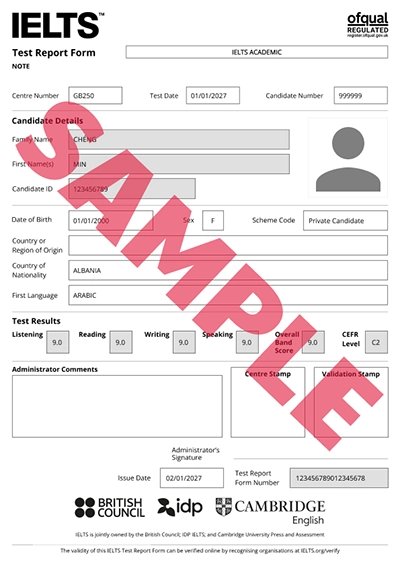
Test Report Form (TRF) The official score certificate issued by IELTS after a test. It shows individual section scores and the overall band score. The TRF is the document submitted to universities, immigration authorities, or employers. It is valid for two years from the test date.
True/False/Not Given A question type in IELTS Reading that appears in factual, non-opinion-based passages. True means the passage confirms the statement, False means the passage directly contradicts it, and Not Given means the passage does not address it at all.
Yes/No/Not Given A variation of True/False/Not Given used specifically with opinion-based passages in IELTS Reading. Yes means the writer’s views agree with the statement, No means the writer’s views contradict it, and Not Given means the writer has not expressed any view on the matter.
Glossary compiled for educational purposes. All definitions reflect current IELTS official testing standards.