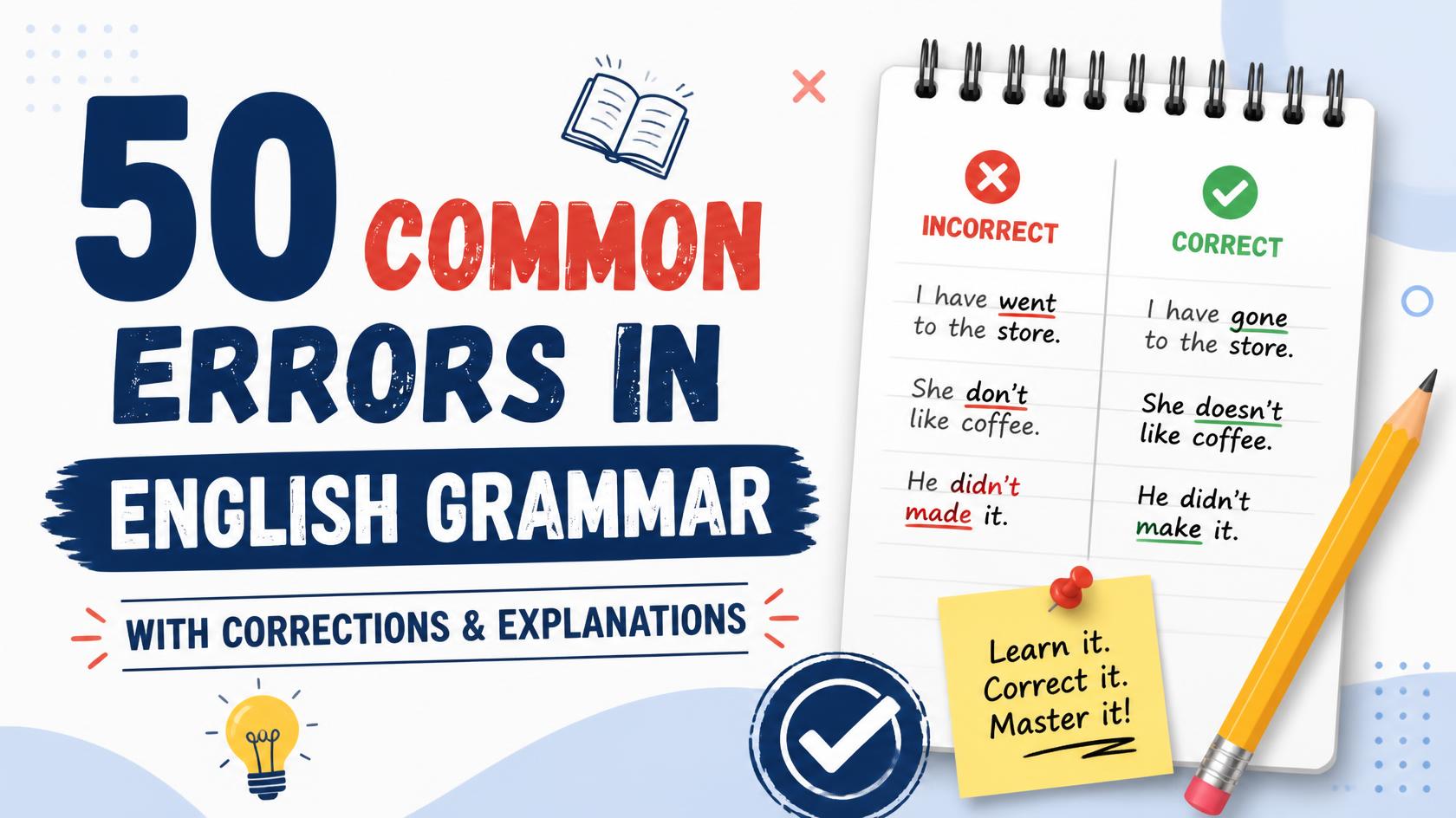
English Grammar errors are not always obvious. That is what makes them dangerous. A student who writes “She is more better than him” may not hear anything wrong with it. A teacher who says “Please revert to my email” is unaware that the word is being misused entirely.
Common errors in English grammar tend to cluster around a handful of predictable problem areas: tenses, articles, prepositions, subject-verb agreement, and word choice. Once you recognize those patterns, most mistakes become avoidable.
This guide covers 50 of the most frequent grammatical errors in English — each one shown with the incorrect form, the correct form, and a clear explanation of why the mistake happens and how to avoid it. There is also a short teaching method section at the end for educators and self-learners.
Quick Answer
The most common errors in English grammar include incorrect tense usage, wrong articles, missing or wrong prepositions, subject-verb disagreement, double negatives, and confused word pairs like fewer/less, who/whom, and its/it’s. Most of these errors come from mother-tongue interference, habit, or simple unfamiliarity with the rule.
Table of Contents
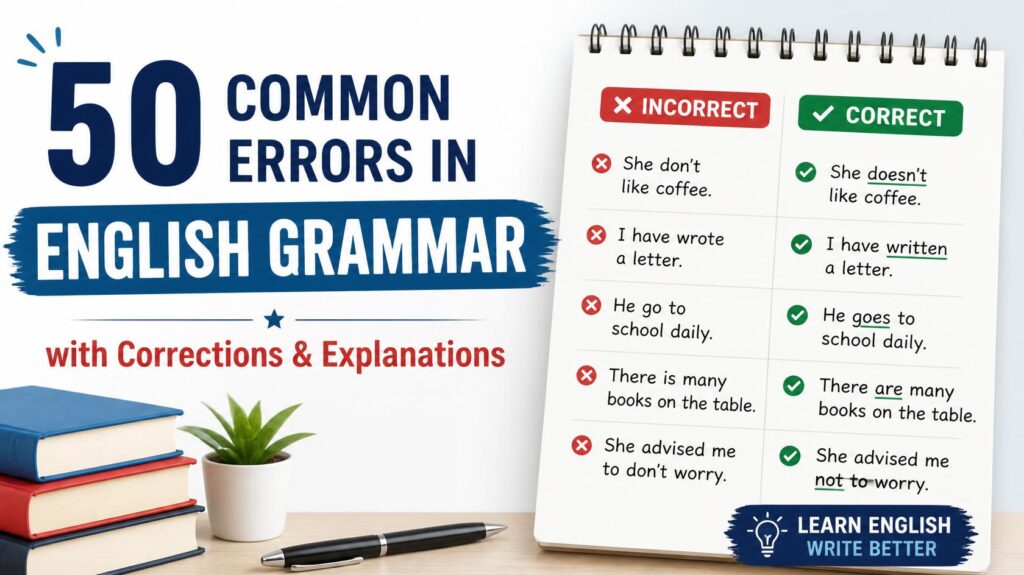
1. English Grammar Common Errors in Articles/ Diterminers (A, An, The)
Articles are small words with outsized consequences. Languages like Hindi, Bangla, and Telugu have no direct equivalent, which means this is one of the most common grammatical trouble spots for Indian learners.
Error 1 ❌ She is engineer. ✅ She is an engineer. Why: Singular countable nouns always need an article. Engineer begins with a vowel sound, so an is correct.
Error 2 ❌ He went to the school to study. ✅ He went to school to study. Why: When school, hospital, church, college, prison are used for their primary purpose (studying, healing, worshipping), no article is used.
Error 3 ❌ She is a honest woman. ✅ She is an honest woman. Why: The H in honest is silent. The word sounds like it starts with a vowel (“on-est”), so an is required — not because of the letter, but because of the sound.
Error 4 ❌ I saw a movie yesterday. Movie was brilliant. ✅ I saw a movie yesterday. The movie was brilliant. Why: Use a when introducing something for the first time, and the from the second mention onward, since both speaker and listener now know which one.
Error 5 ❌ She is the best student in a class. ✅ She is the best student in the class. Why: The class refers to a specific class — the one she belongs to. Use the with superlatives and specific group references.
2. Common Errors in Tenses
Tense errors are among the most penalised mistakes in competitive exams. These errors often come from translating directly from a native language or from not understanding how English marks time.
Error 6 ❌ I am knowing the answer. ✅ I know the answer. Why: Know is a stative verb — it describes a mental state, not an action. Stative verbs (know, understand, believe, love, want) are not used in the continuous form.
Error 7 ❌ She has completed her work yesterday. ✅ She completed her work yesterday. Why: Yesterday is a definite past time marker. The present perfect is used for unspecified past time. With yesterday, last week, in 2020 — use simple past.
Error 8 ❌ He is living in Delhi since 2010. ✅ He has been living in Delhi since 2010. Why: Since signals a continuous action that started in the past and continues now. That requires present perfect continuous, not present continuous.
Error 9 ❌ When she will come, I will tell her. ✅ When she comes, I will tell her. Why: In time clauses beginning with when, before, after, until, do not use will. Use the simple present even when the meaning is future.
Error 10 ❌ I had gone to the market before he arrives. ✅ I had gone to the market before he arrived. Why: Both clauses refer to the past. The earlier event uses past perfect (had gone) and the later event uses simple past (arrived).
Error 11 ❌ She goes to the gym every day and worked out for an hour. ✅ She goes to the gym every day and works out for an hour. Why: When two actions happen regularly in the present, both verbs should be in simple present. Do not shift tenses within a sentence without reason.
Error 12 ❌ I am a student since three years. ✅ I have been a student for three years. Why: For is used with a duration; since is used with a starting point. And have been (present perfect) is needed for a state that continues into the present.
3. Most Common Grammar Errors in Subject-Verb Agreement
The verb must agree with its subject in number — not with the nearest noun, not with a phrase in between.
Error 13 ❌ The quality of the mangoes are good. ✅ The quality of the mangoes is good. Why: The subject is quality (singular), not mangoes. The prepositional phrase of the mangoes does not change the subject.
Error 14 ❌ Neither the students nor the teacher were present. ✅ Neither the students nor the teacher was present. Why: With neither…nor and either…or, the verb agrees with the subject closest to it. The closest subject here is teacher (singular), so use was.
Error 15 ❌ Each of the boys have a book. ✅ Each of the boys has a book. Why: Each, every, either, neither, none are always singular and take a singular verb, regardless of what follows.
Error 16 ❌ The news are shocking. ✅ The news is shocking. Why: News looks plural but is grammatically singular. So is mathematics, physics, economics, politics, ethics — all take singular verbs.
Error 17 ❌ Two miles are a long distance. ✅ Two miles is a long distance. Why: When a number + plural noun represents a single quantity (distance, money, time, weight), treat it as singular.
4. Common English Grammar Errors in Prepositions
Prepositions rarely translate word-for-word between languages, which makes them one of the trickiest areas for non-native speakers.
Error 18 ❌ She is married with a doctor. ✅ She is married to a doctor. Why: Married to is the correct collocation. Married with is a direct translation error common in Indian English.
Error 19 ❌ I will meet you on Monday morning. ✅ I will meet you on Monday morning. (correct) But: ❌ I will meet you in Monday. ✅ I will meet you on Monday. Why: Use on with specific days and dates. Use in with months, years, seasons, and times of day. Use at with clock times and specific moments.
Error 20 ❌ She is good in mathematics. ✅ She is good at mathematics. Why: Good at is the standard collocation when describing skill or ability. Good in is not standard English.
Error 21 ❌ He is suffering with fever. ✅ He is suffering from fever. Why: Suffer from is the correct preposition when talking about illness, disability, or an unpleasant condition.
Error 22 ❌ Please inform to me when you arrive. ✅ Please inform me when you arrive. Why: Inform is a transitive verb that takes a direct object — no preposition is needed between the verb and the person being informed.
Error 23 ❌ She entered into the room. ✅ She entered the room. Why: Enter already implies movement inside, so into is redundant. This is a very common over-translation error.
5. Common Grammar Errors in Pronouns
Error 24 ❌ Everyone must submit their assignments before they leave. ✅ Everyone must submit their assignment before they leave. (now widely accepted) Older rule says: Everyone must submit his or her assignment before he or she leaves. Note: The plural they for singular everyone is increasingly accepted in standard English. Both are acceptable depending on the context and style guide being used.
Error 25 ❌ It is me who solved the problem. ✅ It is I who solved the problem. (formal/written) Note: In spoken informal English, It is me is commonly accepted. In formal writing and exams, It is I follows traditional grammar rules.
Error 26 ❌ Between you and I, this is a mistake. ✅ Between you and me, this is a mistake. Why: Between is a preposition, and prepositions always take object pronouns — me, him, her, us, them — not subject pronouns (I, he, she, we, they).
Error 27 ❌ The book belongs to her’s. ✅ The book belongs to her. Why: Her alone functions as a possessive pronoun in this position. Her’s is not a word in standard English.
6. Common Grammar Errors with Nouns (Countable / Uncountable)
Error 28 ❌ She gave me an advice. ✅ She gave me advice / a piece of advice. Why: Advice is uncountable — it cannot be preceded by a/an or made plural. Use a piece of advice to refer to a single item.
Error 29 ❌ He has very little knowledges about science. ✅ He has very little knowledge about science. Why: Knowledge, information, furniture, luggage, equipment, research are uncountable and have no plural form.
Error 30 ❌ I have many works to do today. ✅ I have a lot of work to do today. Why: Work in the sense of tasks is uncountable. Works is only used in specific contexts: the complete works of Shakespeare, public works.
7. Common Grammar Errors in Adjectives and Adverbs
Error 31 ❌ She is more better than him. ✅ She is better than him. Why: Better is already the comparative form of good. Adding more creates a double comparative, which is grammatically incorrect.
Error 32 ❌ He runs fastly. ✅ He runs fast. Why: Fast is both an adjective and an adverb — no -ly ending is added. The same applies to hard, early, late, high, low.
Error 33 ❌ She speaks English good. ✅ She speaks English well. Why: Good is an adjective (modifies nouns). Well is the adverb (modifies verbs like speaks). This is one of the most common everyday errors.
Error 34 ❌ He is the most oldest player on the team. ✅ He is the oldest player on the team. Why: Oldest is already the superlative of old. Never add most to a word already in superlative form.
8. Common Grammar Errors in Conjunctions and Sentence Structure
Error 35 ❌ Although she studied hard, but she failed. ✅ Although she studied hard, she failed. OR: She studied hard, but she failed. Why: Although and but are both contrast connectors — using both in the same sentence creates a double connector error. Use one, not both.
Error 36 ❌ Despite of the rain, they played. ✅ Despite the rain, they played. OR: In spite of the rain, they played. Why: Despite is never followed by of. It is in spite of, not despite of. This is an extremely common exam error.
Error 37 ❌ I know that where she lives. ✅ I know where she lives. Why: Do not use that and a question word (where, when, why, how) together. Choose one.
Error 38 ❌ Not only he came late, but also he forgot the documents. ✅ Not only did he come late, but he also forgot the documents. Why: When not only begins a sentence, inversion is required: auxiliary + subject + verb.
9. Commonly Confused Word Pairs
These errors are extremely common in writing, especially under exam conditions.
Error 39 — Less vs. Fewer ❌ There are less students in the class today. ✅ There are fewer students in the class today. Rule: Use fewer for countable nouns; use less for uncountable nouns. Students can be counted → fewer.
Error 40 — Its vs. It’s ❌ The dog wagged it’s tail. ✅ The dog wagged its tail. Rule: It’s = it is (contraction). Its = possessive (belonging to it). No apostrophe for possessive its.
Error 41 — Affect vs. Effect ❌ The rain effected our plans badly. ✅ The rain affected our plans badly. Rule: Affect is usually a verb (to influence). Effect is usually a noun (the result). When in doubt, try replacing it with “influenced” — if that works, use affect.
Error 42 — Lay vs. Lie ❌ I need to lay down for a while. ✅ I need to lie down for a while. Rule: Lie (intransitive) means to recline — it takes no object. Lay (transitive) means to place something — it needs an object: She laid the book on the table.
Error 43 — Revert vs. Reply ❌ Please revert to my email at the earliest. ✅ Please reply to my email at the earliest. Rule: Revert means to return to a previous state, not to respond to a message. This misuse is especially common in Indian business English.
Error 44 — Bring vs. Take ❌ Can you bring this letter to the office? ✅ Can you take this letter to the office? Rule: Bring implies movement toward the speaker. Take implies movement away from the speaker. If the person is not at the office, you take the letter there, not bring it.
Error 45 — Between vs. Among ❌ Distribute the books between the five students. ✅ Distribute the books among the five students. Rule: Between is used for two items or people. Among is used for three or more.
10. Common Grammar Errors in Punctuation and Writing
Error 46 ❌ The teacher said, the class is dismissed. ✅ The teacher said that the class was dismissed. OR: The teacher said, “The class is dismissed.” Why: Indirect speech does not use a comma before the content. If reporting speech, use that and shift tense. If quoting directly, use quotation marks.
Error 47 ❌ However it is true, we must accept it. ✅ However, it is true; we must accept it. OR: It is true; we must accept it. Why: However as a connector needs a semicolon before it or a period before the new clause. A comma alone is insufficient (comma splice).
Error 48 ❌ She plays tennis she also plays badminton. ✅ She plays tennis**,** and she also plays badminton. OR: She plays tennis**;** she also plays badminton. Why: Joining two independent clauses with no punctuation or connector creates a run-on sentence.
Error 49 — Redundant Expressions ❌ Please revert back. ❌ We need to end the meeting at its conclusion. ❌ He is a new beginner. ✅ Please revert. / Please reply. ✅ We need to end the meeting. ✅ He is a beginner. Why: Words like back, new, future are often added unnecessarily when the meaning is already contained in the main word.
Error 50 — Dangling Modifier ❌ Walking down the street, the trees looked beautiful. ✅ Walking down the street, I noticed the trees looked beautiful. Why: The introductory phrase walking down the street must refer to the subject of the main clause. Trees cannot walk. This error is called a dangling modifier.
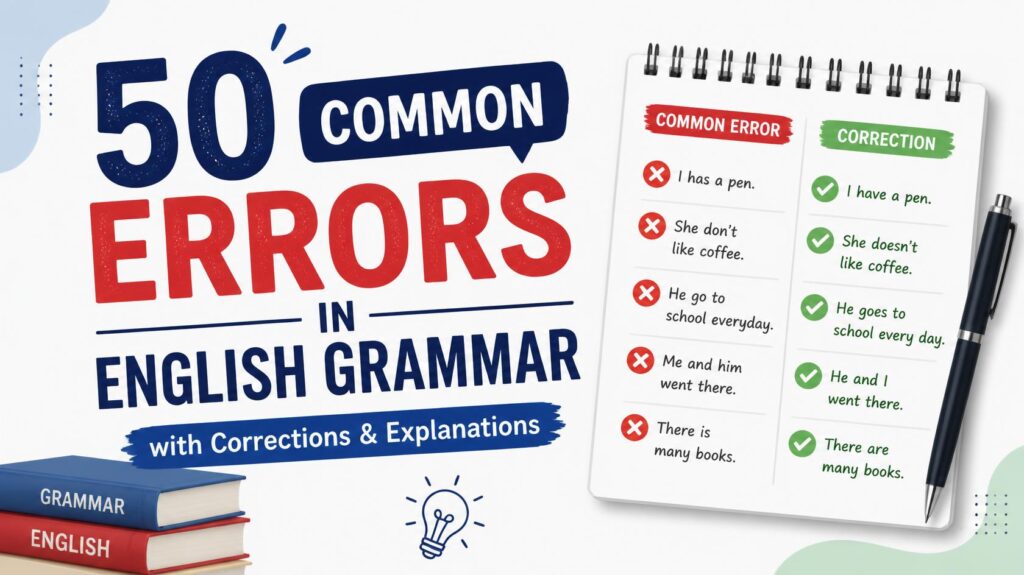
A Teaching Method That Actually Fixes These Grammar Errors
Most grammar drills fail because they treat errors as isolated problems. A student corrects a sentence in an exercise and promptly repeats the same mistake in their next essay, because drilling exercises do not build the habit of self-monitoring.
A more effective approach works in three stages:
Stage 1: Exposure with attention Do not simply give students lists of rules. Show them real sentences — their own writing, authentic texts, news reports — and ask them to find what seems off. When students develop the habit of reading critically, they start catching errors on their own.
Stage 2: Pattern recognition, not rule memorization Group errors by type (preposition errors, article errors, tense shifts). Ask students to collect examples of the same error type from different sources. Seeing ten examples of the same mistake builds stronger pattern recognition than memorizing a rule once.
Stage 3: Self-editing before submission Teach students to read their own work backward — starting from the last sentence. This breaks the natural tendency to read what you intended to write rather than what is actually on the page. A short error checklist (5–7 key items they frequently get wrong) works better than a general grammar review.
This three-stage method — exposure, pattern recognition, and self-editing — shifts grammar from something students perform in exercises to something they monitor in their own language use.
Practice Exercise: Spot the Error
Each sentence below contains one grammatical error. Identify it and write the correction.
- The committee have decided to postpone the meeting.
- Neither the principal nor the teachers was available.
- She is working in this company since five years.
- Despite of his wealth, he is not happy.
- He plays cricket good.
- I have less problems than before.
- Please inform to the manager about the change.
- Although she tried hard, but she could not succeed.
- He is the most tallest player in the team.
- Walking through the park, the flowers smelled wonderful.
Answers:
- have → has (committee is a collective noun, treated as singular)
- was → were (with neither…nor, the verb agrees with the closer subject — teachers, plural)
- is working → has been working (duration since a past point → present perfect continuous)
- Despite of → Despite (never despite of)
- good → well (well is the adverb form)
- less → fewer (problems is countable)
- inform to → inform (no preposition needed)
- Remove but — although and but cannot both appear (double connector)
- most tallest → tallest (double superlative error)
- Add a proper subject — the flowers could not walk. Rewrite: Walking through the park, I noticed the flowers smelled wonderful.
Key Takeaways
Most grammatical errors fall into a small number of recurring categories: articles, tenses, prepositions, agreement, and word choice.
Understanding WHY an error occurs is more valuable than just memorizing the correction.
For Indian learners, mother-tongue interference — especially with articles and prepositions — is the primary driver of recurring mistakes.
Exam-critical errors to prioritize: subject-verb agreement, tense selection, double connectors (although…but, despite of), and uncountable noun misuse.
Self-editing is a learnable skill. A consistent personal checklist reduces repeated errors more effectively than general revision.
Glossary
Key grammatical terms used in this article, with plain-English definitions:
Stative Verb A verb that describes a state of mind, emotion, or condition rather than an action. Examples include know, believe, understand, love, want, prefer, seem. These verbs are not normally used in continuous tenses (I am knowing → wrong; I know → correct).
Double Comparative / Double Superlative Using two comparative or superlative markers together. For example: more better (comparative of good is already better) or most tallest (superlative of tall is already tallest). Both are grammatically incorrect.
Dangling Modifier A word or phrase that modifies a word not clearly stated in the sentence. Usually appears when an introductory participial phrase refers to the wrong subject: Running down the street, the bus was missed by me. The bus was not running — the person was.
Comma Splice The error of joining two independent clauses with only a comma, without a coordinating conjunction. Example: She studied all night, she still failed. Correct with a semicolon, a conjunction, or a period.
Double Connector Using two conjunctions or connectors where only one is needed. Common examples in Indian English: Although…but, Because…so, Despite of… — each pair has one too many connectors.
Mother-Tongue Interference (MTI) Errors that occur because a learner applies the grammatical rules or patterns of their first language when using English. Article errors and preposition errors in Indian English frequently result from MTI, since many Indian languages have no articles and use different prepositional logic.
Collocations Fixed word combinations that sound natural to native speakers. Grammar rules alone will not tell you to say make a decision rather than do a decision — that is a collocation. Getting prepositions right often comes down to learning which preposition collocates with a specific word: good at, married to, suffer from.
Run-On Sentence A sentence where two or more independent clauses are incorrectly joined without adequate punctuation or a connecting word. Example: I woke up early I went for a walk. This needs either a conjunction, a semicolon, or a period.
Internal Links from Lingua Litera
- Articles in English: A, An, and The Explained — deepens the article usage rules introduced here
- The 12 Tenses in English Grammar: A Complete Structural and Conceptual Guide — provides a full tense-by-tense breakdown
- Subject-Verb Agreement: 20 Advanced Rules Every Exam Aspirant Must Know — directly relevant for competitive exam preparation
- Spoken English for Business Communication: The Complete Professional Guide — applies these error-correction skills to real professional communication
- 100 Modern C1 Vocabulary Words You Should Use Every Day — for learners ready to move beyond error correction into active vocabulary growth
Frequently Asked Questions
What are the most common errors in English grammar?
The most frequent errors are in three areas: article usage (a/an/the and zero article), tense selection (especially present perfect vs. simple past), and subject-verb agreement. Preposition errors and confused word pairs like affect/effect, fewer/less, and its/it’s are also extremely common across all levels of learners.
Why do Indian students make more article and preposition errors than other learners?
Most major Indian languages — Hindi, Bengali, Tamil, Telugu, Marathi — have no article system and handle spatial relationships differently from English prepositions. When learners translate from these languages, they carry those structural gaps into English. This is called mother-tongue interference, and it is the primary cause of recurring article and preposition errors in Indian English.
How can I correct my grammar mistakes faster?
The most effective approach is not to drill exercises repeatedly. Instead, keep a personal error log — a notebook or document where you record each mistake you make, the correction, and a brief note on why. Reviewing this weekly is far more effective than generic grammar practice because it targets your specific weak areas.
What is a double connector error, and why is it so common in exams?
A double connector error occurs when two linking words that perform the same function appear in the same sentence. The classic example is Although she studied hard, but she failed. Both although and but signal contrast — using them together is redundant and incorrect. This is a high-frequency error in CBSE, ICSE, and SSC exams, so identifying and eliminating it can directly improve exam scores.
Is “they” acceptable as a singular pronoun in formal writing?
This has changed in recent years. The singular they (for everyone, someone, anyone, each person) is now accepted by major style guides including the APA, Chicago Manual of Style, and Merriam-Webster. In formal academic writing, he or she or restructuring the sentence is still preferred by some institutions. For Indian competitive exams, follow the pattern required by your specific exam board’s answer key.
What is a dangling modifier? How do I identify one?
A dangling modifier is an introductory phrase whose implied subject does not match the actual subject of the main clause. Test it by asking: who or what is performing the action in the opening phrase? If the answer is not the subject of the main clause, the modifier is dangling. Example: Being a student, the rules must be followed — rules are not students. Correct: Being a student, I must follow the rules.
Are grammar errors really that important in everyday communication?
In casual spoken conversation, most native speakers tolerate and even make grammatical errors. But in written English — emails, essays, official documents, exams, and professional communication — errors reduce credibility and clarity. For students, errors in competitive exams directly affect scores. The goal is not perfect grammar in every sentence, but awareness of recurring errors and the ability to self-correct in formal contexts.
Conclusion
Grammar is not about following rules for their own sake. It is about being understood — precisely, clearly, and confidently.
These 50 errors cover the patterns that come up again and again in student writing, exam papers, professional emails, and everyday speech. Fixing them is not about memorizing rules on a list. It is about developing the habit of noticing — reading carefully, writing critically, and building an instinct for what sounds right.
If you took the practice exercise above, you already know which categories need the most attention. Start there. Focus on one error type at a time. Return to this guide as a reference when you are unsure.
That is how the most common errors in English grammar become less common in your own writing.
External Reference Suggestions
- Cambridge Dictionary — Grammar section: dictionary.cambridge.org/grammar — authoritative reference for rules and usage
- Oxford English Grammar (Greenbaum, Oxford University Press) — comprehensive academic reference
- Common Errors in Everyday English by Saumya Sharma (Oxford University Press India): india.oup.com — highly relevant for Indian learners, peer-reviewed publisher
- Purdue OWL — Grammar and Mechanics: owl.purdue.edu — reliable university-level grammar guidance
- Common Errors in English Usage (Washington State University): brians.wsu.edu — practical, frequently referenced usage guide