Every sentence you write contains at least one. Without it, you have no sentence at all. A clause is the fundamental unit of English grammar, and yet it is one of those topics that students read about, think they understand, and then immediately misidentify on an exam.
Clauses in English grammar are not difficult once the logic behind them becomes clear. The confusion usually comes from two things: not knowing what to look for, and not understanding why the distinction matters in real writing.
This guide builds your understanding from the ground up. It covers what a clause is, how to identify one, all the major types with worked examples, how clauses build complex sentences, and exercises you can use to test yourself immediately.
Quick Answer
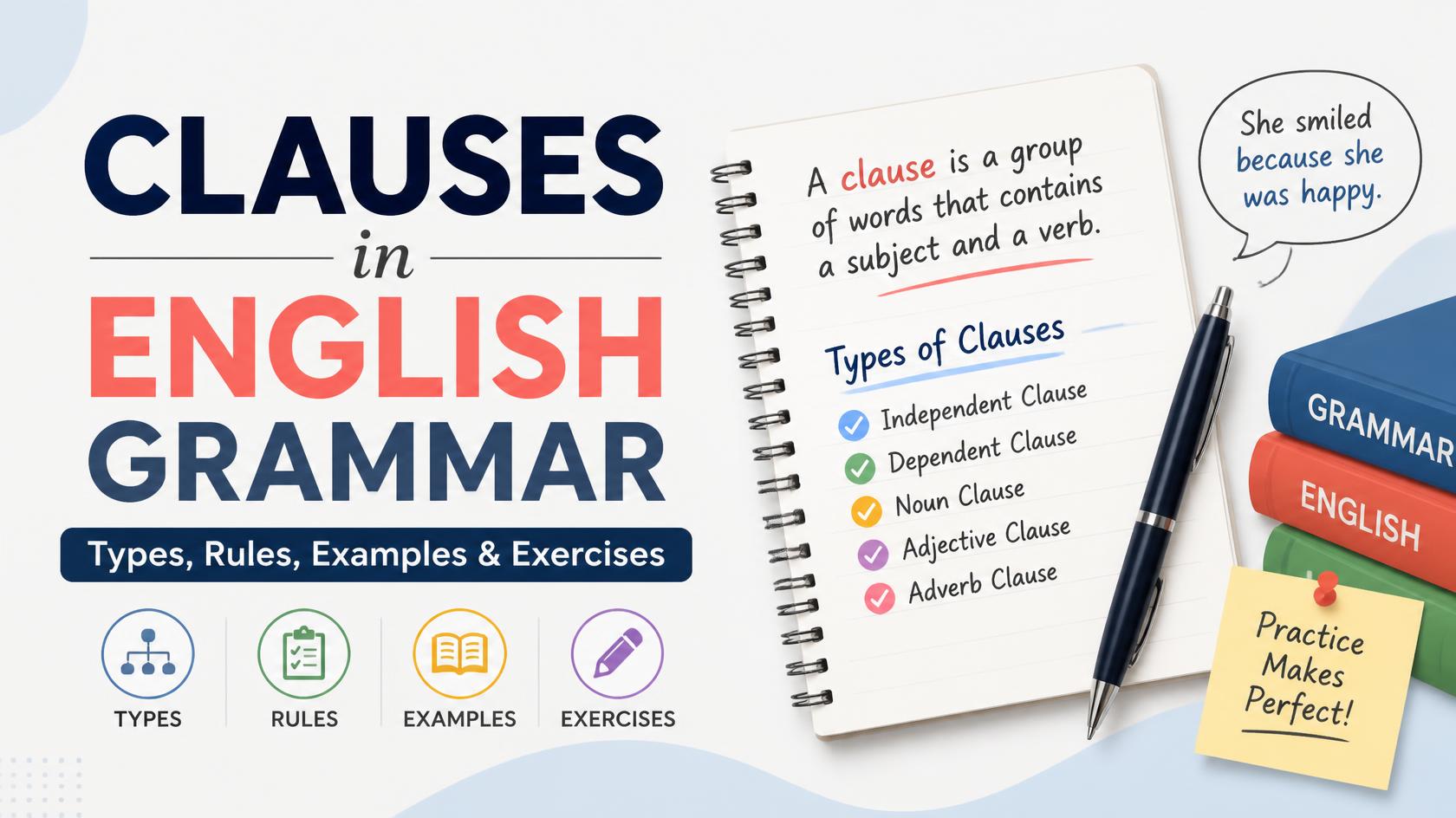
What is a clause in English grammar? A clause is a group of words that contains both a subject and a finite verb. It either forms a complete sentence by itself (independent clause) or forms part of a sentence with the support of another clause (dependent or subordinate clause). Every sentence is made up of at least one clause.
Table of Contents
What Is a Clause?
The classic definition from Wren and Martin, still used in Indian school curricula, puts it plainly:
“A clause is a group of words which forms part of a sentence and contains a subject and a predicate.”
That is accurate, but it does not tell you why it matters or how to use it. Here is a more practical way to understand it.
A clause is a unit of meaning built around a verb. Where there is a working verb with a subject doing something, there is a clause.
Look at this sentence:
“She left the room because she was angry.”
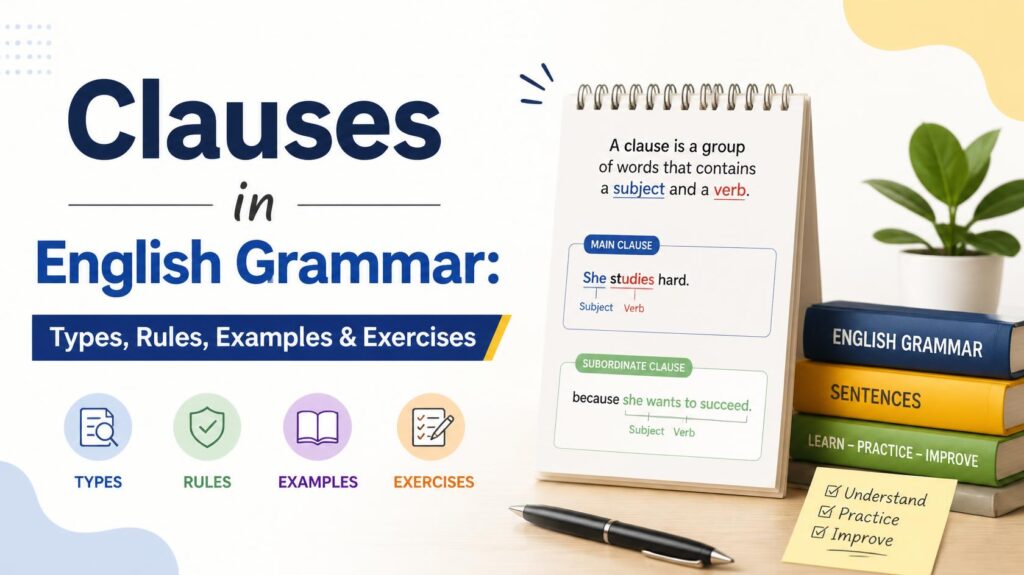
There are two verbs here: left and was. Each verb has a subject: she and she. That means there are two clauses in this one sentence. The first one (She left the room) makes sense alone. The second (because she was angry) adds a reason but cannot stand as a complete sentence on its own.
That distinction — can it stand alone, or does it need support? — is at the heart of everything that follows.
Clause vs. Phrase: The Distinction That Trips Everyone Up
Students frequently confuse clauses with phrases. The difference is actually straightforward once you see it.
| Feature | Clause | Phrase |
|---|---|---|
| Has a subject | Yes | Not necessarily |
| Has a finite verb | Yes | No finite verb |
| Can be a sentence | Sometimes (independent) | Never on its own |
| Example | when she arrived | in the morning |
| Example | because he was tired | after a long day |
A phrase is a group of words that functions as a unit but lacks either a subject or a finite verb (or both).
“At midnight” — no subject, no verb. That is a phrase. “When she arrived at midnight” — has a subject (she) and a verb (arrived). That is a clause.
If you can find a subject and a working verb together, you have a clause. If either is missing, you have a phrase.
Types of Clauses in English Grammar
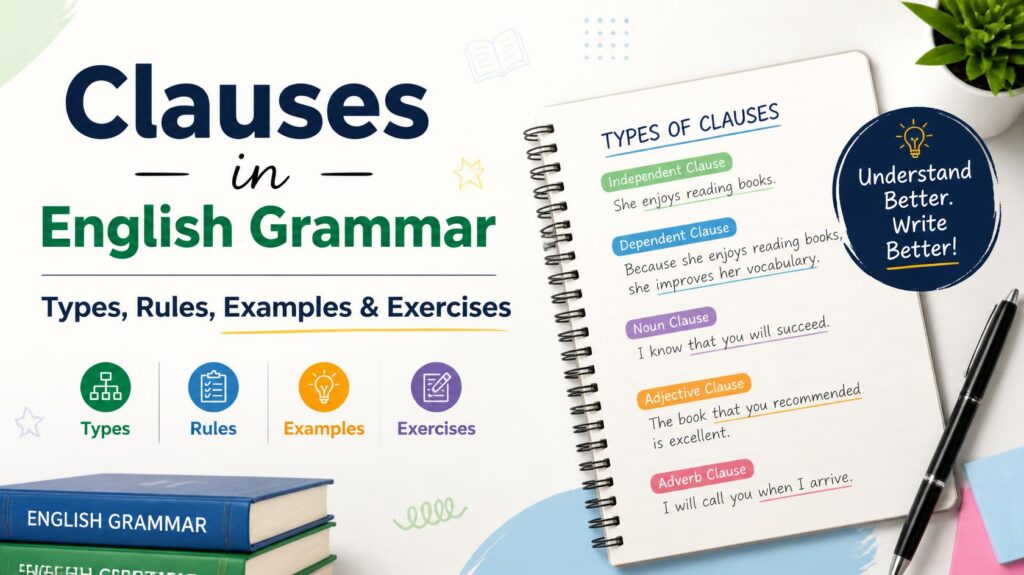
Clauses are classified in two major ways:
By independence:
- Independent (Main) Clause
- Dependent (Subordinate) Clause
By function (for dependent clauses):
- Noun Clause
- Adjective (Relative) Clause
- Adverb Clause
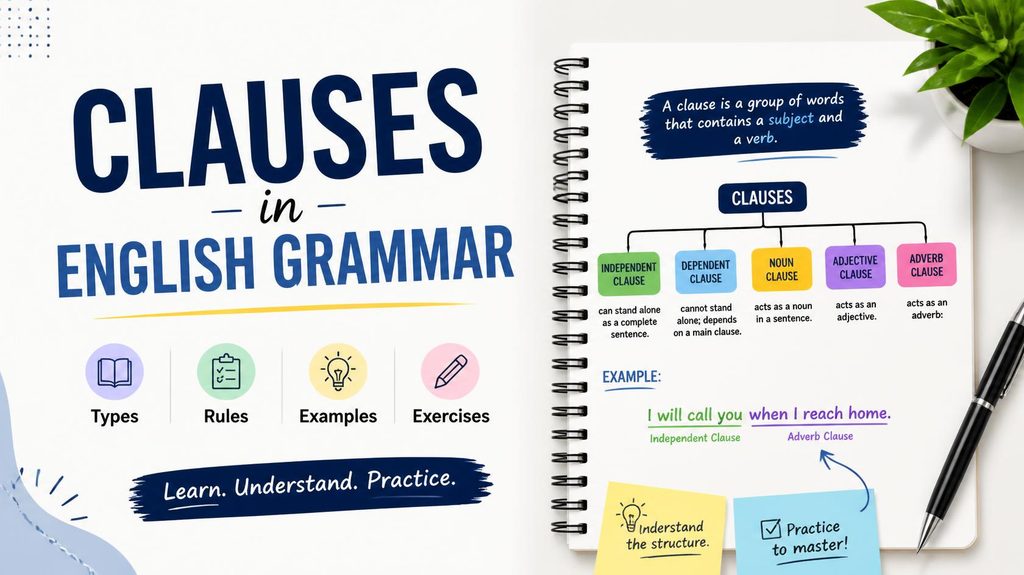
These two systems work together. A dependent clause is always either a noun clause, an adjective clause, or an adverb clause, depending on what job it does in the sentence.
Independent Clause
An independent clause contains a subject and a finite verb and expresses a complete thought. It can stand alone as a sentence.
Examples:
- The teacher explained the lesson.
- Riya passed her exam.
- He does not speak Hindi at work.
Each of these is grammatically complete. Nothing is left unsaid. These are independent clauses.
Two independent clauses can be joined with a coordinating conjunction (and, but, or, so, yet, for, nor) to form a compound sentence:
- She studied all night, and she passed the exam.
- He wanted to help, but he didn’t know what to do.
The key test: Remove the clause from the sentence. Does it still make complete sense? If yes, it is independent.
Dependent (Subordinate) Clause
A dependent clause has a subject and a verb, but it does not express a complete thought. It depends on an independent clause to make sense.
Dependent clauses usually begin with one of the following:
- Subordinating conjunctions: because, although, when, while, if, since, unless, after, before, until, though
- Relative pronouns: who, whom, whose, which, that
- Question words used as connectors: what, where, when, how, why, whether
Examples:
- because she was exhausted — Why? What happened? It needs more context.
- although he tried his best — And then what?
- who lives next door — Who lives next door did what?
None of these is a complete thought. Each depends on an independent clause to complete its meaning.
“She went to bed early because she was exhausted.”
The underlined part is the dependent clause. Remove it and the sentence still works. But the dependent clause alone means nothing without the rest.
Noun Clause
A noun clause is a dependent clause that functions as a noun in the sentence. It can act as a subject, object, or complement, just as a single noun word would.
Noun clauses most commonly begin with: that, what, where, when, why, how, whether, whoever, whatever
As a Subject:
- What she said surprised everyone. (Compare: Her words surprised everyone. The clause replaces the noun.)
As an Object:
- I know that he is lying.
- She asked where the library was.
As a Subject Complement:
- The problem is that no one informed us.
Helpful Test: Replace the clause with the word something or the fact. If the sentence still makes grammatical sense, the clause is functioning as a noun.
- I know that he is lying. → I know something. ✔ Noun clause confirmed.
Common Student Error:
✗ I know where is the station. ✔ I know where the station is.
In noun clauses following question words, the word order follows statement order, not question order. This is one of the most common mistakes in Indian secondary school English exams.
Adjective (Relative) Clause
An adjective clause (also called a relative clause) is a dependent clause that describes or modifies a noun or pronoun. It does the job of an adjective.
Adjective clauses begin with relative pronouns: who, whom, whose, which, that
Examples:
- The student who topped the exam is my cousin. (Which student? The one who topped the exam.)
- The book that I borrowed was excellent. (Which book? The one I borrowed.)
- She met a teacher whose students had won the competition. (Which teacher? The one whose students had won.)
Helpful Test: Ask which one? or what kind? about the noun. The clause that answers that question is your adjective clause.
Defining vs. Non-Defining Relative Clauses
This distinction appears in CBSE, ICSE, and competitive exams.
| Type | What it does | Commas? | Example |
|---|---|---|---|
| Defining | Identifies the noun; the sentence changes meaning without it | No commas | The man who called you is here. |
| Non-defining | Adds extra information; the sentence still works without it | Uses commas | My father, who is a doctor, lives in Kolkata. |
In the defining example, removing the clause (The man is here) loses the identification. In the non-defining example, removing the clause (My father lives in Kolkata) still works fine.
Common Student Error:
✗ She is the teacher, who taught me English. (No comma needed — defining clause.) ✔ She is the teacher who taught me English.
Adverb Clause
An adverb clause is a dependent clause that functions like an adverb. It modifies a verb, adjective, or another adverb, and answers questions like: When? Why? How? Under what condition? Despite what?
Adverb clauses always begin with a subordinating conjunction.
Types of Adverb Clauses
| Type | Conjunction Used | Example |
|---|---|---|
| Time | when, while, after, before, until, as soon as | Call me when you arrive. |
| Reason/Cause | because, since, as | She cried because she lost the game. |
| Condition | if, unless, provided that | If it rains, we will stay inside. |
| Concession | although, though, even though | Although he practiced hard, he didn’t win. |
| Purpose | so that, in order that | She saved money so that she could travel. |
| Result | so…that, such…that | He spoke so quietly that no one heard him. |
| Comparison | than, as…as | She works harder than I do. |
| Place | where, wherever | You can sit wherever you like. |
| Manner | as, as if, as though | She smiled as if she knew something. |
Helpful Test: Ask one of the adverb questions (when, why, how, under what condition) about the main verb. The clause that answers it is your adverb clause.
“She left before the meeting ended.” When did she leave? Before the meeting ended. That answers when, so it is an adverb clause of time.
How Clauses Build Sentences: Simple, Compound, Complex
Understanding clause types also unlocks the logic behind sentence structure.
| Sentence Type | Structure | Example |
|---|---|---|
| Simple | One independent clause | She sings. |
| Compound | Two or more independent clauses joined by a coordinating conjunction | She sings and he dances. |
| Complex | One independent clause + one or more dependent clauses | She sings because she loves music. |
| Compound-Complex | Two+ independent clauses + one+ dependent clause | She sings and he dances, although neither of them trained formally. |
Knowing clause types helps you write more varied, controlled sentences. Most exam writing that sounds flat uses simple sentences or incorrectly punctuated compound sentences. Learning to embed dependent clauses well is one of the fastest ways to improve written expression.
Common Mistakes Students Make with Clauses
Mistake 1: Treating a dependent clause as a complete sentence
✗ Although she worked hard. She didn’t pass. ✔ Although she worked hard, she didn’t pass.
A dependent clause cannot stand alone as a sentence. When it does, it is called a fragment — a common error in both exam writing and everyday writing.
Mistake 2: Wrong word order in noun clauses
✗ I don’t know where is the hospital. ✔ I don’t know where the hospital is.
After question words functioning as connectors in noun clauses, use statement word order: subject first, then verb.
Mistake 3: Using “which” for people
✗ The man which called is waiting. ✔ The man who called is waiting.
Use who or whom for people, which for things, and that for either (in defining clauses).
Mistake 4: Comma placement with relative clauses
✗ My sister, who studies medicine is very hardworking. (missing second comma) ✔ My sister, who studies medicine, is very hardworking.
Non-defining relative clauses are enclosed in commas on both sides.
Mistake 5: Confusing “since” as time vs. reason
Since she left the company, things have changed. — Time clause. Since you are here, let’s begin. — Reason clause.
Both are adverb clauses, but the conjunction serves different purposes. Context determines meaning.
Exam Tips
For CBSE and ICSE Grammar Papers:
- In sentence transformation questions, identifying the clause type tells you exactly what kind of connector to use when combining sentences.
- In error spotting, wrong word order in noun clauses and comma errors in relative clauses appear frequently.
- In passage-based comprehension, adjective clauses help you understand which noun is being described.
For Competitive Exams (SSC, UPSC, Banking):
- Clause identification appears in fill-in-the-blanks (choosing the correct conjunction), error spotting, and sentence improvement.
- Adverb clauses of condition (if, unless, provided that) and concession (although, though, even though) appear regularly in sentence correction sections.
- A solid grasp of noun clauses helps in reported speech questions, since all reported statements and questions become noun clauses.
Quick Exam Identification Method:
- Find all the verbs in the sentence.
- For each verb, find its subject.
- Each subject-verb pair = one clause.
- Ask: can this clause stand alone? Independent or dependent?
- If dependent: what question does it answer about the main clause? That tells you the type.
Practice Exercises with Answers
Exercise 1: Identify the Clause Type
Identify the underlined clause as: noun clause / adjective clause / adverb clause / independent clause.
- She didn’t come because she was unwell.
- What you said hurt him deeply.
- The boy who sits in the front row is very attentive.
- Although it was raining, they continued playing.
- He promised that he would return soon.
Answers:
- Adverb clause (reason — answers why?)
- Noun clause (subject of the sentence)
- Adjective clause (modifies the boy — answers which boy?)
- Adverb clause (concession — answers under what condition?)
- Noun clause (object of promised)
Exercise 2: Correct the Error
Each sentence has one error related to clause structure. Rewrite it correctly.
- I want to know where does she live.
- The woman which helped me was very kind.
- Because he was late. The meeting had already started.
- My brother who is a lawyer lives in Mumbai.
- She spoke so fast that we couldn’t understood her.
Answers:
- I want to know where she lives. (Statement order in noun clause)
- The woman who helped me was very kind. (who for people)
- Because he was late, the meeting had already started. (Fragment corrected by attaching to main clause)
- My brother, who is a lawyer, lives in Mumbai. (Non-defining clause needs commas)
- She spoke so fast that we couldn’t understand her. (couldn’t already marks past; bare infinitive follows)
Exercise 3: Combine the Sentences
Combine each pair of sentences using the conjunction given.
- She felt tired. She went to bed early. (so)
- He worked all night. He finished the project. (until)
- This is the book. I was telling you about it. (that)
- She studied hard. She wanted to score well. (so that)
- He did not know the answer. He raised his hand. (although)
Answers:
- She felt tired, so she went to bed early.
- He worked all night until he finished the project.
- This is the book that I was telling you about.
- She studied hard so that she could score well.
- Although he did not know the answer, he raised his hand.
Key Takeaways
Every clause has a subject and a finite verb. If either is missing, it is a phrase, not a clause.
Independent clauses stand alone. Dependent clauses need an independent clause to complete their meaning.
Dependent clauses do three jobs: they function as nouns, adjectives, or adverbs — and that function is what classifies them.
Wrong word order after question words in noun clauses is one of the most common errors in Indian school exams.
Defining relative clauses have no commas. Non-defining relative clauses are enclosed in commas.
Every adverb clause has a subordinating conjunction that signals its function — time, reason, condition, concession, purpose, result, etc.
Glossary of Key Terms
These terms are standard across English grammar, linguistics, and examination frameworks.
Finite Verb A verb that agrees with the subject in person and number and is marked for tense. She writes and he wrote are finite verbs. Finite verbs are what make a clause a clause. Non-finite verbs (to write, writing, written) do not function as the main predicate of a clause.
Predicate The part of a sentence that says something about the subject. It always includes the finite verb and any objects or complements that follow it. In the clause She finished the report quickly, the predicate is finished the report quickly.
Subordinating Conjunction A conjunction that introduces a dependent (subordinate) clause and connects it to an independent clause, showing a relationship such as time, cause, condition, or concession. Common examples: because, although, when, if, unless, since, while, after, before, until, so that.
Coordinating Conjunction A conjunction that joins two independent clauses (or other grammatically equal elements) of equal status. The seven coordinating conjunctions in English are remembered by the acronym FANBOYS: For, And, Nor, But, Or, Yet, So.
Relative Pronoun A pronoun that introduces a relative (adjective) clause and connects it to the noun it modifies. The main relative pronouns in English are who, whom, whose, which, and that.
Antecedent The noun or pronoun that a relative clause or pronoun refers back to. In The student who won the prize is my classmate, the antecedent of who is student.
Fragment A grammatically incomplete sentence — most commonly a dependent clause punctuated as though it were a complete sentence. “Although he tried.” is a fragment. It is an error in both formal and academic writing.
Clause Embedding The practice of placing one clause inside another, often to add description, qualification, or reason. Skilled writers use clause embedding to create variety and precision. Excessive embedding, however, makes sentences difficult to follow.
Internal Link Suggestions from Lingua Litera
- Subject-Verb Agreement: 20 Advanced Rules Every Exam Aspirant Must Know Why: Understanding subjects and verbs precisely supports clause identification.
- The 12 Tenses in English Grammar: A Complete Structural and Conceptual Guide Why: Tense knowledge is essential for correctly identifying finite verbs in clauses.
- Gerund and Present Participle: The One Grammar Distinction That Changes Everything Why: Both articles deal with how verbs change role in sentence structures.
- How to Crack IELTS: A Real, Section-by-Section Guide to Scoring Band 7 or Higher Why: IELTS writing relies heavily on complex sentence construction using multiple clause types.
- 100 Modern C1 Vocabulary Words You Should Use Every Day Why: Advanced vocabulary + clause complexity together elevate written English quality.
Frequently Asked Questions
What is the difference between a clause and a sentence?
A sentence is a complete unit of meaning, and every sentence contains at least one clause. A simple sentence has one independent clause. A complex sentence has one independent clause and one or more dependent clauses. All sentences are made of clauses, but not all clauses are complete sentences. A dependent clause, for example, is not a sentence on its own.
How many types of clauses are there in English grammar?
Broadly, there are two types: independent (main) clauses and dependent (subordinate) clauses. Dependent clauses are further divided into three functional types: noun clauses, adjective (relative) clauses, and adverb clauses. Most Indian school curricula and competitive exams work within this five-part framework.
How do I identify a noun clause in a sentence?
Look for a clause that begins with that, what, where, when, why, how, whether, whoever, or whatever and functions as the subject, object, or complement of the main verb. A reliable test is to replace the clause with the word something. If the sentence still makes grammatical sense, you likely have a noun clause.
What is the difference between a defining and non-defining relative clause?
A defining relative clause identifies which specific noun you mean, and the sentence loses its precise meaning without it. It takes no commas. A non-defining relative clause adds extra information about a noun already identified, and can be removed without changing the core meaning. It is enclosed in commas on both sides.
Can an adverb clause come at the beginning of a sentence?
Yes, and this is very common. When an adverb clause comes before the main clause, it is followed by a comma: “If it rains, we will cancel the trip.” When the adverb clause comes after the main clause, no comma is usually needed: “We will cancel the trip if it rains.” This rule appears in punctuation sections of many exams.
What is a subordinate clause?
A subordinate clause is another name for a dependent clause. It is “subordinate” because it is lower in rank than the main (independent) clause and depends on it for complete meaning. Every subordinate clause is introduced by a subordinating conjunction or a relative pronoun.
Why does word order change in noun clauses after question words?
In direct questions, English inverts subject and verb: “Where is the hospital?” But in a noun clause, the question word acts as a connector, not as a question starter. Normal statement order is restored: “I don’t know where the hospital is.” This is one of the most tested grammar points in Indian school exams.
How are clauses tested in CBSE and ICSE exams?
Clause topics commonly appear in: sentence transformation (combining sentences using appropriate conjunctions), error correction (fragments, wrong word order, comma errors), gap fills (choosing the right subordinating conjunction), and passage comprehension (understanding complex sentences). A strong grasp of clause types improves performance across all four areas.
Conclusion
Clauses are the engine room of English sentence structure. Everything from a three-word sentence to a twenty-word complex construction depends on the same basic unit: a subject paired with a finite verb, doing a specific job in the sentence.
Once you can identify whether a clause is independent or dependent, and whether a dependent clause is acting as a noun, an adjective, or an adverb, you have a framework for understanding virtually any English sentence ever written.
The exercises in this guide are a starting point. The real skill comes from applying this framework to reading — noticing how clauses work in the texts you study, the passages you read for exams, and the writing you produce yourself.
Clauses in English grammar are not just exam material. They are the tools that give a writer control over meaning, emphasis, and nuance. Learn them well, and your writing improves with every sentence.
External Sources for Further Reference
- Wren & Martin, High School English Grammar and Composition — the standard reference for Indian school grammar; available widely
- Cambridge Grammar of English (Carter & McCarthy) — authoritative descriptive grammar for advanced learners
- British Council LearnEnglish — Relative Clauses: learnenglish.britishcouncil.org
- Purdue OWL — Subordinate Clauses: owl.purdue.edu — free academic writing resource
- Oxford Learner’s Dictionaries: oxfordlearnersdictionaries.com — usage examples with grammatical context