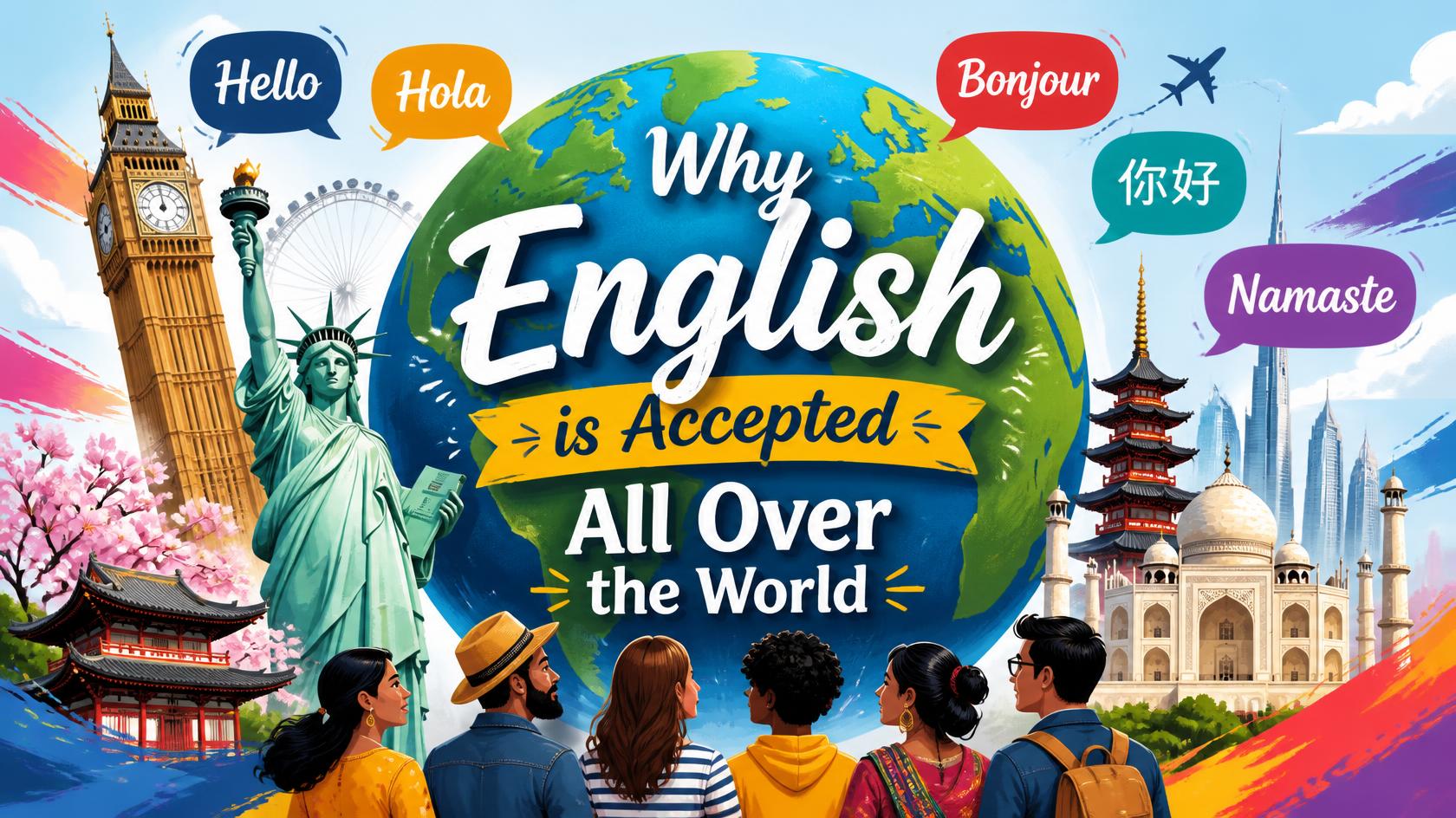
There is something remarkable about English. A fisherman in Kerala, a banker in New York, a tech engineer in Berlin, and a student in Nairobi can all sit in the same room and talk to each other without a translator. That one connecting thread is English.
But why is English accepted all over the world, while languages with more native speakers, like Mandarin or Spanish, have not reached the same universal status? The answer is not luck. It is a long story of empire, economics, technology, culture, and human psychology all working together over centuries.
This article goes beyond the usual surface-level reasons. It looks at how English became the world’s default language, why it keeps that position today, what that means for people in countries like India, the UK, and the USA, and what the honest challenges of this dominance look like.
Table of Contents
What Makes a Language “Global”?
A language becomes global when people who do not share a native tongue choose it as their bridge. It is not about which language has the most native speakers. Mandarin Chinese has far more native speakers than English. What matters is how many people choose a language as their second language for work, education, diplomacy, and connection.
English has achieved something very few languages in history have done. It functions as a living operating system for global communication. You do not need to be British or American to use it. A Japanese professor and a Brazilian doctor publishing joint research will almost certainly write in English, not in each other’s language.
That is the real meaning of a global language. It belongs to no one and everyone at once.
The Historical Roots: How English Spread Across the World
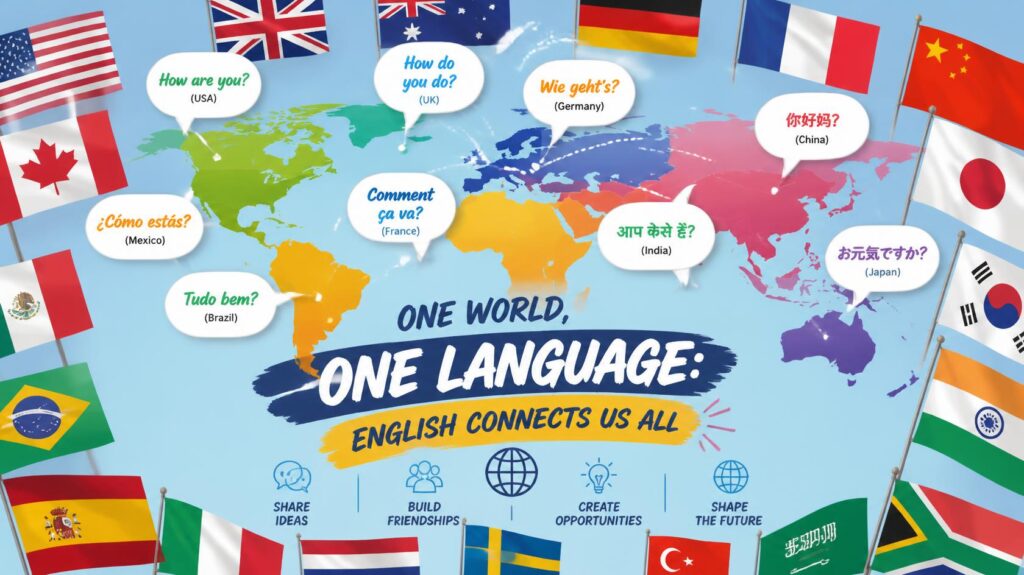
Understanding why English is accepted all over the world today requires stepping back about 400 years.
In the 17th century, Britain began establishing colonies across North America, the Caribbean, Africa, Asia, and the Pacific. At its peak in the early 20th century, the British Empire covered roughly 25% of the Earth’s land surface. Wherever British administration went, English went with it. Schools taught in English. Courts operated in English. Government documents were written in English.
This was not a gentle cultural exchange. Colonial rule imposed the English language as a condition of participation in public life. In India, Lord Macaulay’s Minute on Indian Education in 1835 specifically called for creating a class of people “Indian in blood and colour, but English in taste, in opinions, in morals and in intellect.” That document shaped education policy across the subcontinent for decades.
The point here is not to celebrate colonialism. It is to understand that the global spread of English was powered by political force, not by the language’s inherent superiority.
After the British Empire declined, the United States rose as the dominant world power. Post-World War II, American economic, military, and cultural influence extended into every region. International institutions formed in that era, like the United Nations, the World Bank, NATO, and later the World Trade Organization, all adopted English as a primary working language. The rules of the new global order were written in English.
A Quick Historical Timeline
| Period | Event | Impact on English |
|---|---|---|
| 1600s-1700s | British colonial expansion begins | English spreads to North America, Caribbean, India |
| 1800s | Industrial Revolution in Britain | English becomes the language of trade and manufacturing |
| 1835 | Macaulay’s Minute on Education (India) | English institutionalised in South Asian education |
| 1945 | USA emerges as post-war superpower | English becomes the language of international diplomacy |
| 1945-1960 | UN, WHO, NATO, World Bank founded | English adopted as primary language of global institutions |
| 1970s-1990s | Hollywood’s global expansion | English becomes the language of global entertainment |
| 1991 | World Wide Web launched | English dominates the internet from day one |
| 2000s-present | Silicon Valley tech dominance | English becomes the language of global technology |
Why English Is Accepted All Over the World Today
History explains the starting point. But why does English hold its position now, when empires have fallen and the world looks very different?
The answer lies in what linguists call network effects. Once enough people learn a language, it becomes more valuable for everyone else to learn it too. The more businesses, universities, governments, and platforms operate in English, the more incentive every individual has to learn it.
This creates a self-reinforcing cycle. A student in a small town in Bihar learns English because it opens up jobs in Bangalore. A startup in Seoul pitches in English because their investors are in San Francisco. A researcher in Lagos publishes in English because the journals that matter are English-language journals. Each individual decision strengthens the system.
No law forces anyone to learn English anymore. People do it because the practical benefits are enormous and the cost of not knowing it keeps rising.
The Six Pillars That Keep English Global
- Institutional adoption. English is an official or working language in 67 sovereign countries. Major international organisations, from the UN to the International Civil Aviation Organization (ICAO), operate in English.
- Academic dominance. The world’s top research journals, including Nature, The Lancet, Science, and IEEE publications, publish primarily in English. A researcher who wants global reach must publish in English.
- Digital default. English accounts for nearly half of all content on the internet. When the web was built, it was built in English, and that foundation has never shifted.
- Business lingua franca. Multinational companies from non-English-speaking countries, like Toyota, Samsung, and Airbus, conduct internal international communication in English.
- Cultural reach. From music to film to social media, English-language content dominates global consumption. People absorb the language through entertainment before they ever open a textbook.
- Aviation and maritime law. International aviation and maritime communication are legally required to use English. Every pilot communicating with air traffic control across international airspace does so in English.
The Role of America: Hollywood, Silicon Valley, and Pop Culture
Britain planted English in the soil. America made it grow into something unstoppable.
After 1945, American economic output drove global markets. American dollars rebuilt Europe through the Marshall Plan. American companies like IBM, Coca-Cola, and Ford established themselves on every continent. American music, from jazz to rock to hip-hop, spread into every culture. Hollywood films and American television series became the world’s most-watched entertainment.
This cultural export was not designed to spread English. It was simply the by-product of American commercial success. But the effect was profound. Hundreds of millions of people worldwide learned English not from textbooks but from watching American films, listening to American music, and later scrolling through American social media platforms.
When Silicon Valley invented the smartphone, the app, the search engine, and social media, it did so in English. Google, Facebook, Twitter, YouTube, and later Instagram were all American, all English-first. The language of the digital revolution was already decided before most of the world had a smartphone in their hand.
English in India: A Complicated but Powerful Relationship
India has one of the most unique and layered relationships with English of any country in the world. It is a relationship born from colonial force but transformed into something entirely the country’s own.
India has no single native language. Hindi is the most widely spoken, but hundreds of millions of Indians speak Tamil, Telugu, Bengali, Marathi, Kannada, and dozens of other languages as their first tongue. In a country this linguistically diverse, English functions as a neutral common ground.
A Tamil-speaking lawyer from Chennai and a Punjabi-speaking entrepreneur from Amritsar will likely communicate in English. English is not a foreign language in this context. It is an internal bridge.
India now has one of the largest English-speaking populations in the world, with estimates ranging between 125 million and 250 million English speakers, depending on how proficiency is measured. Indian English has also developed its own identity, with vocabulary, grammar patterns, and idioms that are distinctly Indian, not British or American.
This process has a term in linguistics: nativisation. English did not just enter India. India made it its own.
Related Reading on Lingua Litera: Spoken English for Business Communication: The Complete Professional Guide — if you are building your professional English skills in an Indian context, this guide covers the practical communication skills that matter most.
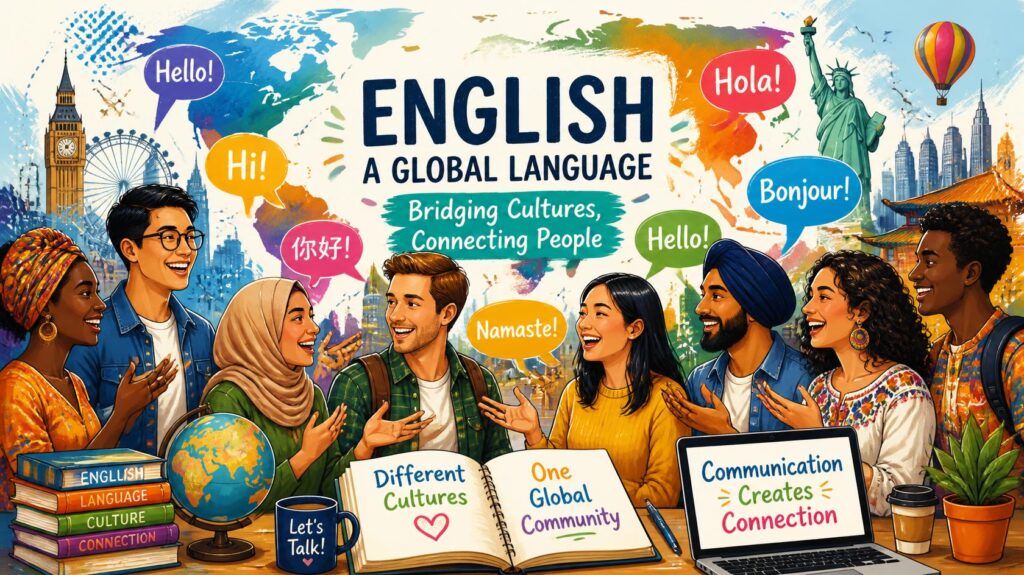
The Internet Chose English First
One detail that most articles miss is this: the internet did not just spread English. The early internet actively required it.
In the 1990s, web browsers, HTML, domain name systems, and programming languages were all designed using English characters and English conventions. Early URLs could only contain ASCII characters, which excluded most of the world’s scripts. Cyrillic, Arabic, Chinese, Hindi, and Tamil users were technically excluded from building web addresses in their own scripts until standards evolved years later.
By the time the internet became multilingual, English was already the default. English-language content had a decade-long head start. The biggest websites, the earliest e-commerce platforms, the first social networks were all English.
Statista data from 2025 shows that English accounts for nearly 50% of all websites worldwide. The next closest language, Spanish, is at around 6%. That is not a language competition. That is a monopoly.
For anyone building a global business, this means English-language content reaches a potential audience roughly eight times larger than any other single language. That practical reality pushes more people to produce and consume in English, reinforcing the cycle every day.
English in Science, Aviation, and Diplomacy
Three specific domains show just how deeply English has become non-negotiable at the international level.
Science: The majority of peer-reviewed academic papers worldwide are published in English, a proportion estimated to be over 95% in many scientific disciplines. A scientist who publishes only in their native language faces severe limitations in how far their research travels. This has been criticised for creating a structural disadvantage for researchers from non-English-speaking countries, but the reality remains: English is the language of global science.
Aviation: The International Civil Aviation Organization mandated English as the international language of aviation in 2008. Every commercial pilot operating internationally must demonstrate English proficiency. Every air traffic controller at an international airport communicates in English. This is not preference. It is international law, designed to prevent the communication failures that contributed to several deadly crashes in the 20th century.
Diplomacy: The United Nations has six official languages: Arabic, Chinese, French, Russian, Spanish, and English. In practice, the working language of most UN operations and documentation is English. Most international treaties and agreements are drafted and negotiated in English. A diplomat who lacks English proficiency is effectively shut out of much of the world’s formal political conversation.
Why Other Languages Could Not Reach the Same Scale
People often ask why Mandarin Chinese, which has the most native speakers of any language, has not become the global lingua franca.
The honest answer is a combination of timing, politics, and accessibility.
Timing matters enormously. English established its global infrastructure during the era when global institutions, standards, and the internet were being built. Mandarin has grown in global influence over the last 30 years, but it entered a world where English was already the default.
Political openness. During the 20th century, the political model that most countries adopted, including many developing nations, was more aligned with Western liberal democracies than with China. This shaped which languages were associated with opportunity and modernity.
Linguistic accessibility. This is a more sensitive point, but it is real. English, while far from simple, uses a 26-letter alphabet that is relatively fast to learn to read and type. It has no tones, which removes one layer of complexity. Mandarin’s writing system involves thousands of characters and four tones. This does not make Mandarin inferior. It does make it harder for adult learners in unrelated linguistic families to reach working proficiency quickly.
The technology gap. Early digital infrastructure, keyboards, operating systems, and internet protocols, was built for Latin-script languages and specifically for English. Mandarin, Arabic, and other non-Latin scripts required years of technical development to integrate smoothly into digital tools.
| Factor | English | Mandarin | Spanish |
|---|---|---|---|
| Native speakers | ~380 million | ~920 million | ~490 million |
| Total speakers | 1.5+ billion | 1.1 billion | 560 million |
| Countries as official language | 67 | ~5 | 20 |
| % of internet content | ~49% | ~1.4% | ~6% |
| UN official language | Yes | Yes | Yes |
| Aviation standard | Yes | No | No |
| Global academic language | Yes | Limited | Limited |
The Honest Downsides of English Dominance
No honest account of English as a global language ignores its costs.
The dominance of English has contributed to the weakening and loss of smaller languages. When education, government, and economic opportunity are all tied to English, communities naturally pull their children toward it. Indigenous languages with no written tradition and no digital presence can lose speakers within two or three generations.
UNESCO has documented thousands of endangered languages around the world. The pressure is not always direct. But a language that offers no access to jobs, education, or the internet struggles to survive against one that offers all three.
There is also a structural inequality in global knowledge production. Researchers who write in English reach global audiences. Researchers who write only in their native language stay local, regardless of the quality of their work. This means the global conversation on science, policy, and ideas is filtered through a linguistic lens that excludes the majority of the world’s population.
Medical researchers have highlighted this specifically. Important health research published in non-English languages often does not reach global audiences, with real consequences for health policy and patient outcomes.
None of this is an argument against learning English. It is an argument for being honest about what English dominance costs, and for investing in multilingual education systems that preserve linguistic diversity alongside English proficiency.
Is English Still Growing, or Slowly Retreating?
English is not declining. But its dominance is becoming more contested in specific domains.
In global entertainment, Korean pop culture (K-pop, K-dramas), Spanish-language television, and Hindi cinema have found massive international audiences without translating everything into English. Netflix’s most-watched series in 2021 was “Squid Game,” a Korean-language show. “Money Heist” from Spain became a global phenomenon in Spanish.
In artificial intelligence and translation technology, real-time translation tools are improving rapidly. Some linguists argue that within a generation, the language barrier may become less significant as machine translation handles more of the burden.
In business, Mandarin has grown in importance across Africa, Southeast Asia, and parts of Europe, driven by Chinese investment and trade relationships.
But English still dominates the academic, digital, and diplomatic world in ways that are structural, not just habitual. These structures change slowly. The realistic forecast is that English will remain the world’s primary lingua franca for the next several decades, even as other languages grow in regional and sector-specific influence.
Common Misconceptions About English as a Global Language

Misconception 1: English became global because it is the best or simplest language. This is not true. Linguistic quality has nothing to do with global reach. English is arguably harder in some ways than many other languages, with highly irregular spelling, complex tense systems, and idiomatic expressions that defy logic. It became global because of power, not quality.
Misconception 2: Most English speakers are native speakers. Actually, non-native speakers outnumber native speakers by a ratio of roughly three to one. English belongs, in practice, to its non-native speakers more than to native speakers. It has been adapted and localised into dozens of distinct varieties, from Indian English to Nigerian English to Singaporean English.
Misconception 3: You need a perfect British or American accent to communicate in English. International research consistently shows that clarity and comprehensibility matter far more than accent. English is now so widely spoken across so many accents that insisting on native-speaker norms is both impractical and increasingly irrelevant in global professional settings.
Misconception 4: One day, one language will replace English as the global tongue. Possible in theory, extremely unlikely in the near future. Language shifts of this scale take generations and require the kind of geopolitical realignment that has not yet materialised, even with China’s growing global influence.
Key Takeaways
English became the world’s global language through a combination of British colonial expansion, American economic and cultural dominance, and its early adoption as the language of the internet, science, aviation, and international institutions.
The network effect keeps English dominant. The more people and institutions use it, the more valuable it becomes for everyone else.
English is not the world’s most natively spoken language. It is the world’s most chosen second language, which is the distinction that makes it a true global tongue.
English dominance has real costs, including the erosion of smaller languages and structural inequality in global knowledge production.
The language continues to grow, but its dominance is being gently challenged in entertainment and regional business by rising languages like Mandarin, Korean, and Spanish.
Glossary of Key Terms
This glossary defines important linguistic and sociolinguistic terms used in this article. These terms are widely used in academic discussion of language and globalisation.
Lingua Franca A language used as a common means of communication between groups of people who do not share the same native tongue. Historically, languages like Latin, Arabic, and Persian served as regional lingua francas. English now functions as the world’s dominant global lingua franca.
Nativisation The process by which a language adopted from another culture is adapted, reshaped, and claimed by its new speakers. Indian English, Nigerian English, and Singaporean English are all nativised varieties of English that have developed distinct vocabularies, rhythms, and grammatical patterns.
Linguistic Imperialism A term introduced by linguist Robert Phillipson in 1992 to describe the promotion of one language over others as part of broader cultural and political dominance. It is used critically to examine how English was spread through colonial power and continues to be maintained through global economic and institutional systems.
Language Endangerment The process by which a language loses speakers and faces the risk of extinction. UNESCO classifies thousands of languages as vulnerable, definitely endangered, severely endangered, or critically endangered. English dominance is considered a contributing factor in many cases.
Code-Switching The practice of alternating between two or more languages or language varieties within a single conversation. Common among bilingual or multilingual speakers, particularly in multilingual societies like India, Nigeria, and Singapore, where English is often woven naturally into sentences alongside a native language.
World Englishes A framework developed by linguist Braj Kachru that recognises the many legitimate varieties of English spoken across the world. It rejects the idea that British or American English are the only “correct” forms, and acknowledges that Indian English, African Englishes, Caribbean English, and others are valid, complete linguistic systems.
Language Policy Official decisions made by governments and institutions about which languages will be used in education, law, and public life. Colonial language policies, like Britain’s decision to use English as the medium of instruction in Indian schools, have had lasting effects on the global status of English.
Bilingualism / Multilingualism The ability to speak or use two (bilingualism) or more (multilingualism) languages. Most of the world’s English speakers are multilingual, using English alongside one or more native languages, rather than replacing their native language with English entirely.
Pidgin A simplified form of language that develops when speakers of different languages need to communicate. Several English-based pidgins developed in West Africa, the Caribbean, and the Pacific during the colonial era as contact languages between English-speaking traders and local populations.
ELF (English as a Lingua Franca) A specific sociolinguistic concept that describes English used as a contact language between speakers who do not share the same native tongue and are not necessarily native English speakers themselves. ELF research shows that communication goals matter more than native-speaker norms in these contexts.
Internal Links from Lingua Litera
Relevant articles on Lingua Litera that complement this post:
- Spoken English for Business Communication: The Complete Professional Guide — An excellent follow-up for readers who want to apply English professionally.
- How to Crack IELTS: A Real, Section-by-Section Guide to Scoring Band 7 or Higher — Directly relevant for readers who want to certify their English for global opportunities.
- What Is Business Communication? A Complete Guide for Students and Professionals — Connects the global importance of English to real professional communication skills.
- The 12 Tenses in English Grammar: A Complete Structural and Conceptual Guide — For readers motivated to strengthen their English after understanding why it matters globally.
- 100 Modern C1 Vocabulary Words You Should Use Every Day — A practical resource for readers who want to actively improve their English.
Frequently Asked Questions
Why is English accepted all over the world?
English became accepted globally because of British colonial expansion, which spread the language across five continents. After World War II, American economic and cultural power reinforced it. English was then adopted by major international institutions, became the default language of the internet, and established itself as the official language of aviation, science, and diplomacy. The network effect now keeps it in place.
Is English the most spoken language in the world?
No. Mandarin Chinese has more native speakers than English, and Spanish has more native speakers too. But English is the most widely spoken second language in the world. When you count both native and non-native speakers, English has approximately 1.5 billion speakers globally, giving it the broadest reach of any language.
Why did English become more global than Mandarin or Spanish?
English built its global infrastructure earlier. The world’s international institutions, academic journals, aviation standards, and the internet were all established during periods of British or American dominance. By the time Mandarin became an economic powerhouse, English was already the structural default. Timing, institutional adoption, and digital early-mover advantage all played a role.
Does English belong to Britain or America?
Linguistically, English belongs to no single nation. It has evolved into dozens of distinct regional varieties, from Indian English and Nigerian English to Singaporean English and Caribbean English. Non-native English speakers now outnumber native speakers by approximately three to one. The language belongs, in practice, to the world that uses it.
Will any other language replace English as the global language?
There is no realistic near-term replacement. Mandarin is growing in regional influence, particularly across Asia and Africa. Spanish is the second-largest language on the internet. But the structural dominance of English in science, aviation, law, and digital infrastructure is extremely difficult to displace. Language shifts of this scale require generations, not decades.
What is the role of English in India specifically?
English serves as a neutral internal language in India’s linguistically diverse landscape. With hundreds of regional languages, English often bridges communication between Indians from different states. It is the language of higher education, the judiciary, and formal business. India has nativised English deeply, developing its own grammar patterns, vocabulary, and idioms that are recognised worldwide.
Is English dominance harmful to other languages?
It can be. When economic and educational opportunity is tied to English, smaller languages lose speakers across generations. UNESCO has identified thousands of endangered languages globally, and the pressure of English dominance is a contributing factor in many cases. Experts advocate for multilingual education systems that develop English proficiency alongside strong native language literacy.
Why English is the language of science and research?
English became the dominant scientific language because the United States and the United Kingdom led global scientific research output throughout the 20th century. The major journals, conferences, and academic institutions were English-language. Once this infrastructure was established, publishing in English became the path to global reach, creating a self-reinforcing cycle that continues today.
How does the internet keep English dominant?
English accounted for the early architecture of the internet, including HTML, URL systems, and programming conventions. English-language websites, platforms, and social networks had a decade-long head start before multilingual internet infrastructure became practical. Today, approximately 49% of all global web content is in English, making the English-language internet far larger and more commercially valuable than any other language’s online presence.
What is “World Englishes” and why does it matter?
World Englishes is a framework developed by linguist Braj Kachru that recognises the many legitimate, distinct varieties of English spoken globally. It challenges the idea that British or American English are the only correct standards. Indian English, Nigerian English, Singaporean English, and others are treated as complete, valid linguistic systems with their own rules and identities. This matters because it shifts English from a language owned by a few countries to one genuinely shared by the world.
Conclusion
The story of why English is accepted all over the world is not a simple or comfortable one. It begins with colonial force, runs through American commercial ambition, and arrives at a world where a language no one planned to globalise has become the invisible connective tissue of human civilisation.
Today, English is not owned by Britain or America. It is reshaped daily by the billions who use it to get an education, build a career, write code, publish research, and reach across borders. From a student preparing for IELTS in Kolkata to a pilot communicating over the Atlantic, English is the language the modern world chose to share.
Understanding this history does not diminish the importance of learning English. It adds context. And context is what separates learning a language out of pressure from learning it with purpose.
Recommended External References
- David Crystal, English as a Global Language (Cambridge University Press) — The most respected academic overview of this topic
- UNESCO Interactive Atlas of the World’s Languages in Danger — atlas.unesco.org
- British Council — The English Effect — Research on English’s global economic value
- Statista — Languages on the Internet — statista.com — Current data on internet language distribution
- ICAO Language Proficiency Requirements — icao.int — Official documentation on English in aviation