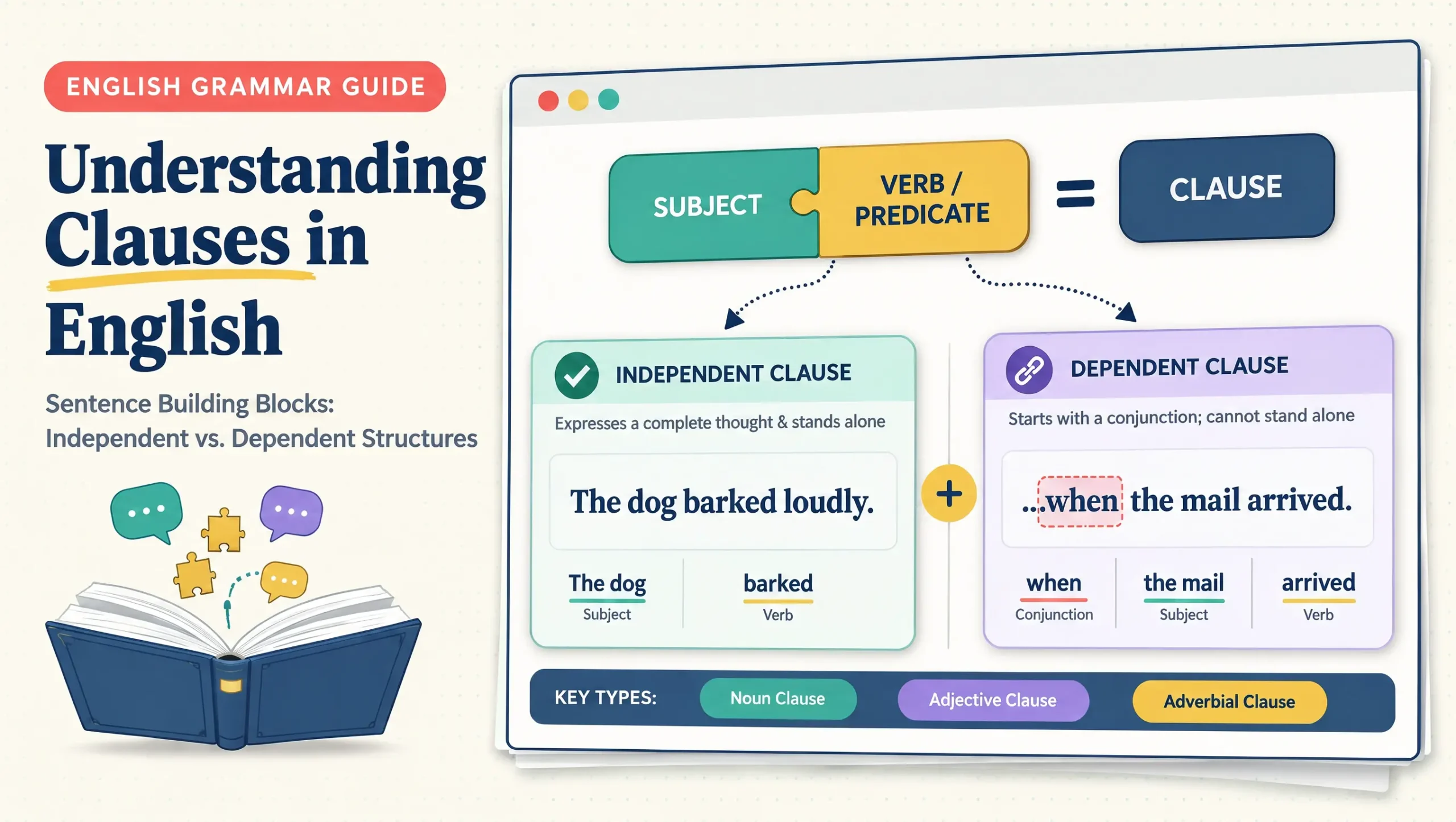
Every sentence you write is built from at least one clause. Understanding what a clause is — and how its types work — is one of those grammar basics that quietly fixes dozens of writing problems students never knew they had.
This article covers the concept from scratch: definition, types, worked examples, common mistakes, and practice questions with answers.
Quick Answer
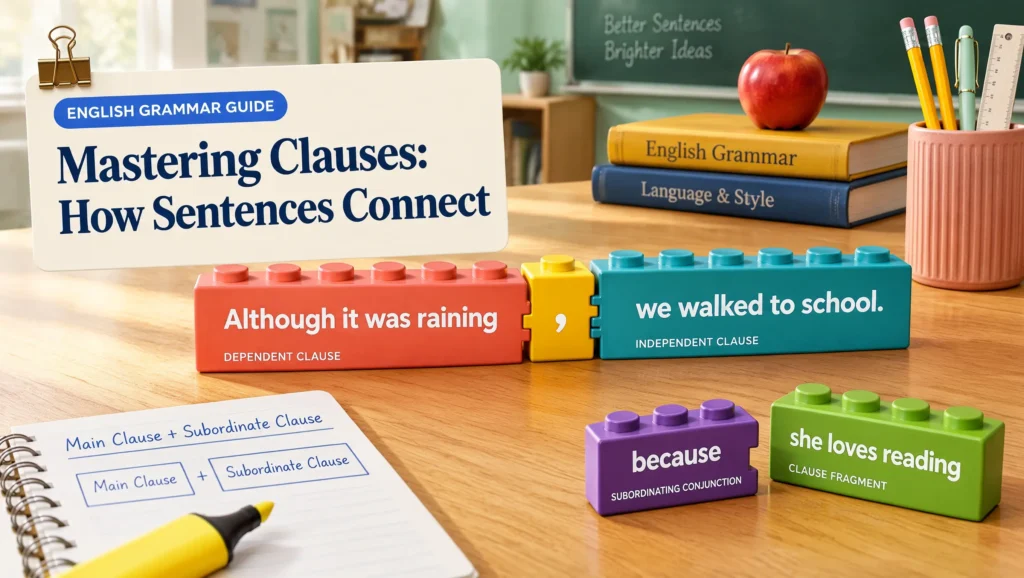
What is a clause in English?
A clause is a group of words that has a subject and a verb. Some clauses make complete sense on their own (She reads every day). Others depend on another clause to complete their meaning (because she wants to improve). Every sentence in English contains at least one clause.
Table of Contents
What Is a Clause in English Grammar?
A clause is any group of words that contains both a subject (who or what does something) and a finite verb (what they do).
Examples:
- The dog barked. — Subject: the dog / Verb: barked
- when the rain stopped — Subject: the rain / Verb: stopped
Notice that both examples have a subject and a verb. Both are clauses. But only the first one makes complete sense alone.
That difference — whether a clause can stand alone or not — is the most important thing to understand.
Clause vs. Phrase — Know the Difference
Students often mix up clauses and phrases. Here is the fastest way to separate them.
| Feature | Clause | Phrase |
|---|---|---|
| Has a subject? | Yes | Not necessarily |
| Has a finite verb? | Yes | No |
| Can form a sentence? | Sometimes | Never alone |
| Example | she laughed | in the morning |
A phrase like on the roof or running fast has no subject-verb pair. A clause always does.
Types of Clauses in English
English clauses divide into two major categories:
- Main Clause (also called Independent Clause or Principal Clause)
- Subordinate Clause (also called Dependent Clause)
Main Clause (Independent Clause)
A main clause expresses a complete thought and can stand alone as a sentence.
Examples:
- Priya finished her homework.
- The sun rose early.
- I called him three times.
Each of these is complete. Remove it from any larger sentence, and it still makes sense.
In a compound sentence, two main clauses are joined by a coordinating conjunction (for, and, nor, but, or, yet, so — remembered as FANBOYS):
She studied hard, and she passed the exam.
Both halves are main clauses. Either one works as a standalone sentence.
Subordinate Clause (Dependent Clause)
A subordinate clause has a subject and a verb, but it cannot stand alone. It depends on the main clause to complete its meaning.
Examples:
- although he was tired — dependent; leaves you waiting for more
- because the road was blocked — dependent; same issue
- that she told me — dependent; what about it?
These always attach to a main clause:
Although he was tired, he kept studying. (subordinate clause + main clause)
Subordinate clauses are introduced by:
- Subordinating conjunctions: because, although, when, if, since, unless, until, after, before
- Relative pronouns: who, which, that, whom, whose
- Noun clause markers: what, how, whether, that
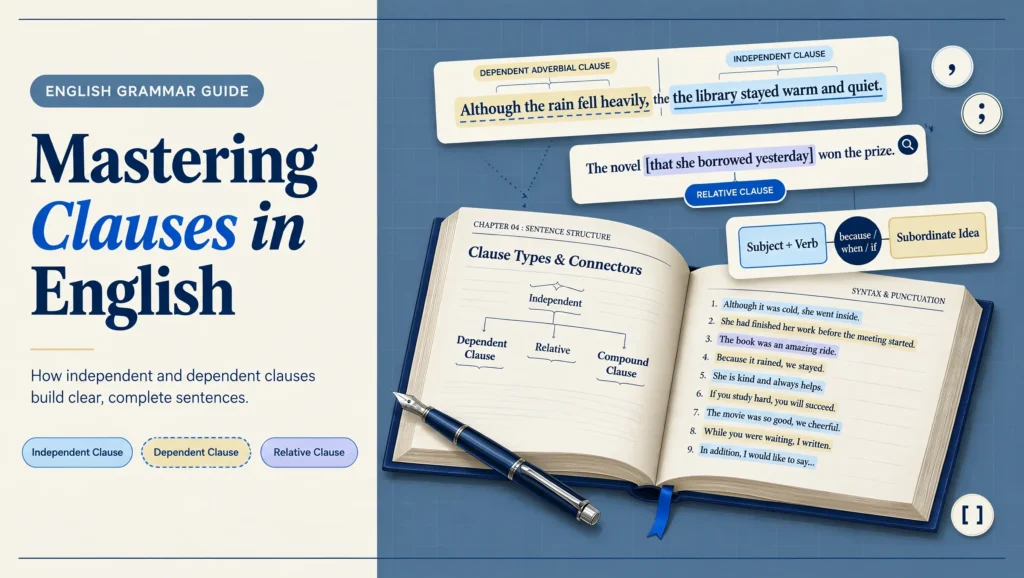
Types of Subordinate Clauses
Subordinate clauses function as different parts of speech inside a sentence. This is where most exam questions come from.
Noun Clause
A noun clause does the job of a noun in the sentence. It can be a subject, object, or complement.
Ask yourself: What did he say / think / know? If a clause answers that, it is a noun clause.
Examples:
- What she said surprised everyone. (subject)
- I know that he is honest. (object)
- The truth is that nobody came. (complement)
Connector words: that, what, how, whether, why, who, whoever
Adjective Clause (Relative Clause)
An adjective clause modifies a noun or pronoun — just like an adjective does. It answers the question which one? or what kind?
Examples:
- The boy who scored full marks was my classmate.
- This is the book that I borrowed from the library.
- She called the person whose number was saved.
Connector words: who, whom, whose, which, that
Exam tip: If you can replace the clause with a single adjective and the sentence still makes sense, it is almost certainly an adjective clause.
Adverb Clause
An adverb clause modifies a verb, adjective, or another adverb. It answers questions like when, where, why, how, under what condition, to what degree.
Examples:
- He left before I arrived. (when?)
- Because it was raining, they stayed indoors. (why?)
- She works harder than anyone else in the class. (to what degree?)
- If you study well, you will pass. (under what condition?)
Connector words: because, since, although, when, if, unless, until, so that, as if, as long as
Quick Summary Table
| Type | Function | Connector Words | Example |
|---|---|---|---|
| Noun Clause | Acts as noun (subject/object) | that, what, whether, how | *I know that she left. |
| Adjective Clause | Modifies a noun | who, which, that, whose | The man who called is my uncle. |
| Adverb Clause | Modifies verb/adjective | because, when, if, although | When the bell rang, we stopped. |
Common Mistakes Students Make
Mistake 1: Treating a subordinate clause as a complete sentence
✗ Because she was late. (incomplete — this is a fragment) ✔ She missed the bus because she was late.
Mistake 2: Confusing adjective clause and adverb clause
A simple test: find what the clause modifies.
- Modifies a noun → adjective clause
- Modifies a verb → adverb clause
The house where I grew up is now demolished. — modifies house (noun) → adjective clause
He went home when the meeting ended. — modifies went (verb) → adverb clause
Mistake 3: Mixing up noun clause and adjective clause with “that”
I believe that he is right. → noun clause (object of believe) The idea that we discussed is interesting. → adjective clause (modifies idea)
Look at what that connects to. If it connects to a verb as an object, it is a noun clause. If it modifies a noun, it is an adjective clause.
Exam Tips
- In most CBSE/ICSE grammar questions, you are asked to identify or combine clauses. Read the entire sentence before labeling.
- Always identify the main clause first. Everything else is subordinate.
- The word that appears in both noun clauses and adjective clauses. Context decides which one it is.
- Subordinating conjunctions always introduce adverb clauses. If you spot because, although, when, if — the clause that follows is an adverb clause.
- For competitive exams (SSC, IBPS), clause-based questions often appear in the sentence improvement and error detection sections.
Related Reading on Lingua Litera: The 12 Tenses in English Grammar: A Complete Structural and Conceptual Guide — understanding tenses helps you identify finite verbs inside clauses more accurately.
Also useful: Subject-Verb Agreement: 20 Advanced Rules Every Exam Aspirant Must Know — many agreement errors occur inside subordinate clauses.
Practice Questions with Answers
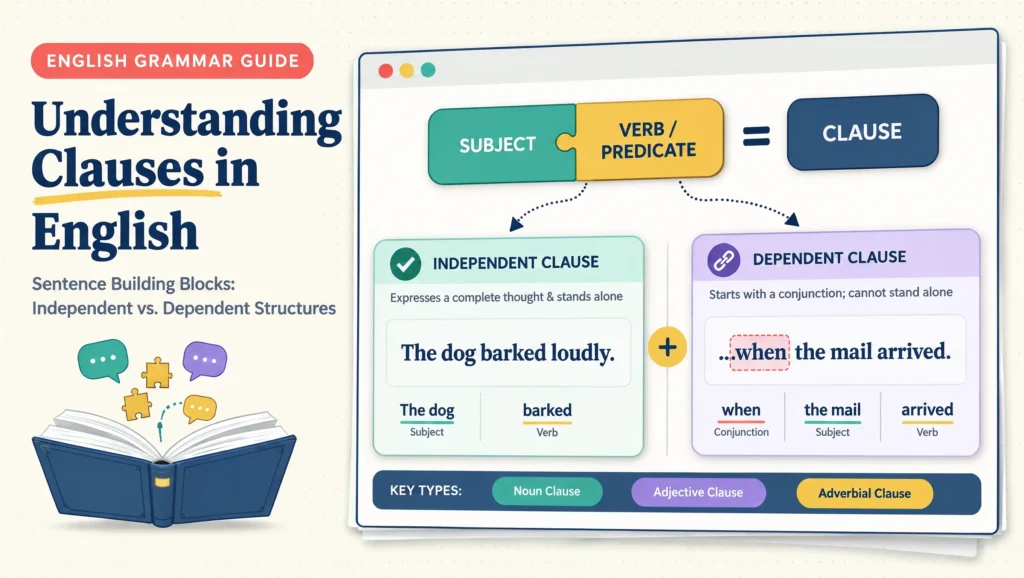
Identify the type of clause underlined in each sentence.
Q1. She told me that the results were out. Answer: Noun clause — it is the object of the verb told.
Q2. The student who answered first won the prize. Answer: Adjective clause — it modifies the noun student.
Q3. Although it was cold, they went for a walk. Answer: Adverb clause — it modifies the verb went (tells us the condition).
Q4. I don’t know where she lives. Answer: Noun clause — it is the object of the verb know.
Q5. This is the road that leads to the station. Answer: Adjective clause — it modifies the noun road.
Q6. If you practise daily, your writing will improve. Answer: Adverb clause — conditional clause modifying will improve.
Glossary of Terms
Terms defined below appear throughout this article. They are provided here for quick revision and reference.
Finite Verb A verb that is marked for tense and agrees with its subject. Every clause must contain a finite verb. For example, runs is finite; running alone is not. The presence of a finite verb is what separates a clause from a phrase.
Coordinating Conjunction A word that joins two grammatically equal elements — including two independent clauses. The seven coordinating conjunctions in English are for, and, nor, but, or, yet, so (FANBOYS). Unlike subordinating conjunctions, they do not make a clause dependent.
Subordinating Conjunction A conjunction that introduces a subordinate (dependent) clause and signals its relationship to the main clause. Examples include because, although, when, if, since, until, unless. The choice of subordinating conjunction tells readers why, when, how, or under what condition something happens.
Relative Pronoun A pronoun that introduces an adjective clause and relates it to the noun it modifies. The relative pronouns in English are who, whom, whose, which, and that. They simultaneously replace the noun and connect the clause.
Principal Clause Another name for the main or independent clause. It is the clause that carries the central statement of the sentence and is grammatically complete on its own.
Fragment A group of words punctuated as a sentence but missing either a subject, a finite verb, or a complete thought. A dependent clause written alone is a common type of fragment. For example: Because she was nervous. — this is a fragment, not a sentence.
Compound-Complex Sentence A sentence that contains two or more independent clauses and at least one dependent clause. Example: She studied hard because exams were near, and she passed with distinction. This sentence type combines coordination and subordination.
Frequently Asked Questions
What is a clause in English grammar?
A clause is a group of words that has both a subject and a finite verb. Clauses are the building blocks of sentences. A sentence must have at least one clause, and that clause must be an independent (main) clause. Clauses differ from phrases because phrases lack the subject-verb combination that clauses require.
What is the difference between a main clause and a subordinate clause?
A main clause can stand alone as a complete sentence. A subordinate clause has a subject and verb but cannot stand alone because it begins with a subordinating conjunction or relative pronoun that makes it dependent on the main clause for its full meaning.
How many types of clauses are there in English grammar?
There are two primary types: independent (main) clauses and dependent (subordinate) clauses. Dependent clauses are further divided into noun clauses, adjective clauses (relative clauses), and adverb clauses. Some grammarians also separately list conditional clauses as a type, though these are structurally a subtype of the adverb clause.
What is a noun clause? Give an example.
A noun clause is a dependent clause that functions as a noun — as the subject, object, or complement in a sentence. Example: Nobody knows what happened that night. Here the clause acts as the object of knows. Noun clauses are commonly introduced by that, what, how, whether, who, and why.
What is the difference between an adjective clause and an adverb clause?
An adjective clause modifies a noun and is usually introduced by a relative pronoun (who, which, that). An adverb clause modifies a verb, adjective, or adverb and is introduced by a subordinating conjunction (because, when, although, if). The key test: find what the clause modifies. Noun → adjective clause. Verb/adjective/adverb → adverb clause.
Why does the word “that” appear in both noun clauses and adjective clauses?
Because that serves two different grammatical roles. As a complementiser, it introduces a noun clause: I think that she is right. As a relative pronoun, it introduces an adjective clause: The answer that she gave was correct. Context — specifically what the clause is modifying — determines which function that is performing.
Is a conditional sentence a type of clause?
A conditional sentence is a sentence structure, not a clause type. However, it contains a conditional clause — an adverb clause beginning with if or unless — that sets a condition for the main clause. Example: If you hurry, you will reach on time. The if-clause is an adverb clause of condition.
How do I identify a clause in an exam?
First, find the finite verb. Then find its subject. That pair forms the core of a clause. If there is more than one finite verb in the sentence, there is more than one clause. Then check whether each clause can stand alone (independent) or depends on another (subordinate). Finally, for subordinate clauses, identify the connector word to determine whether it is a noun, adjective, or adverb clause.
Conclusion
The clause is the engine of every English sentence. Once you can spot a main clause and recognise what each type of subordinate clause does, you gain real control over the language — not just in grammar tests, but in how you write and think in English.
The three types of subordinate clauses (noun, adjective, adverb) appear constantly in reading comprehension, essay writing, and every major English exam. Practise identifying them in texts you already read, not just in isolated exercises, and the pattern will become natural quickly.
Also recommended from Lingua Litera:
- Gerund and Present Participle: The One Grammar Distinction That Changes Everything
- 100 Modern C1 Vocabulary Words You Should Use Every Day
External Source Suggestions
- Oxford Learner’s Dictionaries — Definition of clause — for definitional authority