
Few actors in the history of Indian cinema have carried the weight of real human experience onto the screen the way Nana Patekar did. His characters never felt performed. They felt lived-in, raw, and unmistakably honest. That quality did not come from acting school alone. It came from a childhood shaped by poverty, hunger, and the kind of humiliation that either breaks a person or builds them into something extraordinary.
Born Vishwanath Patekar on January 1, 1951, in the coastal village of Murud-Janjira in Maharashtra’s Raigad district, Nana Patekar went on to become one of the most decorated and respected actors India has ever produced. A three-time National Film Award winner, a Padma Shri awardee, a military officer, a playwright, a filmmaker, a philanthropist — and through all of it, a man who lived in a 1BHK apartment and never forgot where he came from.
He passed away on October 8, 2026, at his residence in Dona Paula, Goa, following a cardiac arrest. He was 75. Indian cinema lost one of its rarest voices that morning.
This essay covers his life from childhood to legacy — the films, the awards, the work he did for farmers in distress, and what his journey means for those who study it.
Quick Overview
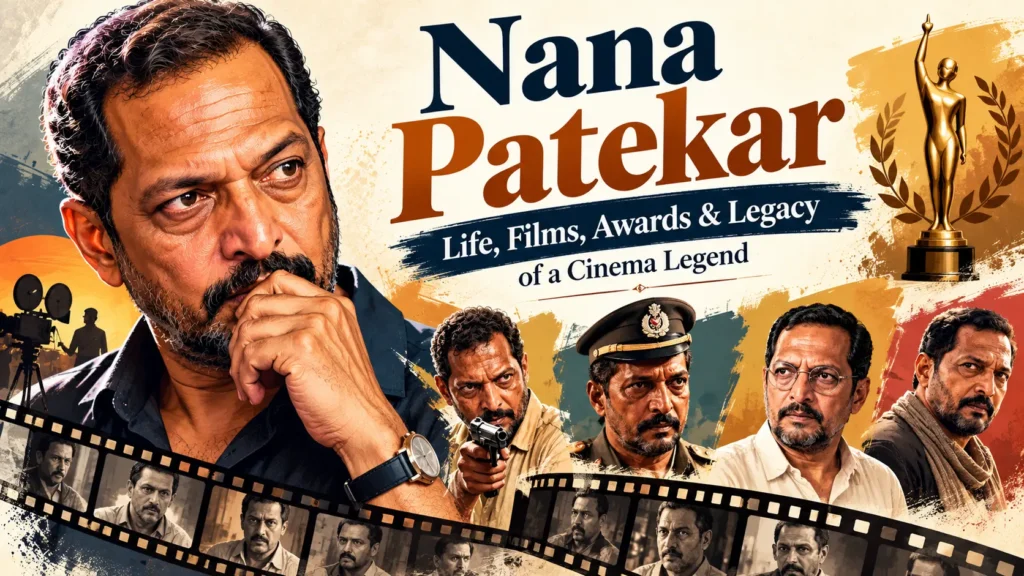
| Detail | Information |
|---|---|
| Full Name | Vishwanath Gajanan Patekar |
| Known As | Nana Patekar |
| Born | January 1, 1951 |
| Birthplace | Murud-Janjira, Raigad, Maharashtra |
| Passed Away | October 8, 2026 (age 75), Dona Paula, Goa |
| Education | Sir J.J. Institute of Applied Art, Mumbai |
| Occupation | Actor, Filmmaker, Screenwriter, Philanthropist |
| Years Active | 1978 – 2026 |
| Awards | 3 National Film Awards, Padma Shri, 4 Filmfare Awards |
| Military Rank | Honorary Lieutenant Colonel, Territorial Army |
| Organization | Naam Foundation (est. 2015) |
Early Life and Childhood: The Foundation of a Legend
Nana Patekar grew up without the comforts most children take for granted. His father worked as a mill labourer, and the family’s financial condition worsened considerably when a business partner cheated them and their property had to be sold. From that point, financial insecurity became a constant presence in the household.
By the time Nana was thirteen, he was already working. He painted film posters in Mumbai for a monthly wage of just thirty-five rupees. He walked sixteen kilometres a day to reach work and back. There was no transport money to spare.
In later interviews, he described this period with remarkable clarity rather than bitterness. He often said that hunger taught him how to act. The emotional vocabulary he needed — fear, desperation, pride, rage, tenderness — was already inside him before he ever stepped on a stage. Life had deposited it there, interest and all.
He once told The Times of India that by thirteen, he had developed the maturity of a thirty-year-old, and that the experience of humiliation and poverty had made him unafraid of failure. “I got my degree from the University of Hunger and Humiliation,” he said, “and that degree never expired.”
His father, despite the family’s hardships, loved theatre and regularly took young Nana to watch plays. That exposure planted something that would shape the rest of his life.
Education and the Road to Theatre
Nana completed his schooling at Samarth Vidyalaya in Dadar West, Mumbai. He later studied at the Bandra School of Arts (now the LS Raheja School of Art) before earning his diploma in commercial art from the Sir J.J. Institute of Applied Art in Mumbai — one of the most respected fine arts institutions in India.
His formal training was in visual art, not drama. But theatre found him anyway. He began performing in Marathi theatre at a young age, and the director Vijaya Mehta, one of the most influential figures in Marathi theatre, directed his first play.
Theatre gave him something cinema cannot always offer — the discipline of performing without retakes, before a live audience, with nowhere to hide. It trained him to be present in every moment of a scene. That quality became the defining characteristic of his screen performances later.
Related Reading on Lingua Litera: Spoken English for Business Communication: The Complete Professional Guide — for students who want to develop the confident communication skills that individuals like Nana Patekar demonstrated throughout their public lives.
Entry into Cinema
Nana Patekar made his Bollywood debut in 1978 with Gaman, a quiet, sombre film about rural migration. The role was small, but it gave him his first real foothold in the industry. Work came slowly. He continued doing theatre alongside small film roles, never quite breaking into the mainstream.
His early Bollywood films — Aaj Ki Awaz (1984), Ankush (1986), Pratighaat (1987) — offered him supporting parts, but they also allowed him to build his craft outside the pressures of leading-man stardom. In 1986, he appeared in the British television series Lord Mountbatten: The Last Viceroy, playing the role of Nathuram Godse. It was an early indication of the range he was developing.
The film that changed everything was Parinda (1989), directed by Vidhu Vinod Chopra. Nana Patekar played Anna, a menacing crime lord — a role that required him to be simultaneously charming and deeply frightening. The performance was unlike anything Indian audiences had seen from him before. He won the National Film Award for Best Supporting Actor and the Filmfare Award for Best Supporting Actor for this role. He was 38 years old when the recognition finally came, and it had been earned the hard way.
Before Parinda, he had also appeared in Mira Nair’s Salaam Bombay! (1988), a film that received an Academy Award nomination. It was brief exposure to international cinema, and it broadened his perspective considerably.
Major Films and Career Highlights
What followed Parinda was a decade that established Nana Patekar as one of the most versatile actors in Hindi cinema. He played villains, heroes, police officers, fathers, soldiers, and politicians — often with an intensity that made audiences uncomfortable in the best possible way.
His performance in Krantiveer (1994) became one of the defining roles in 1990s Indian cinema. He played a gambler and petty criminal who transforms into a revolutionary voice for the oppressed. The film’s climactic speech, delivered with extraordinary force and clarity, is still widely quoted. He won the National Film Award for Best Actor and the Filmfare Award for Best Actor for this role.
Agni Sakshi (1996) gave him yet another National Film Award for Best Supporting Actor, making him one of a very small group of actors to win the award in both categories.
In the 2000s, Ab Tak Chhappan (2004) showcased his ability to carry an entire film on the strength of a single, deeply inhabited performance. He played Sadhu Agashe, an encounter specialist police officer — a character that required him to hold moral complexity within a single frame without simplifying it.
And then came Welcome (2007), which revealed an entirely different dimension: his gift for comedy. His portrayal of Uday Shetty, a crime lord with Bollywood dreams, became one of the most beloved comic performances in recent Hindi cinema history.
In Marathi cinema, his role in Natsamrat (2016) — as a retired stage actor whose brilliance is slowly forgotten — is widely considered one of the greatest performances in Marathi film history. He won the Filmfare Award for Best Actor (Marathi) for the film. The irony of playing a fading genius was not lost on audiences who had watched Nana Patekar’s own career evolve over four decades.
| Film | Year | Role / Notes |
|---|---|---|
| Gaman | 1978 | Bollywood debut |
| Parinda | 1989 | National Award – Best Supporting Actor |
| Salaam Bombay! | 1988 | Academy Award-nominated film |
| Krantiveer | 1994 | National Award – Best Actor; Filmfare Best Actor |
| Agni Sakshi | 1996 | National Award – Best Supporting Actor |
| Ab Tak Chhappan | 2004 | Critically acclaimed police drama |
| Welcome | 2007 | Iconic comic performance as Uday Shetty |
| Raajneeti | 2010 | Political drama; multi-starrer |
| Natsamrat | 2016 | Filmfare Best Actor (Marathi); career peak |
| The Vaccine War | 2023 | Story of Covaxin development |
| Housefull 5 | 2025 | Final major theatrical release |
Nana Patekar as Director and Writer
One chapter in his career that often goes unnoticed is his work as a filmmaker. In 1991, he directed Prahaar: The Final Attack, a film about the Indian Army. To prepare for the role of a military officer that he also played in the film, he underwent actual army training and joined the Territorial Army as a captain. The film reflected his own sense of national duty, and it was a deeply personal project.
He co-wrote several of his films and was known to have strong creative opinions on the scripts he chose. His selection of roles over the years was deliberate — he consistently avoided the comfortable and sought out the complex.
Military Service: A Lesser-Known Chapter
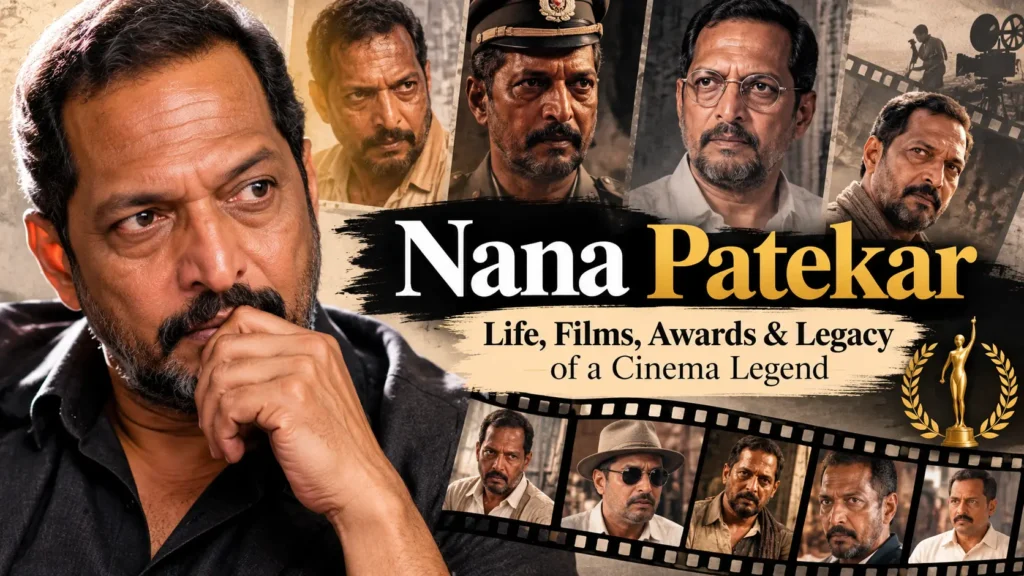
One of the most remarkable facts about Nana Patekar’s life is that his connection to the Indian Army was not limited to film roles.
He joined the Territorial Army as a captain in 1988. During the 1999 Kargil War, he served with the Maratha Light Infantry regiment as a major. He retired from the Territorial Army in 2013 with the rank of Honorary Lieutenant Colonel.
This was not a ceremonial appointment. He trained, he served, and when the country called during Kargil, he went. For an actor whose screen presence already carried military discipline, this added a dimension to his public persona that was entirely genuine.
Nana Patekar’s Awards and Recognition
Nana Patekar is one of the very few actors in Indian cinema to have won Filmfare Awards in three separate acting categories — Best Actor, Best Supporting Actor, and Best Villain — a distinction he shares with Irrfan Khan.
| Award | Category | Film | Year |
|---|---|---|---|
| National Film Award | Best Supporting Actor | Parinda | 1989 |
| National Film Award | Best Actor | Krantiveer | 1994 |
| National Film Award | Best Supporting Actor | Agni Sakshi | 1996 |
| Filmfare Award | Best Supporting Actor | Parinda | 1990 |
| Filmfare Award | Best Villain | Angaar | 1992 |
| Filmfare Award | Best Actor | Krantiveer | 1995 |
| Filmfare Award | Best Villain | Apaharan | 2006 |
| Filmfare Award (Marathi) | Best Actor | Natsamrat | 2017 |
| Padma Shri | Arts and Cinema | Government of India | 2013 |
| Raj Kapoor Special Contribution Award | Government of Maharashtra | 2013 | |
| Maharashtra State Film Award | Best Actor | Raghu Maina | 1983 |
| Screen Award | Best Actor | Krantiveer | 1995 |
He was awarded the Padma Shri in 2013 — the fourth-highest civilian honour in India — on the eve of Republic Day. When he received the Raj Kapoor Award that same year, which carried a cash prize of one million rupees, he donated the entire amount to drought relief activities in Maharashtra.
Related Reading on Lingua Litera: The 12 Tenses in English Grammar: A Complete Structural and Conceptual Guide — an excellent grammar companion for students who want to write essays about personalities like Nana Patekar with accurate tense usage.
Philanthropy and the Naam Foundation
The awards are significant, but they do not fully explain why Nana Patekar occupied a unique place in Indian public life beyond cinema. That place came from his work with farmers.
In September 2015, at a time when Maharashtra was experiencing one of its worst droughts and farmers were taking their own lives under the weight of debt, Nana Patekar established the Naam Foundation alongside fellow Marathi actor Makarand Anaspure. The foundation provided direct financial assistance to families of farmers who had died by suicide — distributing cheques to widows and dependent family members in Vidarbha and the Marathwada region.
He donated his entire fee from the film Paathshaala (2010) to five different charitable organisations. He contributed to flood relief in Bihar. He used social media, specifically a Twitter campaign with the hashtag #IcareIsupport, to raise funds for Maharashtra drought victims.
What made this notable was not just the amount of money involved but the manner. He showed up. He sat with farmers. He listened. For a man who had himself known financial desperation as a child, this was not charity performed for cameras. It was recognition — one human being to another.
Personal Life
Nana Patekar married Neelkanti Patekar in 1978, the same year as his film debut. They had two sons. Their first son, Durvasa, died of illness at the age of approximately two and a half years — a loss that Patekar described in later interviews as one of the most transformative experiences of his life. Their surviving son, Malhar Patekar, has worked as an actor. Despite his own influence in the industry, Nana Patekar chose not to use it to fast-track his son’s career, insisting that success had to be earned.
He and Neelkanti eventually separated.
His father died of a heart attack when Nana was 28. His mother, Nirmala Patekar, lived with him until her death on January 29, 2019, at the age of 99.
He was known for his extraordinarily simple lifestyle. Throughout the peak of his career, he lived in a 1BHK apartment in Andheri, Mumbai. He gave away prize money, donated fees, and seemed genuinely indifferent to the accumulation of wealth that is typically associated with stardom at his level.
Legacy and Contribution to Indian Cinema
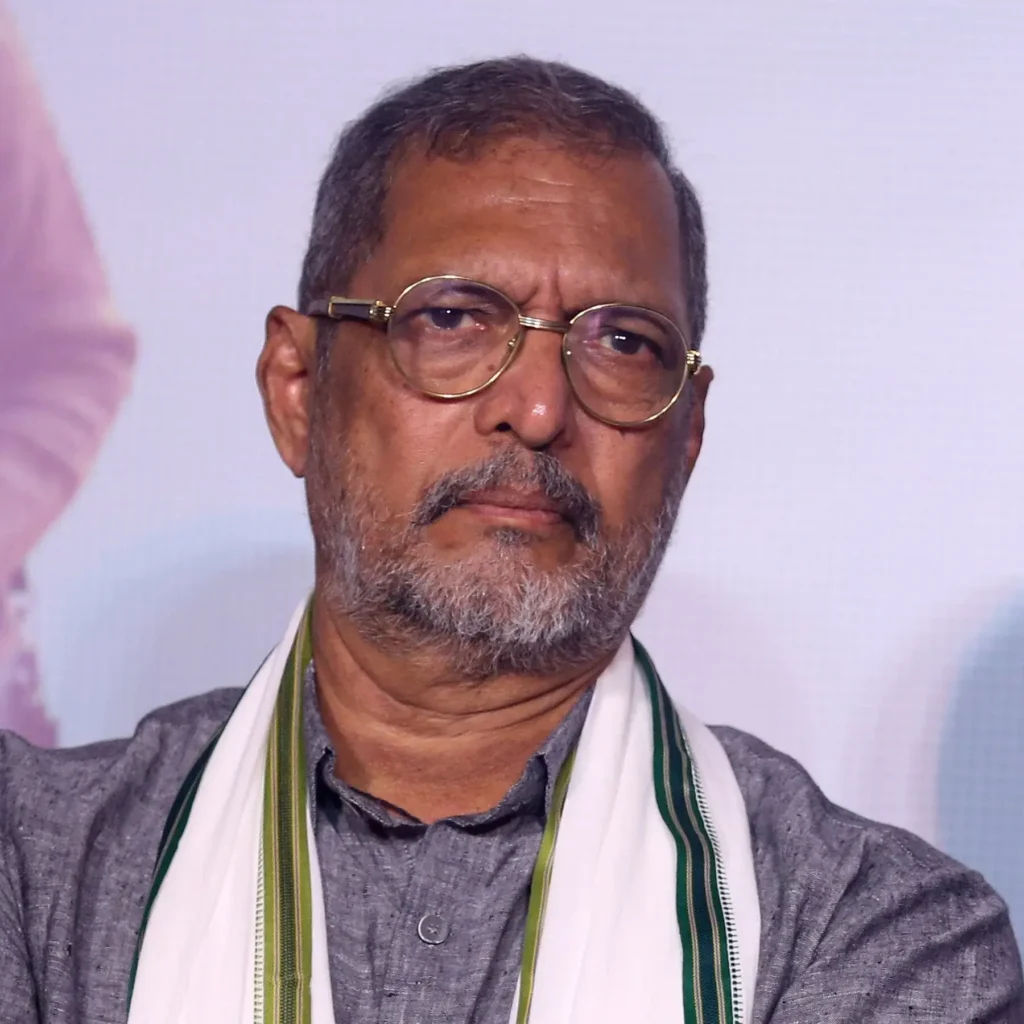
What Nana Patekar gave Indian cinema is not easily summarised in a list of awards. He gave it a different idea of what a screen performance could be.
He proved that intensity does not require volume. Some of his most memorable moments are quiet ones — a long pause before a line, a stillness that carries more weight than most actors’ loudest scenes. He proved that a conventional hero’s face and body were not prerequisites for commanding the screen. He proved, most importantly, that a life lived fully — with all its difficulty and grief and dignity — could be brought directly into a character and make that character unforgettable.
He also left behind something outside cinema: a model of public engagement for artists in positions of influence. He showed that fame could be used as leverage for something more lasting than personal branding.
Three National Film Awards. A Padma Shri. A Lieutenant Colonel’s rank in the Territorial Army. A foundation helping farmers. And nearly fifty years of performances that will be studied long after his time.
That is the essay of a life.
FAQ Section
What is Nana Patekar’s real name?
Nana Patekar’s real name is Vishwanath Gajanan Patekar. He was born on January 1, 1951, in Murud-Janjira, Maharashtra. The name “Nana” is a common Marathi term of affection or respect, and it became the name the public and the film industry knew him by throughout his career.
How many National Film Awards did Nana Patekar win?
Nana Patekar won three National Film Awards. He received the Best Supporting Actor award for Parinda (1989), the Best Actor award for Krantiveer (1994), and the Best Supporting Actor award again for Agni Sakshi (1996). This makes him one of the most decorated actors in the history of the National Film Awards.
What is Nana Patekar’s most famous film?
While opinions vary, Krantiveer (1994) is widely regarded as his defining performance. His portrayal of a rebellious, emotionally complex character who becomes a voice for the oppressed earned him the National Film Award and the Filmfare Award for Best Actor. Parinda (1989) and Natsamrat (2016) are equally celebrated.
What is the Naam Foundation?
The Naam Foundation is a non-profit organisation established by Nana Patekar in September 2015, along with actor Makarand Anaspure. It provides financial support to families of farmers who have died by suicide in drought-affected regions of Maharashtra, particularly Vidarbha and Marathwada.
Did Nana Patekar really serve in the Indian Army?
Yes. Nana Patekar joined the Territorial Army as a captain in 1988. He served with the Maratha Light Infantry during the 1999 Kargil War as a major and retired in 2013 with the rank of Honorary Lieutenant Colonel. His military service was not ceremonial — he underwent training and served actively.
What unique achievement did Nana Patekar hold at Filmfare?
Nana Patekar is one of only two actors in the history of the Filmfare Awards to have won trophies in three separate acting categories: Best Actor, Best Supporting Actor, and Best Villain. The other actor to hold this distinction is Irrfan Khan.
Conclusion
Nana Patekar’s life resists the simple narrative of rags-to-riches that gets attached to most Bollywood biographies. It was not just about rising from poverty to fame. It was about what a person does with that rise, and whether the journey leaves them larger or smaller than it found them.
He remained, by most accounts, the same person throughout — difficult to impress, slow to trust, deeply serious about his craft, and genuinely disturbed by injustice. The hunger he carried as a child in Murud-Janjira shaped not just how he acted but how he chose to live. The awards came. The recognition came. And yet, in an industry that rewards spectacle, he chose a 1BHK apartment, a foundation for farmers, and roles that unsettled rather than comforted.
Writing an essay on Nana Patekar, ultimately, means writing about what it looks like when talent and character align — and when both are tested early enough to matter.
With deep condolences we are very sorry to share that Nana Patekar is no more. He died at 8th October, 2026 at the age of 75, but his works and foundation that he set for out nation cannot be denied and he will still stay in our heart forever.


1 comment
The accurate explantion
Nice