Text
Season of mists and mellow fruitfulness,
   Close bosom-friend of the maturing sun;
Conspiring with him how to load and bless
   With fruit the vines that round the thatch-eves run;
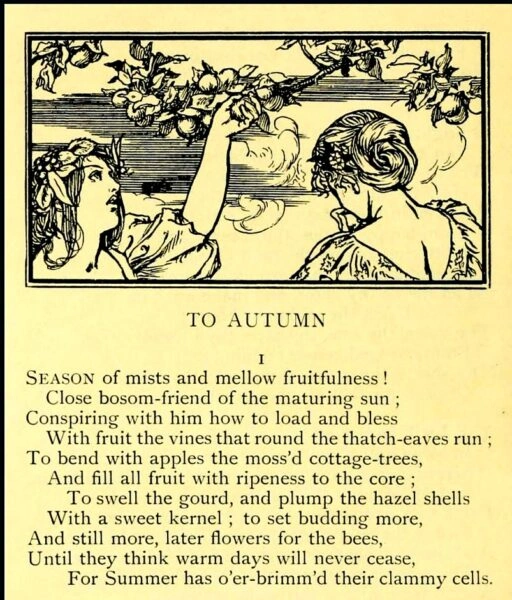
To bend with apples the moss'd cottage-trees,
   And fill all fruit with ripeness to the core;
      To swell the gourd, and plump the hazel shells
   With a sweet kernel; to set budding more,
And still more, later flowers for the bees,
Until they think warm days will never cease,
      For summer has o'er-brimm'd their clammy cells.

Who hath not seen thee oft amid thy store?
   Sometimes whoever seeks abroad may find
Thee sitting careless on a granary floor,
   Thy hair soft-lifted by the winnowing wind;
Or on a half-reap'd furrow sound asleep,
   Drows'd with the fume of poppies, while thy hook
      Spares the next swath and all its twined flowers:
And sometimes like a gleaner thou dost keep
   Steady thy laden head across a brook;
   Or by a cyder-press, with patient look,
      Thou watchest the last oozings hours by hours.

Where are the songs of spring? Ay, Where are they?
   Think not of them, thou hast thy music too,—
While barred clouds bloom the soft-dying day,
   And touch the stubble-plains with rosy hue;
Then in a wailful choir the small gnats mourn
   Among the river sallows, borne aloft
      Or sinking as the light wind lives or dies;
And full-grown lambs loud bleat from hilly bourn;
   Hedge-crickets sing; and now with treble soft
   The red-breast whistles from a garden-croft;
      And gathering swallows twitter in the skies.
Short Summary
The poem begins by describing autumn as a close friend of the sun. Together they help fruits ripen, flowers bloom, and crops mature.
In the second stanza, autumn is personified as a woman engaged in harvesting activities. She appears relaxed and content amid the harvest.
The final stanza shifts attention to the sounds of autumn. Instead of longing for the songs of spring, Keats appreciates the unique music produced by insects, birds, and nature during autumn.
The poem ultimately teaches readers to appreciate every stage of life and nature.
To Autumn by John Keats Explanation: Stanza-Wise Analysis
Stanza 1 Explanation
“Season of mists and mellow fruitfulness”
The poem opens with one of the most famous lines in English literature.
Autumn is described as a season filled with gentle mist and abundant fruit. The phrase “mellow fruitfulness” suggests maturity, richness, and completion.
“Close bosom-friend of the maturing sun”
Autumn and the sun are presented as close friends working together.
The sun provides warmth while autumn oversees the ripening process.
Ripening Fruits and Crops
Keats describes vines, apples, gourds, and hazelnuts becoming fully ripe.
The imagery highlights abundance and prosperity. Everything in nature reaches its fullest stage during autumn.
Deeper Meaning
The first stanza symbolizes maturity in human life.
Just as fruits ripen over time, people gain wisdom and experience as they grow older.
Stanza 2 Explanation
Autumn as a Person
In the second stanza, Keats personifies autumn as a woman.
She appears in different roles associated with harvesting.
Sitting Carelessly on a Granary Floor
Autumn is shown resting comfortably among harvested grain.
This image suggests satisfaction after successful labor.
Sleeping Amid Half-Reaped Furrows
Keats presents autumn as peacefully sleeping in fields.
The image creates a sense of calmness and contentment.
Watching the Cider Press
Autumn patiently observes apple juice flowing from a cider press.
This scene symbolizes completion and fulfillment.
Deeper Meaning
The stanza reflects the rewards that come after effort and hard work.
Autumn is not rushed. It moves calmly and confidently through its tasks.
Stanza 3 Explanation
The Music of Autumn
The final stanza begins with a question:
“Where are the songs of Spring?”
Instead of longing for spring, Keats encourages readers to appreciate autumn’s own beauty.
Natural Sounds
The poet describes:
- Buzzing gnats
- Bleating lambs
- Singing crickets
- Redbreasts whistling
- Swallows gathering
These sounds create autumn’s unique music.
Approaching Winter
Although winter is approaching, the poem remains positive.
Keats accepts change as a natural part of life.
Deeper Meaning
Life constantly changes.
Rather than resisting change, the poem encourages acceptance and appreciation of every stage.