Every sentence you have ever written begins with a decision about a noun. Names, places, feelings, groups, ideas — all of them fall under this single, sprawling word class. Yet most of us learned “a noun is a naming word” in school and never went much further.
That definition is a starting point, not the full picture. The types of nouns in English form a rich classification system that shapes how you write, how sentences are structured, and how meaning changes based on one small word choice. “She showed courage” lands differently from “She showed a courage,” and that difference traces directly back to noun type.
This guide covers every major noun classification — common and proper, abstract and concrete, countable and uncountable, collective, compound, and more. Each type comes with clear definitions, real examples, and the grammar rules that follow from them. By the end, you will know not just what each noun type is, but how to use it correctly.
Quick Answer
What are the types of nouns in English? English nouns are classified into several types: common nouns (general names), proper nouns (specific names), abstract nouns (ideas and feelings), concrete nouns (things you can sense), countable nouns, uncountable nouns, collective nouns (groups), and compound nouns (words combined into one noun). Each type follows specific grammar rules.
Parts of Speech (in English Grammar): Easily Detailed Explained
What Is a Noun?
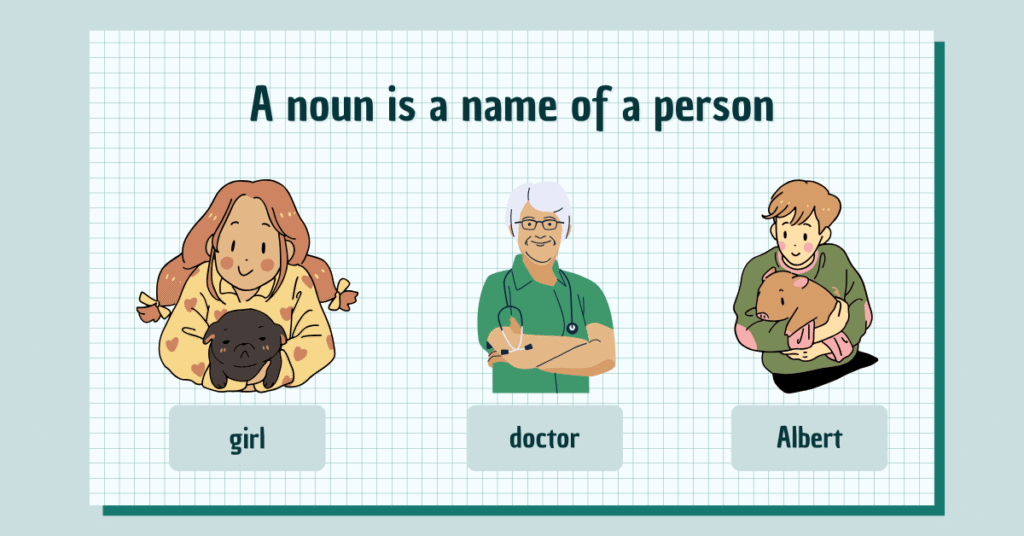
A noun is a word that names a person, place, thing, idea, quality, or action. It is one of the eight traditional parts of speech and arguably the most essential building block of any sentence.
Nouns can function as:
- Subject of a sentence: “The teacher explained the rule.”
- Object of a verb: “She bought a notebook.”
- Object of a preposition: “He sat beside the window.”
- Complement: “She became a doctor.”
Understanding what kind of noun you are dealing with determines the article you use (a, an, or the), whether you add an -s to make it plural, and how it behaves in a sentence.
Types of Nouns in English: Overview
English grammar recognizes several overlapping categories of nouns. A single noun can belong to more than one category at the same time. “Team,” for instance, is a common noun, a concrete noun, and a collective noun all at once.
Here is a quick map of the major types:
| Noun Type | Core Idea | Example |
|---|---|---|
| Common Noun | General name | city, book, teacher |
| Proper Noun | Specific name | Paris, Shakespeare, Monday |
| Abstract Noun | Idea or feeling | freedom, sadness, justice |
| Concrete Noun | Physical, sensory thing | chair, rain, music |
| Countable Noun | Can be counted | apple → apples |
| Uncountable Noun | Cannot be counted | water, advice, luggage |
| Collective Noun | Name for a group | flock, team, jury |
| Compound Noun | Two+ words combined | sunlight, toothbrush, mother-in-law |
| Possessive Noun | Shows ownership | student’s book, India’s capital |
| Gerund (Verbal Noun) | Verb acting as noun | Swimming is healthy. |
Common Nouns
Definition and Examples
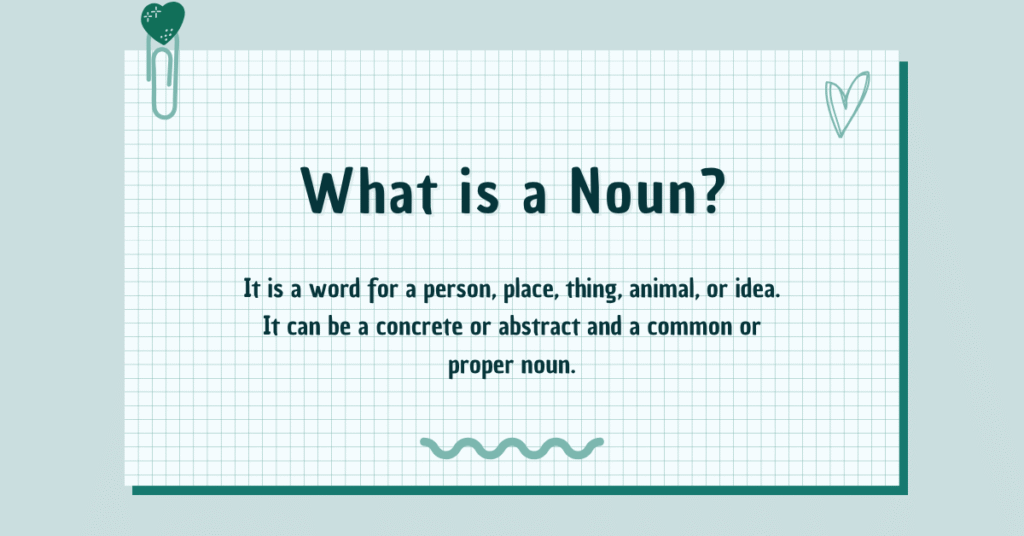
A common noun is a general name for a person, place, thing, or idea. It does not refer to any specific individual — it refers to a class or category.
Common nouns are written in lowercase (unless they appear at the start of a sentence).
Examples:
- Person: teacher, doctor, child, friend
- Place: city, mountain, school, park
- Thing: pen, table, cloud, phone
- Idea: dream, problem, tradition
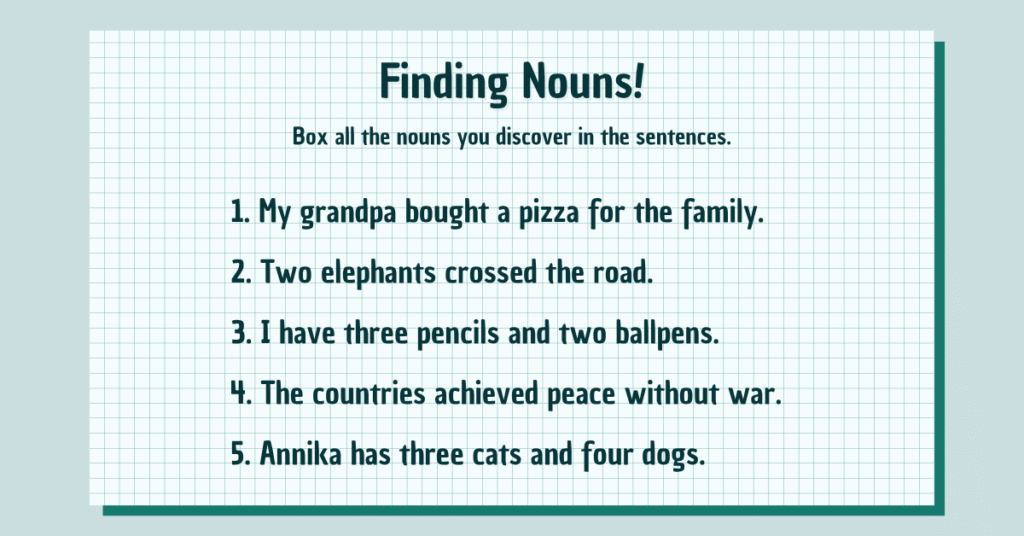
“A teacher walked into the room and placed a book on the table.”
Every noun in that sentence is a common noun — none points to a specific, named individual.
Common Noun vs. Proper Noun
The same concept can shift between common and proper depending on whether it names something specific.
| Common Noun | Proper Noun |
|---|---|
| river | the Amazon |
| city | Mumbai |
| planet | Jupiter |
| month | October |
| day | Saturday |
View the Course to Learn Noun

Proper Nouns
Definition and Examples
A proper noun names a specific, unique person, place, organization, or thing. Every proper noun is capitalized, regardless of where it appears in a sentence.
Examples:
- People: Mahatma Gandhi, Emily Brontë, Elon Musk
- Places: New Delhi, the Nile, Antarctica
- Organizations: UNESCO, Apple Inc., Harvard University
- Events: the Olympics, Diwali, World War II
- Works of art/literature: Hamlet, the Mona Lisa
- Days, months, holidays: Friday, January, Eid
“Priya visited the Louvre in Paris last July.”
Priya, Louvre, Paris, and July are all proper nouns.
Important Rule: Titles with Proper Nouns
When a title directly precedes a person’s name, it becomes part of the proper noun and is capitalized.
- “President Lincoln” ✔ (title + name)
- “The president spoke” ✔ (title used alone → lowercase)
Abstract Nouns
Definition and Examples
An abstract noun names something that cannot be physically touched, seen, or measured — an idea, emotion, quality, concept, or state.
Abstract nouns are among the most powerful words in the language. They carry the weight of argument, emotion, and thought.
Common categories of abstract nouns:
| Category | Examples |
|---|---|
| Emotions | love, fear, happiness, grief |
| Qualities | courage, honesty, patience, creativity |
| Concepts | justice, freedom, democracy, truth |
| States | childhood, poverty, health, confusion |
| Actions/processes | growth, failure, success, education |
“Her courage in the face of adversity inspired everyone in the room.”
Courage and adversity are both abstract nouns — you cannot hold either one in your hand.
Forming Abstract Nouns
Many abstract nouns are formed from adjectives, verbs, or other nouns using suffixes:
| Base Word | Suffix | Abstract Noun |
|---|---|---|
| kind (adj) | -ness | kindness |
| free (adj) | -dom | freedom |
| act (verb) | -ion | action |
| friend (noun) | -ship | friendship |
| brave (adj) | -ry | bravery |
| fail (verb) | -ure | failure |
Concrete Nouns
Definition and Examples
A concrete noun is a types of nouns that names something that exists physically — something you can perceive with at least one of your five senses: sight, sound, touch, taste, or smell.
Concrete nouns are the opposite of abstract nouns.
Examples by sense:
| Sense | Concrete Noun Examples |
|---|---|
| Sight | tree, star, shadow, colour |
| Sound | thunder, whisper, music |
| Touch | silk, gravel, warmth |
| Taste | chocolate, lemon, salt |
| Smell | perfume, smoke, petrichor |
“The rain drummed on the tin roof while coffee brewed on the stove.”
Rain, roof, coffee, and stove are all concrete nouns — real, physical things.
Abstract vs. Concrete: The Key Test
Ask: Can I experience this with my senses?
- “Fear” — cannot see, touch, or taste it → abstract
- “Stone” — can hold it, see it, feel its weight → concrete
Some nouns sit in a grey zone. “Music” is technically audible (concrete by sound), yet it also carries abstract qualities. Context usually makes the classification clear.
Parts of Speech (in English Grammar): Easily Detailed Explained
Countable Nouns
Definition and Rules
Countable nouns (also called count nouns) name things that can be individually counted. They have both singular and plural forms.
Rules that apply:
- Use a or an before singular countable nouns
- Add -s, -es, or use irregular forms for plurals
- Use numbers with them: three cats, two ideas, five problems
Examples and plural forms:
| Singular | Plural |
|---|---|
| book | books |
| child | children |
| city | cities |
| phenomenon | phenomena |
| ox | oxen |
Using Countable Nouns in Sentences
- “She wrote a letter.” (indefinite, singular)
- “She wrote three letters.” (counted, plural)
- “The letters were delivered.” (specific, definite)
Uncountable Nouns
Definition and Rules
Uncountable nouns is a type of nouns that (also called mass nouns or non-count nouns) name things that cannot be counted as individual units. They have no plural form and never take a or an.
Common uncountable nouns:
| Category | Examples |
|---|---|
| Liquids | water, milk, oil, blood |
| Materials | wood, sand, iron, cotton |
| Food substances | rice, flour, sugar, butter |
| Abstract ideas | advice, knowledge, information, wisdom |
| Academic subjects | physics, music, philosophy |
| Weather | rain, fog, thunder |
| Activities | swimming, reading (as concepts) |
Common Errors with Uncountable Nouns
These mistakes appear constantly, even in professional writing:
| Incorrect | Correct |
|---|---|
| an advice | a piece of advice |
| informations | information |
| furnitures | furniture or pieces of furniture |
| a luggage | a piece of luggage |
| researches | research or studies |
Quick tip: When you need to “count” an uncountable noun, use a partitive expression: a glass of water, two pieces of advice, three items of luggage.
Collective Nouns
Definition and Examples
A collective noun names a group of people, animals, or things as a single unit.
People:
| Collective Noun | Members |
|---|---|
| team | players |
| jury | jurors |
| committee | members |
| audience | spectators |
| crew | workers |
Animals:
| Collective Noun | Animal |
|---|---|
| flock | birds or sheep |
| pack | wolves or dogs |
| pride | lions |
| school / shoal | fish |
| colony | ants or bats |
| murder | crows |
| pod | whales or dolphins |
Things:
| Collective Noun | Items |
|---|---|
| bunch | grapes, flowers, keys |
| fleet | ships, cars |
| library | books |
| bouquet | flowers |
Singular or Plural Verb?
This is one of English grammar’s most debated questions. The answer depends on whether you treat the group as a single unit or as individual members.
- “The team is ready.” (acting as one unit → singular verb)
- “The team are arguing among themselves.” (acting as individuals → plural verb — more common in British English)
American English strongly prefers singular verbs with collective nouns. British English allows both.
Compound Nouns
Definition and Forms
A compound noun is a type of nouns by combining two or more words to create a new noun with its own meaning. The combined meaning is often different from the individual words.
Compound nouns appear in three forms:
| Form | Examples |
|---|---|
| Closed (one word) | toothbrush, sunlight, notebook, bedroom |
| Hyphenated | mother-in-law, editor-in-chief, well-being |
| Open (two words) | ice cream, bus stop, post office, swimming pool |
Stress Pattern Rule
In spoken English, compound nouns are typically stressed on the first element:
- “a BLACKbird” (a specific bird species)
- “a black BIRD” (any bird that happens to be black)
That stress difference alone can distinguish a compound noun from a simple noun-adjective combination.
Pluralizing Compound Nouns
Most compound nouns are pluralized at the end:
- notebook → notebooks
- ice cream → ice creams
But hyphenated compounds with a main noun in the middle pluralize the main noun:
- mother-in-law → mothers-in-law
- editor-in-chief → editors-in-chief
- passer-by → passers-by
Possessive Nouns
Definition and Rules
A possessive noun is a type of nouns that something belongs to or is associated with a noun. It uses an apostrophe.
Rules:
| Case | Rule | Example |
|---|---|---|
| Singular noun | Add ‘s | the student’s book |
| Plural noun ending in -s | Add ‘ only | the students’ books |
| Plural noun not ending in -s | Add ‘s | the children’s playground |
| Singular proper noun ending in -s | Add ‘s or ‘ (both accepted) | Charles’s hat or Charles’ hat |
“The company’s policy changed after last year’s review.”
Gerunds (Verbal Nouns)
What Is a Gerund?
A gerund is a verb form ending in -ing that functions as a noun. Gerunds look exactly like present participles, but they serve a different grammatical role.
- As subject: “Swimming strengthens the core.”
- As object: “She enjoys reading.”
- As object of preposition: “He is skilled at cooking.”
Gerunds are sometimes called verbal nouns because they carry the action of a verb while serving the function of a noun.
Gerund vs. Participle test: If the -ing word is the subject or object of the sentence, it is a gerund (noun). If it describes a noun or is part of a continuous tense, it is a participle (adjective/verb).
- “Running is my therapy.” → Gerund (subject)
- “The running water was cold.” → Participle (modifying “water”)
Comparison Table: All Noun Types at a Glance
| Noun Type | Naming | Capitalized? | Plural? | Article? | Example |
|---|---|---|---|---|---|
| Common | General category | No | Yes | Yes | teacher, river |
| Proper | Specific individual | Yes | Rarely | Sometimes | Ganges, Einstein |
| Abstract | Ideas/emotions | No | Rare | Sometimes | justice, love |
| Concrete | Physical things | No | Usually | Yes | stone, rain |
| Countable | Countable units | No | Yes | Yes | book → books |
| Uncountable | Mass/bulk | No | No | No (a/an) | water, advice |
| Collective | Group as unit | No | Yes | Yes | herd, committee |
| Compound | Combined words | No | Yes | Yes | toothbrush |
| Possessive | Ownership | No | N/A | N/A | teacher’s, team’s |
| Gerund | Verb-as-noun | No | No | Sometimes | Swimming, eating |
Common Mistakes with Noun Types
Mistake 1: Pluralizing uncountable nouns
✗ “She gave me many advices.” ✔ “She gave me a lot of advice.”
Mistake 2: Forgetting apostrophes in possessives
✗ “The students books were lost.” ✔ “The students’ books were lost.”
Mistake 3: Using wrong verb agreement with collective nouns
✗ “The committee have made their individual decision.” (mixing singular with plural pronoun) ✔ “The committee has made its decision.” (consistent singular) ✔ “The committee members have made their decisions.” (if individual action intended)
Mistake 4: Capitalizing common nouns incorrectly
✗ “She became a Doctor.” ✔ “She became a doctor.” ✔ “She visited Dr. Mehta.” (proper noun with title)
Mistake 5: Misplacing apostrophes in compound possessives
✗ “My mothers-in-law’s advice” (if only one) ✔ “My mother-in-law’s advice” (singular possessive) ✔ “My mothers-in-law’s advice” (plural possessive)
Mistake 6: Treating gerunds as verbs
✗ “Running fast is his hobby.” → (Is “Running fast” here a problem? No — but the confusion arises when someone treats the gerund phrase as if it needs a verb complement instead of a noun complement.)
The safer test: replace the -ing word with a pronoun. If “It is his hobby” works, then “Running” is a gerund (noun).
Expert Tips for Using Nouns Correctly
Tip 1: Test countability at the dictionary stage When learning a new noun, immediately check whether it is countable (C) or uncountable (U) in a learner’s dictionary like Oxford or Cambridge. This one habit prevents hundreds of errors over time.
Tip 2: Use the “which one?” test for proper nouns If you can answer “which specific one?” — it is probably a proper noun that needs a capital letter. If the answer is “any one in this category,” it is a common noun.
Tip 3: Listen for compound noun stress Say a compound noun aloud and hear where the stress falls. If the stress lands on the first word (SUNlight, TOOTHbrush), you have a true compound. If both words carry equal stress, it may still be a noun phrase in progress.
Tip 4: Abstract nouns make writing precise — use them intentionally Abstract nouns let you name concepts directly: “There was a lack of clarity in the presentation” is sharper than “The presentation was not very clear.” But overusing abstract nouns makes prose dense. Balance them with concrete, sensory language.
Tip 5: Check collective noun conventions by variety of English If you write for British publications, both singular and plural verbs with collective nouns are acceptable. For American audiences, stick to singular verbs. Consistency within a piece matters more than choosing one rule.
Key Takeaways
✅ A noun names a person, place, thing, idea, or quality and can function as a subject, object, or complement.
✅ Common nouns are general; proper nouns are specific and always capitalized.
✅ Abstract nouns name ideas and feelings you cannot physically sense; concrete nouns name things you can.
✅ Countable nouns have plural forms and take a/an; uncountable nouns do not.
✅ Collective nouns name groups and can take singular or plural verbs depending on context and regional convention.
✅ Compound nouns combine words into a single noun and can be closed, hyphenated, or open.
✅ Gerunds are -ing verb forms that function grammatically as nouns.
✅ One noun can belong to multiple categories simultaneously (team = common + concrete + collective).
Frequently Asked Questions
-
What are the main types of nouns in English?
The main types of nouns in English are common nouns, proper nouns, abstract nouns, concrete nouns, countable nouns, uncountable nouns, collective nouns, compound nouns, possessive nouns, and gerunds (verbal nouns). These categories overlap — a single noun can belong to several types at once depending on how it is used in context.
-
What is the difference between an abstract noun and a concrete noun?
A concrete noun names something you can perceive with your senses — rain, stone, music. An abstract noun names something that exists only in thought or feeling — freedom, sadness, justice. The simplest test: ask whether you can physically experience it. If yes, it is concrete. If it exists only as an idea or emotion, it is abstract.
-
How do I know if a noun is countable or uncountable?
Check whether the noun has a plural form and whether you can use a number with it. “Three books” works — book is countable. “Three waters” does not work in the same way — water is uncountable. Learner’s dictionaries mark countable nouns as (C) and uncountable nouns as (U), which is the most reliable reference.
-
Can a noun be both abstract and uncountable?
Yes, and this is very common. Most abstract nouns are also uncountable: love, knowledge, freedom, advice. They name concepts that cannot be counted individually. You say “She gave me advice”, not “She gave me an advice.” To count them, you need a partitive: “a piece of advice.”
-
What is a collective noun? Can it take a plural verb?
A collective noun names a group as a single unit — jury, team, flock, committee. In American English, collective nouns almost always take a singular verb: “The jury has reached a verdict.” In British English, plural verbs are also acceptable when the group’s members are acting individually: “The jury are divided in their opinions.” Consistency within a piece of writing matters most.
-
What is a compound noun and how do you pluralize it?
A compound noun is formed by combining two or more words into a new noun with its own meaning: notebook, swimming pool, mother-in-law. Most compounds are pluralized at the end: notebooks, swimming pools. Hyphenated compounds with a core noun in the middle pluralize the main noun: mothers-in-law, editors-in-chief.
-
Do proper nouns always use “the”?
Most proper nouns do not take the — India, Shakespeare, London. However, some proper nouns conventionally require the: countries with plural or “state/republic” names (the United States, the Netherlands), rivers and oceans (the Thames, the Pacific), mountain ranges (the Himalayas), and certain institutions (the United Nations, the Louvre). These are best learned as fixed phrases.
-
Can the same word be different types of nouns in different contexts?
Yes, absolutely. The word light, for example, is a concrete noun (“Turn off the light”), but can shift in meaning and classification depending on context. “Team” is simultaneously a common, concrete, and collective noun. Even abstract nouns like “love” can be treated as concrete in poetry — “Love walked in through the door.” Noun classification is always context-sensitive, not fixed to the word alone.
Conclusion
The types of nouns in English are not just a grammar checklist — they are the structural logic behind how language names and organizes reality. Every time you write a sentence, you make noun choices that affect clarity, tone, and grammatical correctness.
Common versus proper tells you about specificity and capitalization. Abstract versus concrete shapes how vivid or conceptual your writing feels. Countable versus uncountable controls your article use and plural formation. Collective nouns raise questions of singular or plural agreement. Compound nouns follow their own stress and pluralization patterns.
The good news is that none of this needs to be memorized in a single sitting. Learn the categories, keep a dictionary nearby for countability checks, and notice how skilled writers use these distinctions. Grammar, at its best, is not a set of rules to follow — it is a set of tools that lets you say exactly what you mean.