Introduction
The William Wordsworth biography is, at its core, the story of grief transformed into genius. Born into loss, shaped by revolution, and redeemed by nature, Wordsworth became one of the most consequential poets in the English language. He did not merely write about the natural world — he argued, passionately and convincingly, that nature was the greatest teacher humanity had ever known.
This article covers his early life and education, his radical years in France, his creative partnership with Samuel Taylor Coleridge, his major works, his poetic philosophy, and the legacy he left behind. By the end, you will understand not just what Wordsworth wrote, but why it still matters.
Who was William Wordsworth?
William Wordsworth (1770–1850) was an English Romantic poet who co-authored Lyrical Ballads (1798) with Samuel Taylor Coleridge, helping launch the English Romantic movement. Known for his deep reverence for nature and ordinary life, he served as Britain’s Poet Laureate from 1843 until his death in 1850.
Early Life and Childhood
William Wordsworth was born on April 7, 1770, in Cockermouth, Cumberland, England. He was the second of five children born to John Wordsworth, an attorney, and Ann Cookson. The family home sat beside the River Derwent, and that proximity to moving water, open fields, and the rugged northern landscape planted seeds in the boy’s imagination that would flower for the next eight decades.
His formative years were marked by tragedy and a sense of isolation. His mother died when he was eight, and his father passed away when he was thirteen, leaving him and his siblings effectively orphaned. The children were dispersed among relatives — a painful fragmentation that instilled in Wordsworth a lifelong longing for belonging and connection.
Yet even in grief, nature offered something. Brought up by his father, Wordsworth was exposed to a wide range of books. His father’s library introduced him to Milton, Shakespeare, and Spenser, which sparked a lasting interest in literature. The loss of both parents did not diminish him — it deepened him.
Education: Hawkshead Grammar School and Cambridge
Wordsworth’s formal education began at Hawkshead Grammar School, where he nurtured his early poetic skills. Hawkshead, in the Lake District, gave him something no classroom fully could: unrestricted access to the landscape. He roamed the fells, skated on frozen lakes, and rowed across the waters of Esthwaite. These experiences were not incidental to his development as a poet — they were the curriculum.
Wordsworth entered St. John’s College, Cambridge, in 1787. Repelled by the competitive pressures there, he elected to idle his way through university, convinced that he was “not for that hour, nor for that place.” Mathematics, a dominant subject at Cambridge, held little appeal for him. What captivated him was poetry, and he spent his long vacations on walking tours across Britain and Europe.
In 1787 he also published his first poem — a sonnet that appeared in the European Review. It was a modest debut, but it signalled a direction. At this early stage, no one could have predicted that a decade later Wordsworth would become the spokesperson for a revolution in English poetry.
He graduated in January 1791 with a pass degree — unremarkable by academic standards, but his mind had been shaped by landscapes rather than lecture halls.
France, Revolution, and Annette Vallon
The most important thing Wordsworth did during his college years was devote his summer vacation in 1790 to a long walking tour through revolutionary France. There he was caught up in the passionate enthusiasm that followed the fall of the Bastille and became an ardent republican sympathiser. Encyclopedia Britannica
He returned to France after graduation in late 1791. He attended sessions of the National Assembly and the Jacobin Club, and in December 1791 he met and fell in love with Annette Vallon. Before their child, Caroline, was born in December 1792, Wordsworth had to return to England and was cut off there by the outbreak of war between England and France. He was not to see his daughter until she was nine.
This episode — the abandoned lover, the unseen child, the guilt of a man caught between two countries at war — cast a long shadow over his emotional life. Many scholars believe the anguish of this period surfaces repeatedly in his poetry, particularly in poems about abandoned women and lost children. Wordsworth kept his affair with Annette quiet for years, especially since the child was born out of wedlock.
In 1802, before marrying Mary Hutchinson, Wordsworth and his sister Dorothy visited Annette and Caroline in Calais. The purpose of the visit was to pave the way for his forthcoming marriage. It was the final formal chapter of a relationship that had shaped one of literature’s most emotionally complex decades.
The Dark Years and Dorothy’s Influence
The three or four years that followed his return to England were the darkest of Wordsworth’s life. Unprepared for any profession, rootless, virtually penniless, and bitterly hostile to his own country’s opposition to the French, he lived in London among radicals and learned to feel a profound sympathy for the abandoned mothers, beggars, children, vagrants, and victims of England’s wars who began to appear in his somber poems.
The turning point came in 1795. A legacy of £900 from a friend made it possible for Wordsworth to reunite with his beloved sister Dorothy, and the two settled together at Racedown in Dorsetshire. This reunion was transformative. Dorothy was not merely his sister — she was his most attentive reader, his emotional anchor, and his sharpest observer of the natural world. Her journals, many scholars argue, provided raw material that found its way directly into his verse.
The bond between William and Dorothy Wordsworth is one of the most celebrated sibling relationships in literary history. William and Dorothy Wordsworth were never again to live apart.
Friendship with Coleridge and Lyrical Ballads
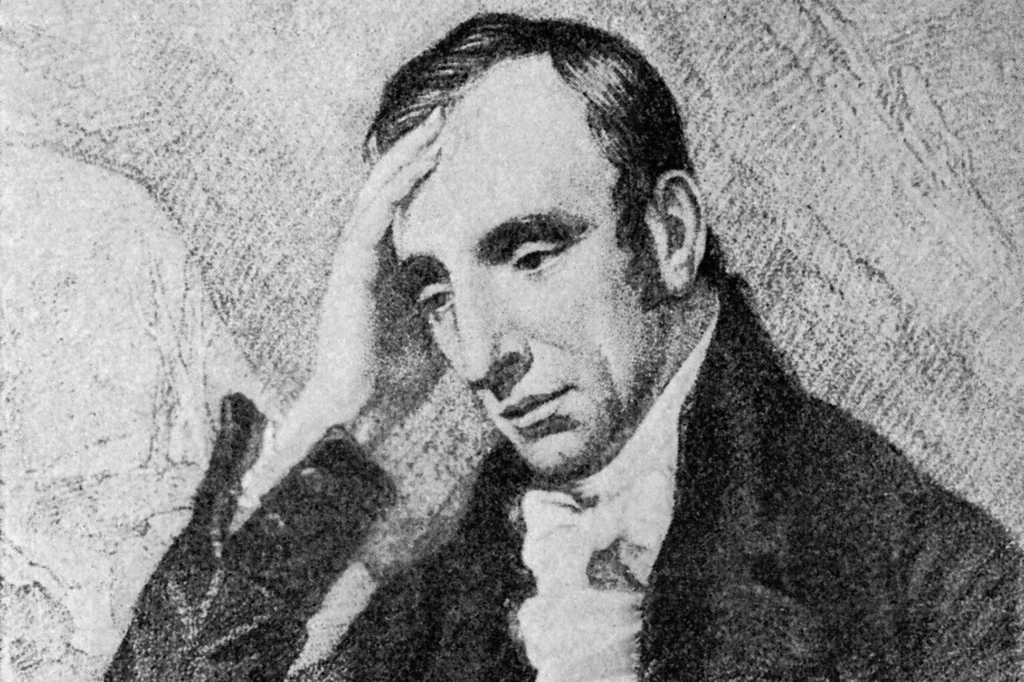
The beginning of Wordsworth’s friendship with Coleridge in 1795 confirmed his resolve to devote himself entirely to poetry. He soon moved with Dorothy to Alfoxden in the Quantock Hills, Somerset, to be near Coleridge, who was then living at Nether Stowey nearby.
William Wordsworth: Life, Major Works & Complete Literary Legacy (2026 Guide)
The two poets were opposites in temperament but equals in ambition. What emerged from their collaboration changed English literature permanently.
One result of the intimacy was the planning of a joint work, Lyrical Ballads, to which Coleridge contributed The Ancient Mariner and Wordsworth contributed, among other pieces, Tintern Abbey. The first edition appeared in 1798. Read & Co. Books
The book divided its labour deliberately. Coleridge was to handle the supernatural — making the fantastical feel emotionally true. Wordsworth was to handle the ordinary — making the everyday feel profound and strange. Together, they intended to show that poetry could speak in the language of real people about the full range of human experience.
The preface to the 1800 second edition, written by Wordsworth, became a manifesto of the Romantic movement. He defined poetry as “the spontaneous overflow of powerful feelings” arising from “emotion recollected in tranquillity” — a phrase that has echoed through literary criticism for over two centuries.
Why Lyrical Ballads Was Revolutionary
| Feature | Before Lyrical Ballads | After Lyrical Ballads |
|---|---|---|
| Language | Elevated, classical diction | Everyday speech of common people |
| Subjects | Heroic figures, mythology | Rustic life, nature, the poor |
| Emotion | Restrained, formal | Direct, personal, sincere |
| Nature | Decorative backdrop | Central moral force |
| Purpose | Entertain the educated elite | Speak to universal human experience |
The Great Decade: 1797–1808
Stirred simultaneously by walks in the English countryside and by his relationships with Dorothy and Coleridge, Wordsworth wrote most of his major works during the “great decade” of 1797–1808.
This period produced a body of work that arguably remains unmatched in English Romantic poetry. The poems he wrote during these years were not merely beautiful — they constituted a new way of thinking about human consciousness, memory, identity, and our relationship to the non-human world.
His output was remarkable for its range: from short lyric gems to extended autobiographical epic, from the melancholy sonnet to the meditative ode.
Major Works and Poems
Lyrical Ballads (1798, 1800)
The foundational text of English Romanticism. The 1800 preface established the theoretical basis for a new kind of poetry rooted in natural language, emotional truth, and democratic sympathy.
The Prelude (written 1798–1805, published 1850)
Wordsworth’s greatest achievement by most scholarly accounts. This book-length autobiographical poem traces the growth of the poet’s mind from childhood to maturity. He began The Prelude during his time in Goslar, Germany, in 1798. He revised it repeatedly over the next four decades but never published it during his lifetime. It was published after his death by his wife, Mary.
“Lines Written a Few Miles Above Tintern Abbey” (1798)
One of the most analysed poems in the English language. Set on the banks of the River Wye, it meditates on the relationship between memory, nature, and the human mind across time. The poem moves from landscape description to philosophical reflection with an effortless fluidity that defined Romantic lyric poetry.
“I Wandered Lonely as a Cloud” (1807)
Known popularly as “Daffodils,” this poem captures a moment in which a field of flowers seen years earlier suddenly floods back into memory and lifts the speaker’s spirit. It perfectly illustrates Wordsworth’s belief that nature stores itself in the mind and returns as emotional sustenance.
“Ode: Intimations of Immortality” (1807)
This ode is among the major works Wordsworth produced during his great decade. It explores childhood’s instinctive sense of the divine and the gradual loss of that visionary power as we age. Philosophically rich, emotionally honest, and technically masterful, it remains one of the finest odes in the English language. Encyclopedia Britannica
“The Solitary Reaper” (1807)
A brief, haunting lyric about a Highland girl singing alone in a field. The poem’s central question — what is she singing? — is never answered, and that unresolved mystery is precisely the point.
“Resolution and Independence” (1807)
A meditation on perseverance prompted by an encounter with an aged leech-gatherer on a moorland road. The poem is a quiet study in dignity and stoic endurance.
Summary of Major Works
| Work | Year | Significance |
|---|---|---|
| Lyrical Ballads | 1798/1800 | Launched the Romantic movement |
| “Tintern Abbey” | 1798 | Defining nature meditation |
| The Prelude | Written 1798–1805, pub. 1850 | Autobiographical masterpiece |
| “I Wandered Lonely as a Cloud” | 1807 | Most beloved lyric |
| “Ode: Intimations of Immortality” | 1807 | Philosophical peak of his poetry |
| “The Solitary Reaper” | 1807 | Perfect Romantic lyric |
| The Excursion | 1814 | Major philosophical poem |
8. Wordsworth’s Poetic Philosophy
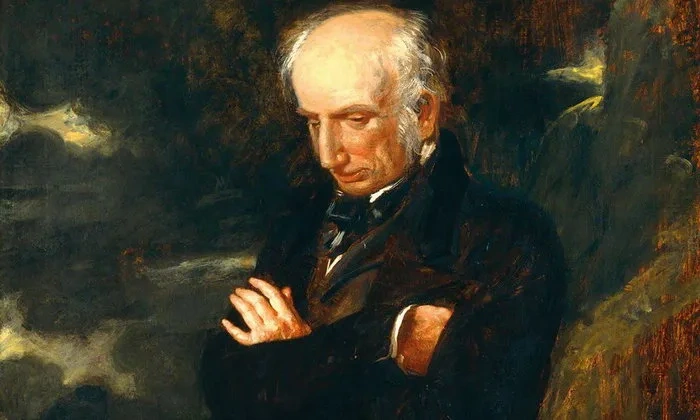
Three ideas sit at the core of Wordsworth’s poetics, and understanding them clarifies not just what he wrote but how he changed literature.
Nature as moral educator. For Wordsworth, the natural world was not merely scenery. It was a living, active force that shaped human consciousness, taught ethical feeling, and provided spiritual sustenance. He formulated a new attitude toward nature — not merely introducing nature imagery, but presenting a fresh view of the organic relation between humans and the natural world.
Emotion recollected in tranquillity. Poetry, in Wordsworth’s definition, does not emerge in the moment of experience but through memory. The mind processes an experience, strips away its noise, and distils what remains into something universal. This theory of memory and composition was radical — it made the inner life, not external events, the subject of poetry.
The language of ordinary people. Wordsworth was deliberately political in choosing to write in plain English about plain people. He rejected the ornate classical diction that dominated eighteenth-century verse. His poetic subjects — shepherds, beggars, old men on moorland roads — were a statement: every human life is worth a poem.
9. Later Life and the Poet Laureateship
After the great decade, Wordsworth’s creative output gradually declined in intensity, though not in volume. He settled at Rydal Mount in the Lake District in 1813, where he would live for the rest of his life. The radical young poet became, with time, a figure of the establishment — politically conservative, religiously orthodox, and occasionally the target of criticism from younger Romantic poets like Byron and Keats, who viewed his later work as a betrayal of his early ideals.
The later part of Wordsworth’s life saw him appointed Poet Laureate of the United Kingdom from 1843 to 1850, the year of his death. He is said to have accepted the honour on the condition that he would not be expected to produce official verse — a telling detail about a man who had always believed poetry answered to no authority but its own truth.
He married Mary Hutchinson in 1802 and had five children with her. Even though Wordsworth lost three of his children, he did not stop writing, and continued to produce work exploring nature’s beauty, spirituality, and human emotion.
Wordsworth died of pleurisy on 23 April 1850 and was buried in St Oswald’s Church, Grasmere. His grave remains one of the most visited literary sites in England. University of Mustansiriyah
10. Themes in Wordsworth’s Poetry
| Theme | Description | Key Poems |
|---|---|---|
| Nature | The natural world as teacher and healer | “Tintern Abbey,” “Daffodils,” “Nutting” |
| Memory | How past experiences shape the present self | The Prelude, “Tintern Abbey” |
| Childhood | Innocence and the loss of visionary power | “Ode: Intimations of Immortality” |
| Ordinary life | Dignity of common people and everyday experience | “Michael,” “The Old Cumberland Beggar” |
| Solitude | Creative power found in solitary experience | “The Solitary Reaper” |
| Time and loss | The passage of time and its emotional toll | “Mutability,” “Elegiac Stanzas” |
| The sublime | Awe and terror in the face of vast natural forces | The Prelude, “Simplon Pass” |
Common Misconceptions
Wordsworth was always a nature poet. Not quite. His early poems deal as much with political suffering, social injustice, and human abandonment as with landscapes. The nature focus intensified over time, but the human dimension never disappeared entirely.
He and Coleridge were always close. Their friendship was intense but ultimately complicated. By the early 1800s, personal tensions and diverging creative philosophies had created a distance that never fully closed.
Wordsworth’s later work was artistically worthless. This is a harsh overstatement. While most scholars agree his creative fire dimmed after 1808, works like The Excursion (1814) and his late sonnets contain passages of genuine power.
“I Wandered Lonely as a Cloud” was inspired purely by Wordsworth himself. Dorothy’s journal entry from 15 April 1802 contains a vivid description of the same field of daffodils near Ullswater. Wordsworth drew directly on her account — a reminder that their creative lives were deeply intertwined.
William Wordsworth’s Legacy
William Wordsworth’s impact on English poetry is immeasurable, and his literary legacy continues to be celebrated. He is remembered as a pioneer of Romantic poetry.
His influence spread in several directions simultaneously. He changed what poetry was allowed to be about — proving that a field of daffodils or an old shepherd’s grief could carry the full weight of human meaning. He changed who poetry was for — insisting it belonged to all people, not just the educated elite. And he changed the relationship between the poet and the natural world, elevating that relationship into something almost spiritual.
Later poets — from Keats and Shelley in his own era to Gerard Manley Hopkins, Thomas Hardy, Ted Hughes, and Seamus Heaney in subsequent centuries — all carry traces of his influence. The American Romantic tradition, including writers like Emerson and Thoreau, owes a substantial debt to Wordsworth’s vision of nature as moral teacher.
In academic study, he remains a cornerstone of undergraduate English curricula across the USA, UK, India, and beyond. The Prelude is widely regarded as one of the greatest autobiographical poems ever written in any language.
Key Takeaways
- William Wordsworth was born on 7 April 1770 in Cockermouth, Cumberland, England.
- He lost both parents in childhood, experiences that deeply shaped his emotional sensibility.
- His partnership with Coleridge produced Lyrical Ballads (1798), which launched the English Romantic movement.
- His “great decade” (1797–1808) produced most of his finest work, including “Tintern Abbey,” “Daffodils,” and the Ode: Intimations of Immortality.
- He defined poetry as “the spontaneous overflow of powerful feelings” arising from “emotion recollected in tranquillity.”
- The Prelude, his autobiographical masterpiece, was published posthumously in 1850.
- He served as Britain’s Poet Laureate from 1843 until his death on 23 April 1850.
- His legacy reshaped English poetry’s relationship to nature, memory, ordinary life, and emotional truth.
Expert Tips for Students Studying Wordsworth
- Read the 1800 Preface to Lyrical Ballads first. It functions as Wordsworth’s own critical manifesto and provides the framework for understanding everything else he wrote.
- Read Dorothy’s journals alongside his poems. The overlap is striking and illuminating.
- Don’t skip The Prelude. It is long, but the “spots of time” passages in Books I and II are among the most extraordinary things written in English Romantic poetry.
- Compare the 1799, 1805, and 1850 versions of The Prelude if you are writing a research paper — the revisions tell a story of a man rethinking his own life and beliefs over fifty years.
- Pay attention to the interplay between description and reflection in his longer poems. Wordsworth rarely stays in pure description for long before the landscape becomes a lens for examining inner experience.
Frequently Asked Questions
-
When and where was William Wordsworth born?
William Wordsworth was born on April 7, 1770, in Cockermouth, Cumberland, England. He grew up surrounded by the landscapes of the Lake District, which would shape his poetry throughout his life. His birthplace is now a National Trust property open to the public.
-
What is William Wordsworth best known for?
Wordsworth is best known for co-authoring Lyrical Ballads (1798) with Samuel Taylor Coleridge, which launched the English Romantic movement. He is also celebrated for The Prelude, “I Wandered Lonely as a Cloud,” “Tintern Abbey,” and the “Ode: Intimations of Immortality,” all of which remain central texts in English literary study.
-
What is the main theme of Wordsworth’s poetry?
Nature is the dominant theme, but it is inseparable from related themes of memory, childhood, solitude, and the growth of human consciousness. Wordsworth believed the natural world had the power to heal, educate, and morally sustain the human mind — a conviction that runs through virtually everything he wrote.
-
What was Wordsworth’s contribution to the Romantic movement?
The principles Wordsworth outlined in the preface to the second edition of Lyrical Ballads (1800) were revolutionary. He argued for poetry written in the language of ordinary people, about subjects drawn from everyday life, and driven by genuine emotional truth rather than classical convention. These principles defined Romanticism as much as any other single document.
-
Did Wordsworth have children?
Yes. He had an illegitimate daughter, Caroline, born in December 1792 with Annette Vallon in France. He later married Mary Hutchinson, who bore him five children. Sadly, three of those children died during his lifetime.
-
What is The Prelude about?
The Prelude is an autobiographical poem tracing the development of Wordsworth’s mind from childhood through young adulthood. It explores how key formative experiences — moments he called “spots of time” — shaped his imagination and sense of self. It is often described as the first great psychological autobiography in poetry.
-
When did Wordsworth become Poet Laureate?
Wordsworth was appointed Poet Laureate of the United Kingdom in 1843, a position he held until his death in 1850. He was reportedly reluctant to accept the role, agreeing only on the understanding that he would not be required to produce ceremonial verse.
-
How did Wordsworth die?
Wordsworth died of pleurisy on 23 April 1850 and was buried in St Oswald’s Church, Grasmere. He was 80 years old. His wife Mary supervised the posthumous publication of The Prelude later that same year.
-
What is the relationship between Wordsworth and Coleridge?
Their friendship began in 1795 and immediately confirmed Wordsworth’s resolve to commit fully to poetry. Their collaboration produced Lyrical Ballads, one of the most influential books in English literary history. Though their personal relationship grew complicated over time, their shared creative vision in the late 1790s permanently changed the direction of English poetry.
-
Why is Wordsworth still relevant today?
Wordsworth’s insistence that the natural world is essential to human wellbeing feels more urgent now than it did in 1798. His poetry of attention — of slowing down to notice a field, a river, a passing cloud — offers a counter-model to the speed and noise of contemporary life. His work also remains a foundational text for understanding the philosophy of mind, the psychology of memory, and the ethics of environmental relationship.
Conclusion
The William Wordsworth biography is not simply a literary timeline. It is the record of a mind shaped by loss, radicalized by revolution, steadied by nature, and ultimately committed to the belief that ordinary human experience contains extraordinary meaning. From the orphaned boy roaming the fells of Cumbria to the Poet Laureate buried in the churchyard at Grasmere, Wordsworth’s life and his poetry are inseparable.
He gave English literature a new language, a new range of subjects, and a new purpose. More than two centuries after Lyrical Ballads appeared, readers still find in his poems something that feels essential — a reminder that attention, memory, and the natural world have the power to restore us.
Recommended Authority Links
- Wordsworth Trust (official) — wordsworth.org.uk
- British Library — Romantics collection — bl.uk
- National Trust — Wordsworth’s birthplace — nationaltrust.org.uk