Table of Contents
Introduction
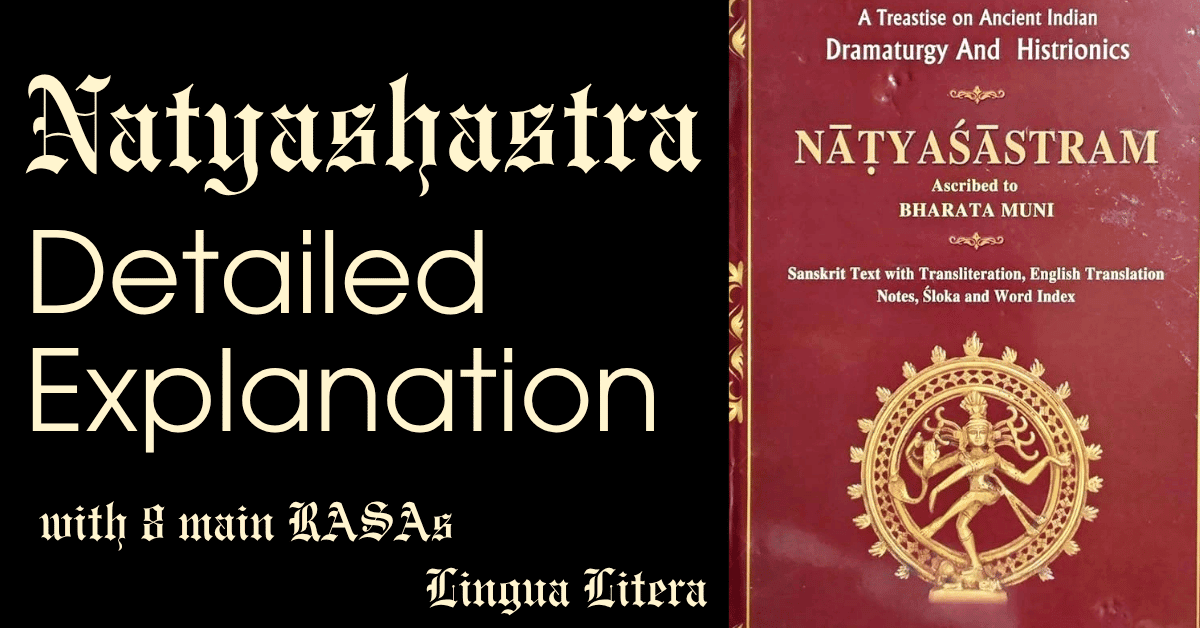
More than two thousand years ago, a sage named Bharata Muni wrote a treatise that would shape every classical Indian art form that exists today. The Natyashastra — a Sanskrit text on drama, music, dance, and performance — did something no other artistic manual had done before. It did not simply describe how to perform. It explained, with philosophical precision, why art moves us. The Natyashastra rasas are the important element for the recent drama in english literature also.
At the centre of the Natyashastra rasas is a deceptively simple question: what happens inside an audience member when great art is performed? Bharata’s answer — codified over 36 chapters and roughly 6,000 verses — is the theory of rasa: the idea that art creates a refined aesthetic experience, distinct from everyday emotion, which is universally accessible to a sensitive audience.
This guide covers everything from the structure of the Natyashastra and Bharata’s famous rasa formula to a detailed analysis of each of the eight original rasas, the Bhava system that supports them, Abhinavagupta’s landmark commentary, and the critical debates this text has inspired across centuries of scholarship.
Quick Overview
What are the eight rasas in the Natyashastra? The eight rasas described by Bharata Muni in the Natyashastra are: Shringara (love/romance), Hasya (laughter/comedy), Karuna (compassion/sorrow), Raudra (fury), Veera (heroism), Bhayanaka (fear), Bibhatsa (disgust), and Adbhuta (wonder). Each rasa corresponds to a permanent emotion (sthayi bhava) and is evoked through a combination of determinants, consequents, and transitory states.

What Is the Natyashastra?
The Natyashastra (also spelled Natya Shastra) is an ancient Sanskrit treatise on the performing arts, traditionally attributed to the sage Bharata Muni. Scholars date its composition to somewhere between 200 BCE and 200 CE, though this remains debated. The text itself claims a divine origin — Brahma is said to have distilled the essence of the four Vedas and entrusted it to Bharata, making drama the Fifth Veda.
This is not artistic mythology. The claim carries a serious argument: that drama, by bringing together poetry, music, gesture, emotion, and spectacle, reaches what no single Vedic text can — the complete human experience.
The Natyashastra covers an extraordinary range of subjects: stage design, costume, makeup, musicology, prosody, dramatic structure, acting technique, the psychology of emotion, and the philosophy of aesthetic experience. It is simultaneously a practitioner’s handbook and a work of aesthetic philosophy.
Bharata Muni: Author and Context

Traditional scholarship attributes the entire Natyashastra to a single author, Bharata Muni. Modern scholars, however, suggest the text may have been compiled over centuries by multiple contributors, with Bharata as either the primary author or a revered name under which the work was unified.
What is certain is that Bharata wrote during a period when Sanskrit drama was already a sophisticated art form in India. The Natyashastra does not invent theatre — it codifies and philosophically grounds a practice already flourishing around it. Its genius is systematic: it takes what performers knew intuitively and turns it into a coherent aesthetic science.
Structure of the Natyashastra
The text comprises 36 chapters covering:

According to scripture itself, “The recitative (pāṭhya) he took from the Ṛgveda, the song from the Sāmaveda, the Histrionic Representation (abhinaya) from the Yajurveda and Sentiments (rasa) from the Atharvaveda and thus was created the Nāṭyaveda.” (Ch-1). With thirty-six chapters and over six thousand verses, this is an encyclopaedia of NāṭyaVidyā (Vidyā of dance, drama and music).
| Chapter Range | Subject |
|---|---|
| Chapter 1 | Mythological origin of theatre |
| Chapters 2–5 | Stage design and theatre architecture |
| Chapter 6 | Rasa theory (Rasadhyaya) — the heart of the text |
| Chapter 7 | Bhava theory (Bhavadhyaya) |
| Chapters 8–12 | Body movements, gestures, and semiotics of expression |
| Chapter 13 | Space and blocking on stage |
| Chapter 18 | The ten forms of Sanskrit drama (Dasharupaka) |
| Chapters 28–34 | Music, vocals, instruments |
| Chapter 36 | The purpose and conclusion of theatre |
Chapters 6 and 7 — the Rasadhyaya and Bhavadhyaya — are widely considered the philosophical nucleus of the entire work and the most influential chapters in the history of Indian aesthetics.
What Is Rasa? The Core Philosophy

The word rasa in Sanskrit has several meanings: juice, essence, flavour, taste. In the aesthetic context Bharata creates, rasa refers to a refined emotional experience that a sensitive audience member (the sahrdaya, literally “one who has heart”) savours when art is performed well.
Rasa is not the same as an everyday emotion. If you witness a road accident and feel grief, that is raw emotion (bhava). If you watch a great actor portray grief on stage and feel something profound — moved, elevated, aesthetically transformed — that is rasa. The same emotional territory, but encountered through artistic mediation rather than personal experience.
Bharata defines the purpose of drama with elegant clarity in verse 6.10:
Drama is that which aesthetically arouses joy in the spectator, through the medium of the actor’s art, and helps connect and transport the individual into a supersensual inner state of being.
This is crucial. Entertainment is a byproduct of great art, not its goal. The goal is the rasa experience — a form of aesthetic bliss that connects the individual to something larger than everyday consciousness.
The Rasa Formula: Vibhava, Anubhava, Vyabhicharibhava
Bharata’s most famous formulation — often called the Rasasutra — appears in Chapter 6:
“Vibhava anubhava vyabhichari samyogad rasanishpattih”
Translation: Rasa is produced from the combination of Vibhava, Anubhava, and Vyabhicharibhava.
This is the engine of rasa production. Understanding these three components is essential to understanding how the theory works.
Vibhava — The Determinants
Vibhava refers to the causes or stimuli that awaken emotion. Bharata identifies two types:
- Alambana Vibhava: The primary object or person who triggers the emotion. In Shringara rasa (love), for instance, the beloved is the alambana vibhava.
- Uddipana Vibhava: Enhancing circumstances that intensify the emotion — moonlight, the fragrance of flowers, a love song playing softly. These are the atmospheric amplifiers.
Anubhava — The Consequents
Anubhava refers to the outward physical manifestations of inner emotion — the bodily reactions through which both the performer and the audience recognise that an emotion has been aroused. Weeping, trembling, a particular glance, a posture of pride — these are anubhavas. They are not causes; they are recognisable effects.
Vyabhicharibhava — The Transitory States
These are the 33 fleeting emotional states that accompany and intensify the dominant emotion without displacing it. Joy, anxiety, impatience, recollection, shame, and excitement are examples. They come and go like waves, strengthening the central emotional experience.
Together, these three elements work on the sthayi bhava — the dominant, stable emotion — to transform it into its corresponding rasa.
The Eight Rasas in Natyashastra — Detailed Analysis

Bharata enumerates eight rasas in the Natyashastra, each paired with a dominant emotion (sthayi bhava), a presiding deity, and a colour.
1. Shringara — The Erotic / Romantic
- Sthayi Bhava: Rati (love, longing)
- Presiding Deity: Vishnu
- Colour: Green (Shyama)
- Analysis: Shringara is considered the king of rasas — the most complete and fundamental of all aesthetic experiences. It has two dimensions: Sambhoga Shringara (the joy of union) and Vipralambha Shringara (the anguish of separation). Some scholars argue that all other rasas ultimately derive from or relate back to Shringara. It appears prominently in the Ramayana, Meghaduta, and the poetry of Kalidasa.
2. Hasya — The Comic / Humorous
- Sthayi Bhava: Hasa (laughter, amusement)
- Presiding Deity: Shiva
- Colour: White
- Analysis: Hasya arises from something incongruous, absurd, or unexpected. Bharata describes six varieties — from gentle amusement (smita) to loud, uncontrolled laughter (atihasita). Significantly, Bharata notes that Hasya often arises from Shringara — physical awkwardness, misunderstanding between lovers, or comic self-importance in romantic pursuit.
3. Karuna — The Pathetic / Compassionate
- Sthayi Bhava: Shoka (grief, sorrow)
- Presiding Deity: Yama (god of death)
- Colour: Grey (dove-coloured)
- Analysis: Karuna is evoked by loss — death of a loved one, separation, defeat, or any profound suffering. It is a central rasa in the Mahabharata and the Ramayana. The Valmiki Ramayana itself is said to have been born from grief: the poet witnessed a hunter kill a kraunch bird mid-flight, and his anguished curse spontaneously took the form of a verse. Karuna remains the most emotionally resonant rasa for general audiences.
4. Raudra — The Furious
- Sthayi Bhava: Krodha (anger, wrath)
- Presiding Deity: Rudra (Shiva in his fierce aspect)
- Colour: Red
- Analysis: Raudra represents righteous anger, fierce indignation, and explosive wrath. It is distinct from petty irritation — this is the anger of warriors, of those whose dharma has been violated. Think of Duryodhana’s fury, Karna’s pride, or Durga on the battlefield. Performed well, Raudra produces a thrilling, energising aesthetic effect in the audience.
5. Veera — The Heroic
- Sthayi Bhava: Utsaha (enthusiasm, courage, determination)
- Presiding Deity: Indra (king of gods)
- Colour: Saffron / Gold
- Analysis: Veera represents the rasa of valour, resolve, and moral courage. Bharata distinguishes four types: heroism in battle (Yuddha Veera), heroism in charity (Dana Veera), heroism in compassion (Daya Veera), and heroism in righteousness (Dharma Veera). This breadth makes Veera far more than martial bravado — it encompasses any act of extraordinary human resolve. Arjuna’s courage in the Gita is Dharma Veera. The warrior charging into battle is Yuddha Veera.
6. Bhayanaka — The Terrible / Fearsome
- Sthayi Bhava: Bhaya (fear, dread)
- Presiding Deity: Yama
- Colour: Black
- Analysis: Bhayanaka is evoked by terrifying sounds, darkness, encounters with dangerous creatures, or the presence of evil. It is closely connected to Raudra — the source of fear is often the same force that generates fury. In drama, Bhayanaka creates suspense and a form of pleasurable dread in the audience — analogous to what contemporary aesthetics calls the sublime.
7. Bibhatsa — The Disgusting / Odious
- Sthayi Bhava: Jugupsa (disgust, aversion)
- Presiding Deity: Shiva
- Colour: Blue (dark)
- Analysis: Bibhatsa is perhaps the most counterintuitive of the rasas. How can disgust be a source of aesthetic pleasure? Bharata’s answer is that artistic disgust — encountered through the safe distance of performance — produces its own aesthetic experience, distinct from real revulsion. Descriptions of battle carnage, rotting flesh, or moral depravity in great literature evoke Bibhatsa. Its presence prevents art from being merely prettified.
8. Adbhuta — The Marvellous / Wonderful
- Sthayi Bhava: Vismaya (wonder, astonishment)
- Presiding Deity: Brahma
- Colour: Yellow (gold)
- Analysis: Adbhuta arises from the encounter with the extraordinary — the magical, the divine, the impossible made visible. The appearance of a god on stage, a miraculous rescue, a moment of uncanny beauty. Adbhuta is closely linked to devotional aesthetics and is the dominant rasa of many puranic narratives and classical dance performances depicting divine events.
The Bhava System: Sthayi, Sanchari, and Sattvika
The rasas do not exist in isolation. They emerge from a rich ecosystem of emotional states that Bharata categorises systematically.
Sthayi Bhavas (Permanent/Dominant Emotions): The eight foundational emotions that correspond to the eight rasas. These are stable, enduring states that form the emotional core of a performance.
Vyabhicharibhavas / Sanchari Bhavas (Transitory Emotions): Bharata identifies 33 of these fleeting states — including joy, anxiety, intoxication, shame, envy, recollection, indolence, and agitation. They move through and around the dominant emotion, intensifying it without displacing it.
Sattvika Bhavas (Involuntary Physical Responses): These are the eight involuntary psychophysical reactions that occur in a performer when they achieve true absorption in an emotion — hair standing on end (romanchana), tears (ashru), trembling (kampana), perspiration (sveda), pallor (vaivarnya), fainting (pralaya), paralysis (stambha), and voice breaking (svarabhanga). Bharata considers these the highest proof of genuine emotional embodiment in a performer.
Together, these constitute a total of 49 emotional states that underpin the entire system of rasa production.
Read More: Macbeth by William Shakespeare: Complete Explanation to the Play, Themes & Characters (2026)
Read More: William Wordsworth: Life, Major Works & Complete Literary Legacy (2026 Guide)
The Natyashastra canonised eight rasas. But in the 11th century CE, the Kashmiri philosopher and aesthetician Abhinavagupta wrote Abhinavabharati — the most celebrated commentary on the Natyashastra ever produced — and made an argument that would transform Indian aesthetics forever.
Abhinavagupta proposed a ninth rasa: Shanta (tranquillity, peace).
- Sthayi Bhava: Shama (equanimity, peace of mind)
- Presiding Deity: Vishnu or Narayana (in some traditions)
- Nature: Spiritual stillness, the cessation of agitation, the experience of pure consciousness
Abhinavagupta did not merely add Shanta as a ninth item on the list. He argued that Shanta is, in a profound sense, the ground of all other rasas — the string that holds the necklace together. Every rasa, when fully savoured, opens into a moment of blissful stillness. Shanta is that stillness itself, elevated to an art form.
This gave rise to the term Navarasas (nine rasas), which is how the system is most commonly referenced in classical Indian dance, music, and drama today.

Comparison Table: All Eight (+ One) Rasas
| Rasa | Meaning | Sthayi Bhava | Deity | Colour |
|---|---|---|---|---|
| Shringara | Love/Romance | Rati (love) | Vishnu | Green |
| Hasya | Comedy/Laughter | Hasa (mirth) | Shiva | White |
| Karuna | Compassion/Sorrow | Shoka (grief) | Yama | Grey |
| Raudra | Fury | Krodha (anger) | Rudra | Red |
| Veera | Heroism | Utsaha (courage) | Indra | Saffron |
| Bhayanaka | Fear | Bhaya (dread) | Yama | Black |
| Bibhatsa | Disgust | Jugupsa (aversion) | Shiva | Dark Blue |
| Adbhuta | Wonder | Vismaya (astonishment) | Brahma | Yellow |
| Shanta (Abhinavagupta) | Tranquillity | Shama (peace) | Vishnu/Narayana | White/Silver |
Natyashastra vs. Western Theories of Aesthetics
The Natyashastra predates Aristotle’s Poetics (c. 335 BCE) by at best a century and postdates it by at most four. Yet the two traditions developed entirely independently, and the comparison is illuminating.
| Feature | Natyashastra (Bharata) | Poetics (Aristotle) |
|---|---|---|
| Primary focus | Rasa — aesthetic experience of the audience | Mimesis — imitation of human action |
| Goal of drama | Transporting audience to elevated consciousness | Catharsis — emotional purgation |
| Central concept | Bhava transformed into Rasa | Plot as the soul of tragedy |
| Audience role | Active co-creator of aesthetic experience | Passive recipient of mimesis |
| Emotion theory | Refined, universalised, aesthetically distanced | Aroused directly, purged |
| Scope | Drama, dance, music, gesture, stagecraft | Drama (primarily tragedy and comedy) |
| Influential on | All classical Indian arts across 2,000 years | Western dramatic theory and literary criticism |
The most fundamental difference lies in audience theory. Aristotle’s catharsis suggests that the audience releases emotion through watching drama. Bharata’s rasa theory suggests the audience experiences a refined, heightened form of emotion — not release, but elevation.
Critical Analysis: Strengths and Limitations
Strengths
1. Psychological sophistication: The rasa system is remarkably nuanced. By distinguishing between permanent emotions, transitory states, and involuntary physical responses, Bharata builds a psychology of performance that anticipates modern understanding of emotion as layered and complex.
2. Universal applicability: The eight rasas are not culture-specific archetypes. Love, laughter, grief, anger, courage, fear, disgust, and wonder are human universals. This gives the theory astonishing durability and cross-cultural relevance.
3. Performer-audience integration: Bharata insists that rasa is co-created — it requires both a skilled performer and a sahrdaya (sympathetically receptive audience). This anticipates ideas in reader-response theory and modern performance studies by nearly two millennia.
4. Democratic scope: Unlike some aesthetic theories that privilege elite experience, Bharata states that rasa is available to any sensitive audience member, not just the educated or the aristocratic.
Limitations and Scholarly Critiques
1. The authorship problem: Multiple recensions of the Natyashastra exist, showing significant textual variation. Some scholars argue the text is a composite work from different periods, which complicates any reading of it as a unified philosophical argument.
2. The Bibhatsa question: The inclusion of disgust as an aesthetic pleasure remains philosophically contested. Critics argue that the distance required for aesthetic experience collapses when confronted with genuine revulsion.
3. Gender and representation: Feminist scholars have noted that the Natyashastra prescribes highly gendered roles for male and female performers, with significant restrictions on what female characters can express and how they may be portrayed.
4. The “sahrdaya” prerequisite: The theory relies on the concept of the sahrdaya — the ideally receptive audience member. This introduces a problematic elitism: if only the sensitive and educated can truly experience rasa, the theory implicitly limits the democratic claims it appears to make.
5. Translation and context loss: The rasa system is deeply embedded in Sanskrit poetics, classical Abhinaya technique, and a cultural-religious worldview. Transplanting it uncritically onto non-Indian art forms — as some modern practitioners attempt — risks misrepresenting both the theory and the art form it is applied to.
Legacy and Modern Relevance
The Natyashastra is not a museum artifact. Its influence has been continuous and alive across two and a half millennia.
Classical Indian Arts: Every major classical dance tradition — Bharatanatyam, Kathak, Odissi, Kuchipudi, Manipuri — is built on the Natyashastra‘s framework of rasa and bhava. Classical musicians calibrate their ragas to the rasas. Sanskrit playwrights from Kalidasa to Bhavabhuti worked within its dramatic forms.
Film and Literature: The Indian film industry has drawn consciously on rasa theory. Satyajit Ray explicitly applied the rasa method to cinema, arguing that film could achieve the same aesthetic elevation as classical Sanskrit drama. Indian novelists writing in multiple languages have used rasa as an analytical framework for character and emotion.
Academic scholarship: The Natyashastra is a primary text in departments of Sanskrit, performance studies, aesthetic philosophy, and comparative literature worldwide. Scholars like A.B. Keith, Kapila Vatsyayan, and Sheldon Pollock have produced landmark studies placing it in global context.
Contemporary theatre: Some modern theatre directors — both in India and internationally — have drawn on rasa theory as an alternative to Stanislavski’s method acting, precisely because it relocates the focus from psychological realism to aesthetic effect.
Common Misconceptions
Misconception 1: The rasas are just emotions The rasas are not emotions. They are refined aesthetic experiences produced from emotions. Grief (shoka) is an emotion; Karuna rasa is the aesthetic experience of grief encountered through art.
Misconception 2: There are nine original rasas The original Natyashastra lists eight rasas. Shanta was added by Abhinavagupta in the 11th century — centuries after Bharata. The term Navarasas is accurate for the tradition post-Abhinavagupta.
Misconception 3: The Natyashastra is only about dance It covers drama, music, stagecraft, costume, gesture, prosody, and philosophy. Dance is one component of a much larger treatise.
Misconception 4: Rasa experience is only for trained audiences While Bharata does emphasise the sahrdaya (receptive audience), he does not restrict rasa to scholars or experts. A genuinely engaged audience member, regardless of formal training, can access the rasa experience.
Expert Tips for Students and Researchers
Tip 1: Read Chapters 6 and 7 first If your time is limited, the Rasadhyaya (Chapter 6) and Bhavadhyaya (Chapter 7) contain the philosophical core of the entire text. Everything else contextualises or applies what these two chapters establish.
Tip 2: Study Abhinavagupta alongside Bharata The Abhinavabharati is not just a commentary — it is a philosophical extension. Abhinavagupta’s arguments about Shanta rasa and the sahrdaya deepen and sometimes reframe Bharata’s positions significantly.
Tip 3: Use the paired structure Each rasa has a sthayi bhava, a deity, and a colour. Memorising these pairs is the fastest way to retain the system for examinations or essays.
Tip 4: Apply it to texts you already know Try mapping the rasa system onto a Shakespeare play, a Hindi film, or a novel you have studied. The exercise reveals how universal the categories are — and where the theory does and does not translate cleanly.
External References
- Wikipedia: Natya Shastra — Good entry point with citation trail
- INFLIBNET E-PG Pathshala (ebooks.inflibnet.ac.in) — Indian government academic repository with primary texts and analysis
- Lucknow University Study Materials (lkouniv.ac.in) — Peer-reviewed academic PDFs on Rasa theory
- Philosophy Institute (philosophy.institute) — Scholarly aesthetic analysis of Bharata’s theory
Key Takeaways
✅ The Natyashastra is a 2,000-year-old Sanskrit treatise by Bharata Muni covering drama, music, dance, and philosophy.
✅ Its central contribution is rasa theory — the idea that art produces a refined aesthetic experience distinct from ordinary emotion.
✅ The Rasasutra states: Rasa arises from the combination of Vibhava (determinants), Anubhava (consequents), and Vyabhicharibhava (transitory states).
✅ Bharata describes eight original rasas: Shringara, Hasya, Karuna, Raudra, Veera, Bhayanaka, Bibhatsa, and Adbhuta.
✅ Abhinavagupta added a ninth rasa — Shanta (tranquillity) in the 11th century, giving rise to the concept of Navarasas.
✅ Each rasa corresponds to a sthayi bhava (permanent emotion), a presiding deity, and a colour.
✅ The Natyashastra continues to shape classical Indian dance, music, cinema, and literary theory today.
Frequently Asked Questions
What is the Natyashastra and who wrote it?
The Natyashastra is an ancient Sanskrit treatise on performing arts traditionally attributed to the sage Bharata Muni. It covers drama, music, dance, gesture, stage design, and aesthetic philosophy. Scholars date its composition between 200 BCE and 200 CE. It is considered the foundational text for all classical Indian art forms and one of the most comprehensive works of aesthetic theory in world history.
What are the eight rasas in the Natyashastra?
The eight rasas are Shringara (love), Hasya (comedy), Karuna (compassion/sorrow), Raudra (fury), Veera (heroism), Bhayanaka (fear), Bibhatsa (disgust), and Adbhuta (wonder). Each corresponds to a permanent human emotion, a presiding deity, and a colour as prescribed in Chapter 6 of the Natyashastra. Together, they represent the full spectrum of human aesthetic experience.
What is the difference between rasa and bhava?
Bhava is an ordinary emotion — something you feel in daily life, like grief or anger. Rasa is what happens when that emotion is artistically processed and communicated to a sensitive audience. The performer’s bhava — mediated through vibhava, anubhava, and vyabhicharibhava — becomes rasa in the audience. Put simply: bhava is the raw emotion; rasa is the refined aesthetic experience of it.
What is the Rasasutra and why is it important?
The Rasasutra is Bharata’s core formula: “Vibhava anubhava vyabhichari samyogad rasanishpattih” — rasa is produced from the combination of determinants (vibhava), consequents (anubhava), and transitory states (vyabhicharibhava). It is important because it provides a structured, replicable explanation of how aesthetic experience is created — making it both a philosophical statement and a practical guide for performers and playwrights.
Abhinavagupta was an 11th-century Kashmiri philosopher and aesthetician who wrote Abhinavabharati, the most influential commentary on the Natyashastra. He proposed Shanta (tranquillity) as a ninth rasa, giving rise to the concept of Navarasas. More broadly, he deepened the theory by arguing that all rasas, when fully savoured, open into a state of pure aesthetic bliss — and that Shanta is the ground from which all other rasas emerge.
How does Natyashastra rasa theory compare to Aristotle’s catharsis?
Aristotle’s catharsis suggests that drama purges emotion — audiences feel terror and pity, and leave feeling cleansed. Bharata’s rasa theory argues that drama elevates emotion — audiences experience a refined, universalised version of emotion that transports them to a heightened state of consciousness. The two theories agree that emotion is central to theatrical experience; they disagree on what the audience should do with it.
What are sthayi bhavas and how do they relate to the rasas?
Sthayi bhavas are the eight permanent, dominant emotions identified by Bharata: love, laughter, grief, anger, courage, fear, disgust, and wonder. They are the emotional foundations from which the eight corresponding rasas arise. When a sthayi bhava is intensified and refined through the action of vibhava, anubhava, and vyabhicharibhava, it blossoms into the corresponding aesthetic rasa in the audience.
Is the Natyashastra still relevant today?
Absolutely. The Natyashastra remains the foundational text for every Indian classical dance form — Bharatanatyam, Kathak, Odissi, Kuchipudi, and others. Classical Hindustani and Carnatic music theory references its concepts. Indian film directors have applied rasa theory to cinema. And academic departments worldwide use it as a primary text in comparative aesthetics, performance studies, and Sanskrit scholarship. Its framework for understanding art’s emotional effect remains intellectually vital.
What is a sahrdaya in the Natyashastra?
A sahrdaya — literally “one who has heart” — is the ideal audience member in Bharata’s theory. This is someone who brings emotional openness, cultural sensitivity, and imaginative receptivity to a performance. The rasa experience is co-created between the performer and the sahrdaya. Without a receptive audience capable of empathetic engagement, even the most technically perfect performance cannot fully produce rasa.
What is Shanta rasa and why was it added later?
Shanta rasa represents tranquillity or spiritual peace, with equanimity (shama) as its sthayi bhava. Bharata did not include it in the original Natyashastra. Abhinavagupta added it in the 11th century, arguing that it is the most profound of all rasas — the state of pure aesthetic consciousness that underlies all the others. While it is now widely accepted as the ninth rasa, some scholars still debate whether it fulfils Bharata’s original criteria for rasa classification.
Conclusion
The Natyashastra rasas represent one of the most ambitious attempts in human intellectual history to explain what art does to us — and why it matters. Long before modern psychology, neuroscience, or literary theory had the vocabulary to describe emotional experience, Bharata built a system that was simultaneously precise and profound.
The eight rasas are not a list. They are a map of the full landscape of human feeling as it is encountered through art — love and laughter, grief and anger, courage and fear, disgust and wonder. Each rasa has its mechanism (the Rasasutra), its emotional foundation (the sthayi bhava), and its aesthetic purpose (elevating ordinary experience into something universally shareable and spiritually resonant).
Two thousand years later, the theory holds. Every time a Bharatanatyam dancer expresses karuna through her eyes, or a carnatic vocalist modulates a raga to evoke shringara, or a film director holds a frame just long enough to produce adbhuta — Bharata Muni’s framework is at work.
Understanding the Natyashastra and its eight rasas is not just an academic exercise. It is an education in how all great art functions: not to entertain, but to transform.