Rabindranath Tagore is one of those rare figures who genuinely changed more than one field at once. He rewrote what Bengali literature could be, introduced Indian poetry to a Western world that barely knew it existed, won the Nobel Prize before any other Asian writer, composed music that still moves people to tears, and built a school that challenged everything Victorian education stood for.
For students studying English literature, especially in India, understanding Tagore is not just an academic requirement. It is an encounter with someone who thought deeply about language, beauty, freedom, and what it means to belong to the world.
This guide covers his life, his most important works, the Nobel Prize story, his educational vision, and why his writing continues to matter in classrooms and beyond.
Quick Overview
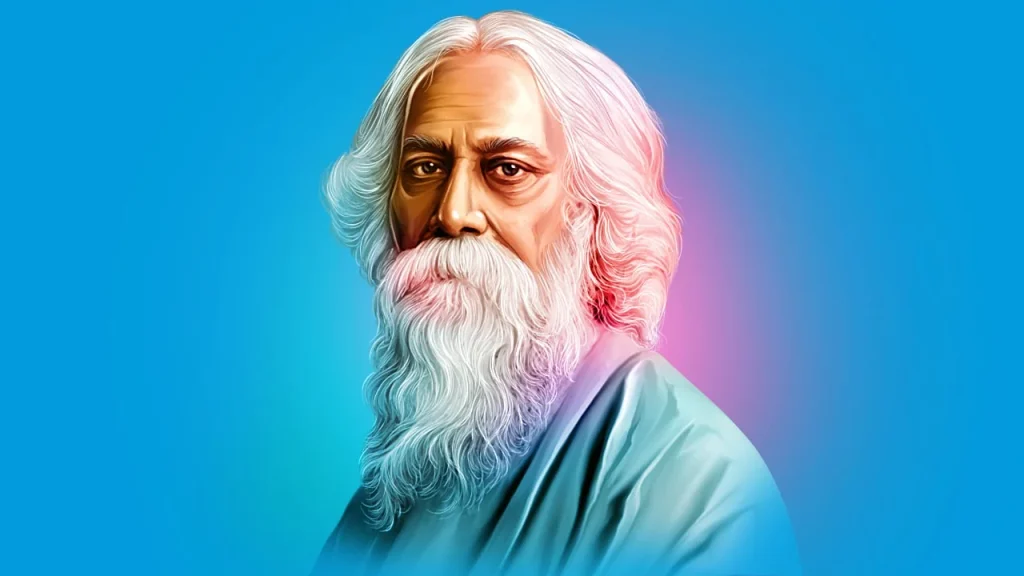
Full Name: Rabindranath Tagore (রবীন্দ্রনাথ ঠাকুর) Born: 7 May 1861, Calcutta (now Kolkata), India Died: 7 August 1941, Calcutta, India Nobel Prize: Literature, 1913 — awarded for Gitanjali: Song Offerings Known as: Gurudev, Kabiguru, Biswakobi Languages: Bengali (primary), English Notable Achievement: First non-European and first Asian to win the Nobel Prize in Literature
Table of Contents
Early Life and Family Background
Tagore was born on 7 May 1861 into one of the most intellectually prominent families of 19th-century Bengal. His father, Debendranath Tagore, was a philosopher, religious reformer, and leader of the Brahmo Samaj — a movement that sought to reform Hinduism by rejecting idol worship and emphasising ethical monotheism. Growing up in this household meant growing up surrounded by ideas.
The family home on Jorasanko in north Calcutta was almost a cultural institution in itself. Music, literature, philosophy, and debate were daily realities, not weekend pursuits. His elder brothers were poets and playwrights. His sisters wrote. His household employed servants who sang.
Tagore began writing verse very early. By his early teens, he was already producing poetry with a maturity that surprised the adults around him. He published his first significant poem at seventeen under the pen name Bhanusimha (meaning “lion of the sun”), imitating the style of the medieval Vaishnava poets. The imitation was so convincing that some scholars initially believed the poems were genuinely ancient texts.
Education: The Student Who Rejected Western Schooling
There is something quietly ironic about studying Tagore in a conventional classroom. He hated conventional classrooms.
Tagore had almost no formal schooling as a child. He attended several schools briefly but found them mechanical, joyless, and disconnected from real experience. He was largely educated at home by tutors, which gave him room to read widely and think freely.
In 1877, at sixteen, he was sent to England — partly to study law at University College London, partly to absorb English culture. He attended lectures on English literature, which genuinely interested him. But he found Western educational practices rigid and unimaginative, and returned to India in 1880 without completing a degree.
This experience shaped everything that came after. The tension Tagore felt between the energy of Western knowledge and the warmth of Indian tradition never left him. It became, in many ways, the creative tension at the heart of his writing.
Rabindranath Tagore’s Major Works
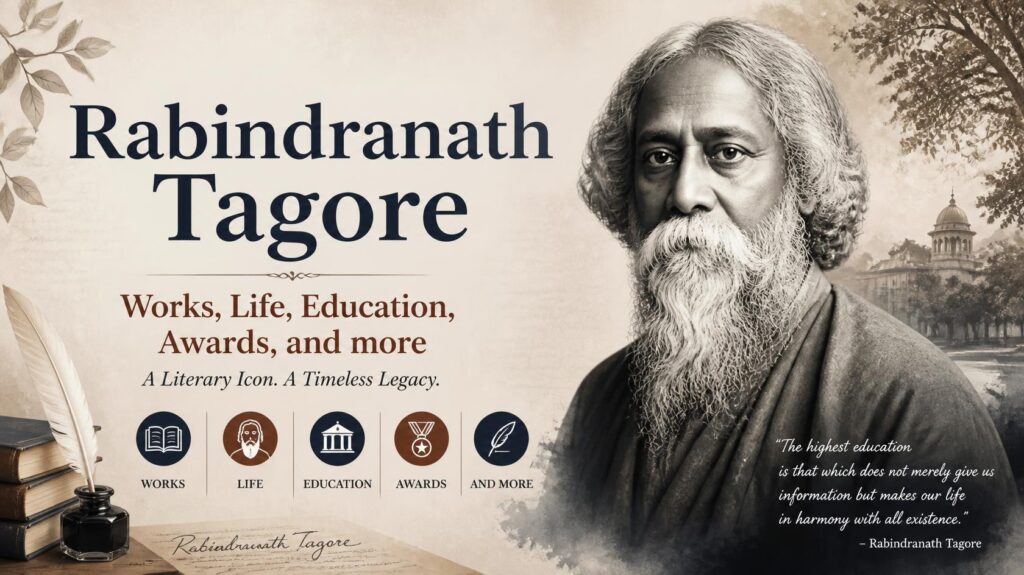
Tagore was extraordinarily prolific. Over his lifetime, he wrote more than one thousand poems, around two thousand songs, eight novels, numerous short stories, plays, essays, and philosophical writing. The range is almost impossible to summarise fairly, so what follows are the works most relevant to students of English literature.
Poetry
Gitanjali: Song Offerings (1912) This is the work most associated with Tagore in the English-speaking world. Gitanjali was originally written in Bengali; Tagore translated it into English himself during a sea voyage to England in 1912. The English edition was published in September 1912 by the India Society of London, with an introduction by W.B. Yeats, who was deeply moved by the poems.
The poems are deeply spiritual — meditations on the soul’s relationship with the divine, but without the weight of dogma. Tagore’s God in Gitanjali is not distant or punishing. The divine is present in the harvest, in the child’s laughter, in ordinary human love. The Nobel Committee described the verse as “profoundly sensitive, fresh and beautiful.”
Sonar Tari / The Golden Boat (1894) Written in Bengali, this collection includes what many critics consider some of Tagore’s finest shorter poems. The title poem uses the image of a golden boat arriving to collect the harvest but leaving the poet behind — a meditation on creativity, recognition, and the relationship between the artist and their work.
Manasi / The Ideal One (1890) An early Bengali collection where Tagore began developing his mature poetic voice. The poems explore the relationship between the individual soul and the infinite, between earthly life and the transcendent.
Novels
Ghare-Baire / The Home and the World (1916) Set against the backdrop of the Swadeshi Movement of 1905, this novel follows three characters — a nobleman, his wife Bimala, and a charismatic nationalist leader — whose relationships reveal the personal cost of political passion. It is Tagore’s most widely read novel in translation and is a genuinely complex exploration of idealism, desire, and the limits of nationalism.
Gora (1910) A longer and more philosophically ambitious novel, Gora follows a young man who is a fierce defender of Hindu tradition, only to discover late in the story that he is not, in fact, Hindu by birth. The novel asks difficult questions about identity, belonging, and what it means to love a country. It remains one of the great novels of Indian literature.
Chokher Bali / A Grain of Sand (1903) Often considered the first modern Bengali novel in terms of psychological realism. It explores desire, jealousy, and social convention through the story of a young widow — a radical subject for early 20th-century India.
Plays
Chitra (1914) Based on an episode from the Mahabharata, this short verse play explores the story of Chitrangada, a warrior princess, who asks the god of love to transform her into a conventionally beautiful woman to attract Arjuna. The play questions whether love based on external beauty is worth having.
The Post Office / Dakghar (1912) Perhaps Tagore’s most beloved play internationally. A young boy named Amal, confined to a room by illness, watches the world through a window and imagines receiving a letter from the king. It is about childhood, imagination, freedom, and the acceptance of death. The play moved audiences deeply in Europe when it was first performed, and it still does.
Read More: Macbeth by William Shakespeare: Complete Explanation to the Play, Themes & Characters (2026)
Short Stories
Tagore is considered the pioneer of the modern short story in Bengali literature. His short fiction is sharp, psychologically precise, and often quietly devastating. The Hungry Stones and Other Stories (1916) and The Glimpses of Bengal Life (1913) are the most accessible English translations.
Essays and Lectures
Nationalism (1917) A collection of lectures Tagore delivered in Japan and the United States, warning against the dangers of unchecked nationalism. His critique was unusual for its time and has aged remarkably well. He argued that nations which glorify themselves above humanity create conditions for violence and moral collapse.
The Nobel Prize: The Story Behind Gitanjali
The story of how Tagore won the Nobel Prize is not widely told, and it is worth knowing.
In 1912, Tagore came to England carrying a notebook of English translations he had made from his Bengali Gitanjali during the sea voyage. He showed the notebook to the painter William Rothenstein, who read it and was stunned. Rothenstein introduced him to W.B. Yeats, then at the height of his fame as a poet. Yeats read the manuscript, and in his introduction to the published edition, wrote that the poems moved him to tears on several occasions.
The India Society published the English Gitanjali in a limited edition that quickly circulated among literary figures in London. Within a year, Tagore was awarded the Nobel Prize in Literature — the first non-European and the first Asian to receive it.
The Nobel Committee’s citation read: the prize was awarded “because of his profoundly sensitive, fresh and beautiful verse, by which, with consummate skill, he has made his poetic thought, expressed in his own English words, a part of the literature of the West.”
Note that phrase — “expressed in his own English words.” This is important. Tagore translated his own work. The Nobel was awarded not merely for the Bengali originals but specifically for Tagore’s own English rendering of them. This makes his case unique in Nobel history: he is the only laureate credited with introducing a major literary tradition to the West through his own translations.
Gitanjali by Rabindranath Tagore: A Complete Literary Analysis
Tagore in English Literature: His Role as a Bridge
Students often ask: where does Tagore sit in English literature? Is he an English writer?
The honest answer is that he sits at the intersection of two traditions, and that position is itself what makes him remarkable.
Tagore wrote primarily in Bengali. But he translated significant portions of his own work into English, and some of his plays and essays were composed directly in English. His English writing shaped how the West understood Indian thought, Indian spirituality, and Indian literary sensibility at a time when very little Indian writing was accessible in English.
He was not simply an exotic figure for Western audiences to consume. He actively shaped the conversation. He corresponded with Einstein. He argued with Gandhi about the relationship between nationalism and universal humanity. He lectured in universities across Europe, America, and East Asia.
In the context of postcolonial literature studies, Tagore is studied as someone who navigated the encounter between Indian and Western traditions on his own terms, neither rejecting the West entirely nor surrendering to it. That balancing act, more than any single poem or novel, is his contribution to English literature.
Shantiniketan and His Educational Philosophy
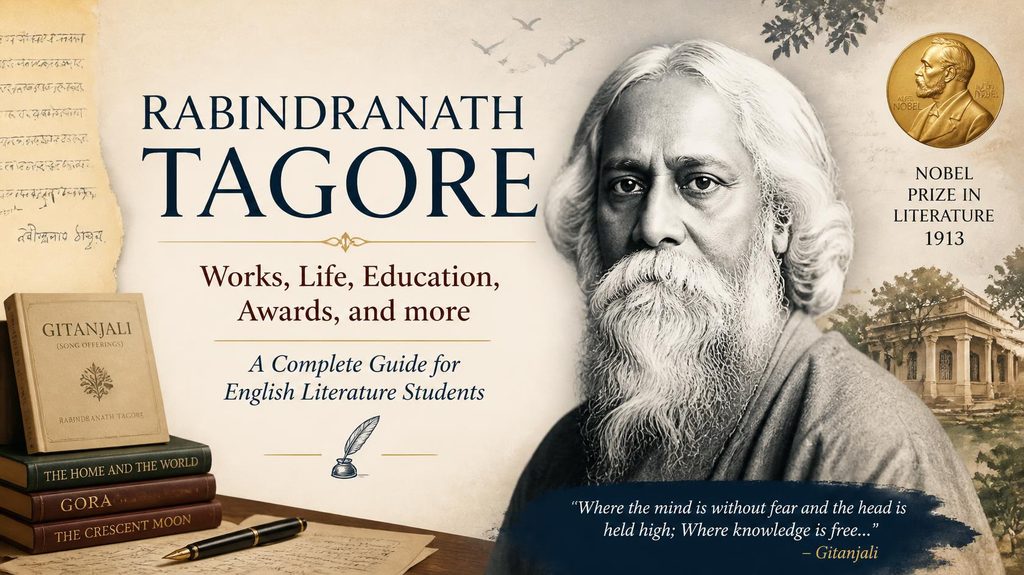
In 1901, Tagore founded an experimental school at Shantiniketan in West Bengal — on land his father had purchased years earlier. He called it Brahmacharya Ashrama. The institution eventually grew into Visva-Bharati University, formally established in 1921.
The school was everything his own education was not. Classes were held outdoors, under trees. Students were encouraged to learn through observation, music, art, and debate, rather than rote memorisation. The curriculum blended Indian classical traditions with Western science and philosophy.
Tagore’s educational philosophy rested on a core conviction: that education should awaken a child’s capacity for joy, curiosity, and creativity — not suppress it. He wrote extensively about this, arguing that the conventional school system, both colonial and post-colonial, treated children as vessels to be filled rather than flames to be kindled.
This idea of education as liberation rather than instruction has influenced educators worldwide. In India, Shantiniketan remains one of the most distinctive educational institutions in the country, and Visva-Bharati University continues to operate under a special status as a central university.
Tagore’s Political Courage: The Knighthood He Returned
In 1915, King George V awarded Tagore a knighthood. At the time, this was a significant honour — a formal recognition by the British Crown of his literary achievement.
Tagore returned the knighthood in 1919, following the Jallianwala Bagh Massacre in Amritsar, in which British troops under the command of General Reginald Dyer fired on an unarmed crowd of Indian civilians — many of them there for a religious gathering — killing hundreds.
Tagore’s letter to the Viceroy of India on this occasion is a remarkable document. He wrote that he could no longer carry “with pride” the distinction of a title that placed him among those who had demonstrated such contempt for Indian life.
This act cost him significantly in terms of his relationship with the British establishment. But it gained him something more durable: the respect of millions who saw it as proof that his poetry about human dignity was not merely decorative language but a lived conviction.
For exam purposes, this episode is frequently cited as evidence of Tagore’s engagement with the independence movement — though his relationship with Indian nationalism was always complex. He supported independence while consistently warning against what he saw as the dangers of nationalist sentiment that put nation above humanity.
Tagore as a Painter and Composer
Two aspects of Tagore’s work are often underestimated in literary discussions: his painting and his music.
He began drawing and painting seriously in his late sixties — relatively late. His visual art is deeply personal, full of fantastical creatures, abstracted human forms, and ink drawings with a quality that moves between folk art and something entirely his own. Today his paintings are housed in the Rabindra Bhavana at Shantiniketan and have been exhibited internationally.
His compositions — which he called Rabindra Sangeet — number more than two thousand songs, both music and lyrics. Two of these compositions were adopted as national anthems: “Jana Gana Mana” became the national anthem of India, and “Amar Sonar Bangla” became the national anthem of Bangladesh. Sri Lanka’s national anthem was also reportedly influenced by Tagore’s work, though he did not write it directly.
This means Tagore is the only person in history whose compositions became the national anthems of two countries. That detail alone deserves more attention than it typically receives.
Why Tagore Still Matters: His Legacy Today
It is easy to describe a historical figure as “timeless” and mean very little by it. So let’s be specific about what Tagore’s legacy actually looks like.
In education: Visva-Bharati University at Shantiniketan operates to this day and continues to attract students from across India and internationally. Tagore’s ideas about learning, creativity, and the relationship between nature and human development have influenced progressive education movements worldwide.
In literature: His short stories are studied in university literature programmes across South Asia, Europe, and North America. Ghare-Baire and Gora are standard texts in postcolonial literature courses.
In music: Rabindra Sangeet is a living tradition. Every year on 25 Boishakh (the day of his birth, according to the Bengali calendar), concerts and programmes are held across Bengal and Bangladesh in his memory. His songs are not museum pieces — they are actively sung, recorded, and reimagined.
In film: The filmmaker Satyajit Ray adapted several of Tagore’s works for cinema, including Charulata, Teen Kanya (Three Daughters), and Ghare-Baire. These films brought Tagore’s stories to global film audiences.
In global thought: His lectures on nationalism, delivered in 1916 and 1917, read as startlingly contemporary. His warning against nations that define themselves through exclusion and his argument for a universal humanism that transcends national borders remain relevant in ways he could not have anticipated.
A Closer Look at Tagore’s Timeline
| Year | Event |
|---|---|
| 1861 | Born in Calcutta, 7 May |
| 1877 | Travels to England; studies briefly at University College London |
| 1880 | Returns to India without a degree |
| 1883 | Marries Mrinalini Devi |
| 1890 | Publishes Manasi, a significant early poetry collection |
| 1894 | Publishes Sonar Tari (The Golden Boat) |
| 1901 | Founds Brahmacharya Ashrama at Shantiniketan |
| 1910 | Publishes Gora |
| 1912 | Translates Gitanjali into English during voyage to England |
| 1913 | Wins Nobel Prize in Literature — first Asian to do so |
| 1915 | Awarded knighthood by King George V |
| 1919 | Returns knighthood in protest of Jallianwala Bagh Massacre |
| 1921 | Visva-Bharati University formally established |
| 1941 | Dies in Calcutta, 7 August |
Common Exam Questions and How to Approach Them
Students in Indian universities, CBSE, and ISC boards frequently encounter Tagore in their English syllabus. Here are some common question types and how to handle them.
“Discuss Tagore as a poet.” Do not just list poems. Talk about what makes his poetry distinctive: the spiritual quality, the blending of Bengali and English literary traditions, the directness of emotion combined with philosophical depth. Use Gitanjali as your primary example.
“What was the significance of Tagore winning the Nobel Prize?” Mention that he was the first non-European and first Asian to win it. Note that the prize was specifically for his English translations of Gitanjali. Discuss what this said about the relationship between Indian and Western literary traditions at the time.
“What was Tagore’s educational philosophy?” Focus on Shantiniketan. Explain his belief that education should be joyful, nature-based, and whole-person — not merely academic. Contrast this with colonial-era rote learning. Mention Visva-Bharati University.
“Why did Tagore return his knighthood?” This requires knowing the context of the Jallianwala Bagh Massacre (1919). Explain that Tagore returned the honour as a moral protest, not a political strategy. Connect this to his larger conviction that human dignity cannot be separated from political action.
Read More: What Is Business Communication? A Complete Guide for Students and Professionals
Key Takeaways
Tagore was born in 1861 in Calcutta and died in 1941. He wrote primarily in Bengali but translated many of his works into English himself.
He won the Nobel Prize in Literature in 1913 for Gitanjali, becoming the first non-European and first Asian Nobel laureate in literature.
His major works include the poetry collection Gitanjali, the novels Gora and Ghare-Baire, the play The Post Office, and numerous short stories and essays.
He founded Shantiniketan, an experimental school that later became Visva-Bharati University, based on the belief that education should be rooted in nature, creativity, and joy.
He returned his British knighthood in 1919 to protest the Jallianwala Bagh Massacre.
Two of his compositions became national anthems — “Jana Gana Mana” for India and “Amar Sonar Bangla” for Bangladesh — making him the only person in history for whom this is true.
Frequently Asked Questions
Who was Rabindranath Tagore?

Rabindranath Tagore (1861-1941) was a Bengali poet, novelist, playwright, composer, and painter from Calcutta, India. He is widely regarded as one of the greatest writers in the history of South Asian literature. He won the Nobel Prize in Literature in 1913, becoming the first Asian to receive it, primarily for his English translation of his poetry collection Gitanjali.
Why did Tagore win the Nobel Prize?
Tagore won the 1913 Nobel Prize in Literature for Gitanjali: Song Offerings, a collection of devotional poems he translated from Bengali into English himself. The Nobel Committee cited his “profoundly sensitive, fresh and beautiful verse” through which he made Indian poetic thought a part of Western literature. W.B. Yeats, who wrote the introduction to the English edition, played a significant role in drawing Western attention to the work.
What is Tagore’s most famous work?
Gitanjali: Song Offerings (1912) is his most internationally recognised work. However, within India and Bangladesh, his songs — collectively known as Rabindra Sangeet — and his novels Gora and Ghare-Baire are equally celebrated. Among students of English literature, the play The Post Office and the essay collection Nationalism are frequently studied.
What was Tagore’s contribution to English literature?
Tagore’s contribution to English literature is best understood as the work of a bridge-builder. He brought Indian philosophical and spiritual thought to Western literary audiences through his own English translations. His writing challenged the cultural hierarchy that placed European literature above all others, and he did so at a time when very few Indian writers had access to Western publishing channels.
Why did Tagore return his knighthood?
Tagore was knighted by King George V in 1915, but he returned the honour in 1919 following the Jallianwala Bagh Massacre, in which British troops fired on an unarmed civilian crowd in Amritsar, killing hundreds. He wrote that he could no longer carry a title that connected him to those who had shown such contempt for Indian life. This act is considered one of the most significant moral gestures in Indian literary history.
What is Shantiniketan and why did Tagore create it?
Shantiniketan is the educational institution Tagore founded in 1901 in West Bengal. He created it as a direct response to what he saw as the failure of conventional colonial education: mechanical, disconnected from nature, and designed to produce obedient clerks rather than creative human beings. His school held classes outdoors, integrated music and art into daily learning, and welcomed students regardless of caste. It grew into Visva-Bharati University in 1921.
Was Rabindranath Tagore a nationalist?
Tagore’s relationship with nationalism was deliberately complicated. He supported Indian independence from British rule but was consistently critical of nationalism as an ideology. He argued that nationalism — whether Indian, Japanese, or European — became dangerous when it placed the nation above universal humanity. His essay collection Nationalism (1917) makes this case explicitly and has been widely read as a prescient critique of 20th-century political movements.
How is Tagore taught in Indian schools and universities?
In India, Tagore appears at multiple levels of the curriculum. His short stories are studied in school-level English literature texts. His poetry and novels appear in undergraduate and postgraduate English and Bengali programmes. His educational philosophy is a standard topic in B.Ed. courses. Tagore Jayanti (7 May) is observed in many institutions, particularly in West Bengal, with cultural programmes, recitations, and discussions of his life and work.
Conclusion
Rabindranath Tagore is not simply a subject to be studied and set aside after an exam. He is a genuinely useful companion for anyone who thinks carefully about language, education, creativity, and what it means to live a life of principle.
His poetry argues, quietly but persistently, that beauty and truth are not separate things. His educational experiments at Shantiniketan tried to prove that learning can be joyful without being shallow. His political choices — especially returning his knighthood — demonstrated that moral conviction is not something kept in verse and left out of action.
For students of English literature, Tagore represents an important historical turning point: the moment when the question “whose literature counts?” began to be answered differently, and when an Indian writer on his own terms stepped into the canon not because the West made space, but because the work was impossible to ignore.
External Sources
- Nobel Prize official biography: https://www.nobelprize.org/prizes/literature/1913/tagore/facts/
- Visva-Bharati University official site: https://www.visvabharati.ac.in
- Rabindra Bhavana (archive at Shantiniketan): https://www.visvabharati.ac.in/RabindraBhavana.html