Table of Contents
Introduction
Some symbols in literature do not announce themselves. They arrive quietly, then refuse to leave.
The albatross in Samuel Taylor Coleridge’s The Rime of the Ancient Mariner is exactly that kind of symbol — one that enters the poem as a seabird cutting through Antarctic fog, and exits the poem as one of the most layered, contested, and culturally embedded images in the English literary tradition.
Published in 1798 as part of Lyrical Ballads — the collection Coleridge co-authored with William Wordsworth — the poem tells the story of an aged mariner who shoots the albatross that had guided his ship to safety. What follows is not simply a story of bad luck at sea. It is a psychological and spiritual ordeal: guilt that cannot be spoken, a curse that cannot be broken, and a penance that lasts a lifetime.
The albatross symbolism in The Rime of the Ancient Mariner operates on at least four simultaneous levels — natural, moral, religious, and psychological — and understanding all four is what separates a surface reading from a genuinely illuminating one. This article covers every dimension of that symbolism, the critical debates it has sparked, and why the image of an albatross hung around a guilty neck still resonates more than two centuries later.
Quick Answer
What does the albatross symbolize in The Rime of the Ancient Mariner? The albatross first symbolizes good fortune and divine grace — it guides the ship from ice toward open water. After the Mariner shoots it without reason, it becomes a symbol of sin, guilt, and spiritual burden. Hung around his neck in place of a cross, it represents the weight of an unredeemed conscience.
The Poem at a Glance: Context Before Symbol
Before any symbol can be understood, its home must be known.
The Rime of the Ancient Mariner is a ballad-style narrative poem in seven parts. An old sailor — the Ancient Mariner — stops a wedding guest on his way to a feast and compels him to listen to his story. The guest cannot leave. He does not want to stay. But the Mariner’s eyes hold him, and the story begins.
The ship sails south from England into a violent storm, then further into cold, fog-wrapped seas near Antarctica. Then the albatross appears.
Coleridge was writing in the Romantic era, a period that pushed back against Enlightenment rationalism and restored nature, emotion, and the supernatural to the center of human experience. The poem is saturated with that Romantic energy — but it also carries heavy debts to Christian allegory, maritime folklore, and Coleridge’s own complicated spiritual life.
Understanding that the poem was written in that intersection — Romanticism, Christian guilt, and sailor superstition — helps explain why the albatross carries so much symbolic weight. Coleridge chose a bird that real sailors genuinely revered and feared, and placed it at the moral center of a poem about what happens when a human being acts against the natural and spiritual order for no reason at all.
That last part is crucial. The Mariner gives no reason for shooting the bird. This absence of motive is not an oversight. It is the point.
Also Read Poems of ST Coleridge: Kubla Khan by Samuel Taylor Coleridge
The Albatross as a Symbol of Good Omen and Divine Grace
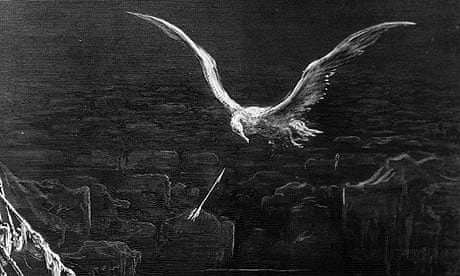
When the albatross first appears in Part I of the poem, the ship is surrounded by ice — “The ice was here, the ice was there / The ice was all around.” There is no wind. No direction. Only frozen silence and the creaking of a trapped vessel.
Then the albatross arrives through the fog.
The sailors hail it “as if it had been a Christian soul” — a line that does significant work. From the very beginning, Coleridge elevates the bird beyond biology. The crew does not simply notice a seabird. They greet it as a sacred visitor, feeding it and calling to it as though it belongs to some higher order of being.
In real maritime folklore, albatrosses were believed to carry the souls of dead sailors. Killing one was considered deeply unlucky — not merely superstition, but a violation of a moral code shared among people who understood that the sea could take your life and that you depended on forces larger than yourself to survive it.
In the poem, this folk belief translates into something more spiritualized: the albatross comes, the ice splits, a favorable wind rises, and the ship moves again. The bird has functioned as an intercessor — something between the sailors and the forces governing their fate.
At this stage, the albatross symbolizes:
- Divine grace — an unearned gift that arrives to protect
- Natural harmony — the balance between human beings and the world they inhabit
- Hope — the possibility of safe passage through an inhospitable world
It is worth noting that Coleridge does not make this symbolism heavy-handed. The bird is not described with elaborate religious language. It simply appears, eats the food offered to it, plays around the ship, and guides the vessel forward. Its holiness is implied, not declared — which is exactly what makes the killing so disturbing.
The Killing: When a Symbol Turns
In Part I, without warning, without reason, and without any preceding conflict, the Mariner raises his crossbow and shoots the albatross.
That is it. No explanation. No motivation. No dramatic buildup.
Coleridge offers one line: “With my cross-bow / I shot the ALBATROSS.”
The word “crossbow” is not incidental. A crossbow is a cross-shaped weapon. The Mariner kills a creature his shipmates have greeted as a Christian soul, using a weapon shaped like a cross. Coleridge is already building the symbolic architecture that will dominate the rest of the poem.
The crew’s reaction is instructive. They immediately condemn the Mariner — they say he has done a “hellish thing.” But then a favorable wind appears, and they change their position entirely, concluding that the bird “deserved” to die since a fog had brought it. They become accomplices in the moral failure by rationalizing it.
This detail — the crew’s shift in moral judgment — adds a layer to the symbolism. The albatross does not just represent the Mariner’s sin. It represents the ease with which people abandon moral clarity when circumstances seem to excuse transgression. The crew’s guilt makes the punishment that follows collective, at least initially.
The Albatross as a Symbol of Sin and Guilt
Once the bird is dead, the poem’s symbolism undergoes its central transformation.
The crew, dying of thirst and stranded on a still, burning sea, turns against the Mariner. Unable to speak through cracked lips and parched throats, they communicate their blame through glances. Then they hang the dead albatross around his neck.
“Instead of the cross, the Albatross / About my neck was hung.”
This is one of the most famous lines in English poetry — and it is the line that crystallizes the albatross symbolism most precisely. The cross that a Christian would wear as a sign of faith, identity, and divine protection is replaced by a dead bird. The symbol of life and grace has become a symbol of death and condemnation.
What makes this moment so powerful is that the punishment is self-contained. The Mariner wears the bird not because some external authority places it there, but because the crew — fellow human beings who shared in the crime of moral inconsistency — decide it is fitting. The burden of guilt is social before it becomes psychological.
At this stage, the albatross symbolizes:
- The specific sin of destroying innocence without cause
- Guilt — a weight that cannot be removed until atonement occurs
- Social condemnation — the judgment of the community upon a transgressor
- The inversion of grace — what was a blessing has become a curse
The Albatross as a Christ Figure: Religious Dimensions
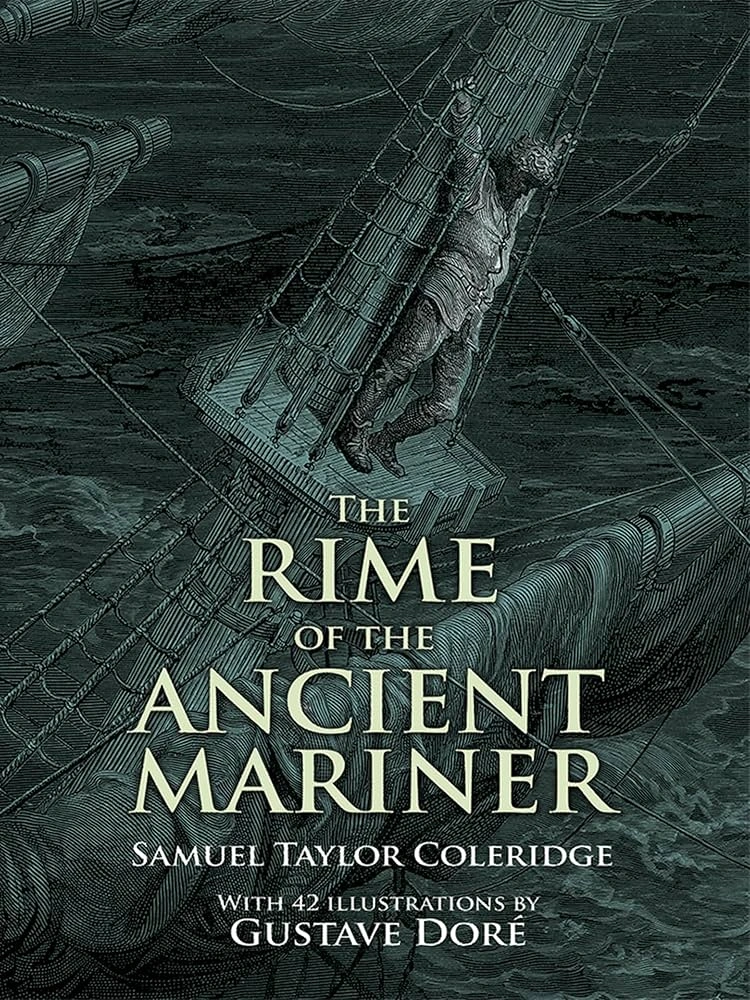
Scholars of Romantic literature have long identified the albatross as a Christ figure — and the textual evidence supports this reading at several points.
Consider the pattern: the albatross appears as a savior when the ship is trapped, brings salvation freely and without condition, is killed by its beneficiaries for no defensible reason, and its death triggers a long ordeal that can only end when the Mariner learns to love all of creation.
This mirrors the Christian narrative of crucifixion and redemption in compressed form. The Mariner, by shooting the bird, enacts something structurally similar to the betrayal of Christ — and the crossbow, as noted above, literalizes the symbolic connection to the crucifixion.
What is uniquely Coleridgean about this reading is that the redemption arc does not require traditional religious observance. The Mariner is not saved by prayer alone, or by confession, or by the performance of a specific ritual. He is saved at the moment he spontaneously blesses the water snakes — creatures he had previously found repulsive — because he perceives their beauty without being told to. Grace arrives when he learns to love what he had rejected.
This is a Romantic inflection of Christian theology: redemption comes not through institutional religion but through the expansion of the self to recognize the sanctity of all living things. The albatross, in this reading, is not just a Christ symbol — it is a symbol of the kind of universal love that Christ is understood to represent.
Also Read: Hamartia in Oedipus Rex and Macbeth
Psychological Reading: The Albatross as Internalized Guilt
Literary psychology offers another angle entirely — one that does not require religious frameworks but is no less illuminating.
The albatross hung around the Mariner’s neck is a perfect image for what modern psychology might call a traumatic intrusion — an act so morally dissonant that it cannot be integrated into normal experience and instead dominates the psyche indefinitely.
The Mariner’s compulsion to tell his story, which frames the entire poem, is itself a psychological symptom. He stops the wedding guest repeatedly throughout the poem’s narrative. He tells the story over and over to anyone he feels “hath his will.” He does not tell it for entertainment or connection. He tells it because he has to — because the story has not yet finished working itself through him.
The dead bird around his neck, in this reading, is guilt given physical form: the way traumatic guilt makes itself felt as a literal weight, a heaviness in the chest, a burden that colors every subsequent experience.
The Mariner’s final state — condemned to wander the earth and periodically tell his story as penance — maps onto what we now understand about unresolved guilt. It does not destroy the person entirely. But it prevents them from fully living. They remain caught between the moment of transgression and the unattainable state of full absolution.
Ecocritical Reading: Nature as Moral Force
One of the most intellectually fertile contemporary approaches to the poem reads it through an ecocritical lens — which means asking what the poem says about the relationship between human beings and the natural world.
From this angle, the albatross is not primarily a religious symbol or a psychological one. It is a representative of the non-human world — a living creature with its own claim to existence, independent of what humans need from it.
The Mariner’s sin, in this reading, is not theological transgression. It is ecological arrogance: the belief that human will can act upon the natural world without consequence, without reciprocity, without accountability.
The punishment that follows — the dead calm, the burning sun, the rotting sea, the spectral ship, the dying crew — is not divine punishment. It is natural consequence. The world does not simply absorb human violence against it. It responds.
Coleridge was writing at the very beginning of the Industrial Revolution. The poem can be read as an early warning: the natural world is not a backdrop for human activity. Treat it as though it exists only for your use, and you will find yourself becalmed, dying of thirst, surrounded by water you cannot drink — a remarkably precise metaphor for ecological crisis.
The Symbolic Arc: From Death to Redemption
The albatross does not remain a static symbol. It changes as the Mariner changes — and tracking that movement reveals the poem’s moral logic.
| Stage | Event | Albatross Symbol |
|---|---|---|
| Arrival | Albatross appears from the fog | Divine grace, natural harmony, hope |
| Killing | Mariner shoots it without reason | Violation of natural and moral order |
| Neck | Crew hangs bird around Mariner’s neck | Sin made visible; guilt as burden |
| Dying crew | All 200 sailors die; Mariner lives | Collective punishment; isolation |
| Water snakes | Mariner blesses them spontaneously | Beginning of redemption through love |
| Fall from neck | Albatross falls into the sea | Guilt begins to lift; grace re-enters |
| Return home | Mariner reaches home port | Partial redemption; penance remains |
| Storytelling | Mariner compelled to repeat his tale | Guilt as ongoing obligation; wisdom through suffering |
The fall of the albatross from the Mariner’s neck is the poem’s pivotal moment of grace — and it happens not because the Mariner performs a religious act, but because he sees beauty in creatures he had found disgusting. That is Coleridge’s moral: love is not selective. Redemption cannot arrive in a heart that withholds compassion from any part of creation.
The Albatross in Culture: Beyond the Poem
The poem has given English a phrase that functions independently of any knowledge of Coleridge: “an albatross around one’s neck.”
The phrase refers to any burden — professional, personal, moral — from which a person cannot escape and which prevents forward movement. Its usage has traveled far beyond literary circles. Politicians speak of failed policies as albatrosses. Businesspeople use it to describe liabilities that haunt companies for years.
What is remarkable is how precisely the original symbol translates: the phrase captures not just the weight of the burden, but its origin in a moment of transgression. An albatross around the neck is not an accident. It is a consequence.
The albatross has also influenced popular culture in ways that range from the obvious to the unexpected — including Iron Maiden’s song Rime of the Ancient Mariner (1984), which retells the poem in thirteen minutes of progressive metal, and various uses in films, television series, and novels that deploy the image whenever a character cannot escape the consequences of a past decision.
Comparison Table: The Albatross Symbol Across the Poem’s Stages
| Symbolic Layer | What the Albatross Represents | Textual Evidence |
|---|---|---|
| Natural | Good luck, safe passage, divine favor | Crew hails it “as if it had been a Christian soul” |
| Moral | The cost of senseless destruction | Unprovoked killing, immediate suffering of crew |
| Religious | Christ figure; burden of unredeemed sin | “Instead of the cross, the Albatross / About my neck was hung” |
| Psychological | Internalized guilt; traumatic repetition | Mariner’s compulsion to tell and retell the story |
| Ecological | Nature’s claim against human violence | Supernatural punishment mirrors environmental collapse |
| Cultural | Universal burden of past transgression | “Albatross around the neck” as enduring idiom |
Common Misconceptions About the Albatross Symbol
Misconception 1: The albatross symbolizes only bad luck. The albatross is first a symbol of good luck and divine favor. It becomes a symbol of guilt only after the Mariner kills it. Both meanings coexist in the poem.
Misconception 2: The Mariner is punished immediately. The punishment is initially collective — the crew suffers alongside the Mariner, partly because they rationalized his act. The individual punishment intensifies after the crew dies.
Misconception 3: The Mariner achieves full redemption. He does not. The poem ends with the Mariner still wandering, still compelled to tell his story at intervals. Redemption in this poem is partial, ongoing, and never quite complete.
Misconception 4: The crossbow is just a weapon. The crossbow is cross-shaped by design. Coleridge’s choice of this specific weapon to kill a Christ-figure albatross is not accidental. It is the poem’s most compressed symbolic act.
Misconception 5: The albatross has one fixed meaning. Coleridge himself reportedly said that the poem suffered from too much moral being obtruded. The albatross resists reduction to any single reading — and that resistance is itself part of what makes it a great literary symbol.
Expert Tips for Analyzing Symbolism in This Poem
Also Read: Literary Terms in English Literature: The Complete Guide
Tip 1: Read the marginal glosses. The 1817 edition of the poem included prose annotations in the margins — added by Coleridge, not by an editor. These glosses often deepen, and sometimes complicate, the poem’s symbolism. They are part of the text, not a study aid.
Tip 2: Track the weather. The weather in this poem is never neutral. Wind means grace. Calm means guilt and spiritual stasis. Ice means entrapment. Each meteorological shift corresponds to a moral shift in the Mariner’s journey.
Tip 3: Notice what the Mariner does NOT explain. The most important information in the poem is missing: why does the Mariner shoot the albatross? That absence is not a flaw in the poem. It is the poem’s most deliberate and unsettling choice.
Tip 4: Read the poem alongside Coleridge’s notebooks. Coleridge’s notebooks from the 1790s reveal his preoccupation with guilt, atonement, and the nature of evil acts. The poem did not emerge from nowhere — it emerged from a mind that was genuinely troubled by questions of moral accountability.
Tip 5: Resist the urge to fix the symbol. The poem’s power lies precisely in the albatross’s resistance to a single meaning. Treat it as a multi-layered symbol and your analysis will be richer than any single-reading interpretation.
Key Takeaways
✅ The albatross first symbolizes divine grace, natural harmony, and hope when it guides the ship from ice.
✅ After the killing, it becomes a symbol of sin, guilt, and the inversion of blessing into burden.
✅ The line “Instead of the cross, the Albatross / About my neck was hung” positions the bird as a Christ figure and the Mariner as a Judas-like transgressor.
✅ From a psychological perspective, the bird represents internalized, unresolvable guilt — the kind that compels repetition and cannot be silenced.
✅ From an ecocritical perspective, the poem warns that nature is not passive and that violence against it carries real consequence.
✅ The albatross falls from the Mariner’s neck the moment he blesses the water snakes — proving that grace returns through love, not punishment.
✅ The phrase “albatross around one’s neck” entered common English usage directly from this poem and remains in active use today.
Frequently Asked Questions
What does the albatross symbolize in The Rime of the Ancient Mariner?
The albatross carries multiple meanings across the poem. It begins as a symbol of divine grace and good fortune — guiding the ship from ice to open sea. After the Mariner kills it for no reason, it transforms into a symbol of sin, guilt, and spiritual burden. When hung around his neck, it replaces the cross, marking his transgression against nature and the sacred.
Why does the Mariner kill the albatross?
Coleridge gives no reason. The killing is entirely unmotivated — and that is the point. The poem is not about a man who kills a bird for understandable reasons and suffers for it. It is about the capacity for gratuitous destruction that exists within human beings, and the consequences of that destruction even when no intent to harm can be identified.
What does “albatross around the neck” mean?
The phrase describes any burden — guilt, liability, mistake, or obligation — that a person cannot escape and that prevents them from moving forward freely. It derives directly from The Rime of the Ancient Mariner, in which the dead bird is hung around the Mariner’s neck as a mark of his guilt and the cause of his curse.
Is the albatross a Christ symbol in the poem?
Many scholars read the albatross as a Christ figure. It arrives as a savior, is killed by those it helped, and its death triggers a long redemptive ordeal. The specific line “Instead of the cross, the Albatross / About my neck was hung” directly substitutes the bird for the crucifixion symbol. That said, Coleridge’s symbolism is layered — the Christ reading is strong, but not exclusive.
How does the albatross relate to the theme of redemption?
The albatross falls from the Mariner’s neck at the precise moment he blesses the water snakes — creatures he had previously despised. This spontaneous act of love, extended to beings he had not valued, signals that his capacity for compassion has been restored. Redemption in the poem is not earned through punishment alone — it arrives through love freely given.
What does the poem say about nature through the albatross?
The poem treats nature as a morally active force rather than a passive backdrop. The albatross represents a natural world that has its own sacred status, independent of human need. When the Mariner violates that status, nature responds — not as mere bad luck, but as a structured moral consequence. This reading connects the poem to modern ecological thinking.
Why is the albatross specifically used — why not another bird?
Coleridge chose deliberately. The albatross was a real part of maritime folklore — sailors genuinely believed killing one was catastrophic bad luck because the birds were thought to carry the souls of dead sailors. By choosing a bird already embedded in a moral code known to seafarers, Coleridge grounded his supernatural narrative in cultural reality. The bird’s actual size and grace — albatrosses can have wingspans exceeding eleven feet — also made it a plausible object of awe.
What happens to the Mariner at the end of the poem?
The Mariner returns to land but is not fully restored. He is condemned to wander the earth and periodically tell his story to whoever he senses needs to hear it. The Wedding Guest he speaks to is left “a sadder and a wiser man.” The Mariner’s penance is not a one-time event — it is a permanent state of partial redemption, suggesting that some acts leave permanent marks regardless of remorse.
Also Read: Macbeth by William Shakespeare: Complete Explanation
Conclusion
The albatross symbolism in The Rime of the Ancient Mariner has endured for over two centuries not because it is simple, but because it is not. The bird arrives as grace, dies as sin, hangs as guilt, falls as redemption, and lives on as idiom — a symbol that has escaped the poem entirely and entered the way ordinary people describe the burdens they cannot put down.
Coleridge accomplished something rare: he created a symbol that is fully convincing at the literal level (a real bird, a real crossbow, a real sea) and fully illuminating at the symbolic level simultaneously. You do not need to know the theological readings to feel the weight of the dead albatross. You feel it because Coleridge makes you feel it — through rhythm, image, and the terrible simplicity of a guilt that cannot be undone.
The poem’s final lesson, delivered through the arc of that albatross, is one the Mariner articulates near the poem’s close:
“He prayeth best, who loveth best / All things both great and small.”
Not a complicated moral. But one that, in the poem’s unfolding, has cost the Mariner everything to learn.
Recommended External References
- The British Library — holdings on Coleridge’s manuscripts and the original Lyrical Ballads (1798)
- The Coleridge Society — publishes scholarly journals on Coleridge’s life and works
- JSTOR — peer-reviewed articles on ecocritical and psychological readings of the poem
- Oxford Reference — entries on Romantic literature, the sublime, and allegory