Few grammar topics trip up learners — and even native speakers — as quietly as articles. You use them dozens of times a day without noticing. But the moment you write “I saw movie yesterday” or “She is the best student in an university,” something sounds off immediately.
Articles in English are among the most frequently used words in the language, yet they carry enormous meaning in a small package. Just three words — a, an, and the — control whether you are pointing to something specific or introducing something new, whether you mean one of many or exactly this one.
This guide covers everything you need to know: what articles are, how each one works, when to skip them entirely, and the tricky cases that confuse even advanced speakers.
What are articles in English?
Articles are a type of determiner that appear before nouns to signal specificity. English has two types: the definite article (the) and the indefinite article (a/an). The refers to something specific or already mentioned. A/an introduces something unspecific or mentioned for the first time.
An article is a word that introduces a noun and signals how specific that noun is. Articles belong to a broader word class called determiners — words that come before nouns to clarify their reference.
In English, articles are small but mighty. Leaving one out, or choosing the wrong one, changes meaning entirely.
“I need a doctor.” — Any doctor will do. “I need the doctor.” — A specific doctor, probably already known to both speakers.
That distinction — specific versus general — is at the heart of every article decision you will ever make.
Types of Articles in English
English has three articles:
| Article | Type | Example |
|---|---|---|
| a | Indefinite | a book, a car, a decision |
| an | Indefinite | an apple, an hour, an idea |
| the | Definite | the book, the car, the idea |
Some grammar textbooks also describe a zero article (∅) — the intentional omission of an article before certain nouns. This is covered in its own section below.
The Indefinite Article: A and An
What Does It Mean to Be “Indefinite”?
Indefinite simply means unspecified — you are referring to any one member of a group, not a particular one.
- “She adopted a cat.” — It could be any cat.
- “I read an article about space.” — One article, but not any article you would already know.
Use a or an when:
- Introducing something for the first time
- Talking about one of many possible things
- Making a general statement about a type of thing
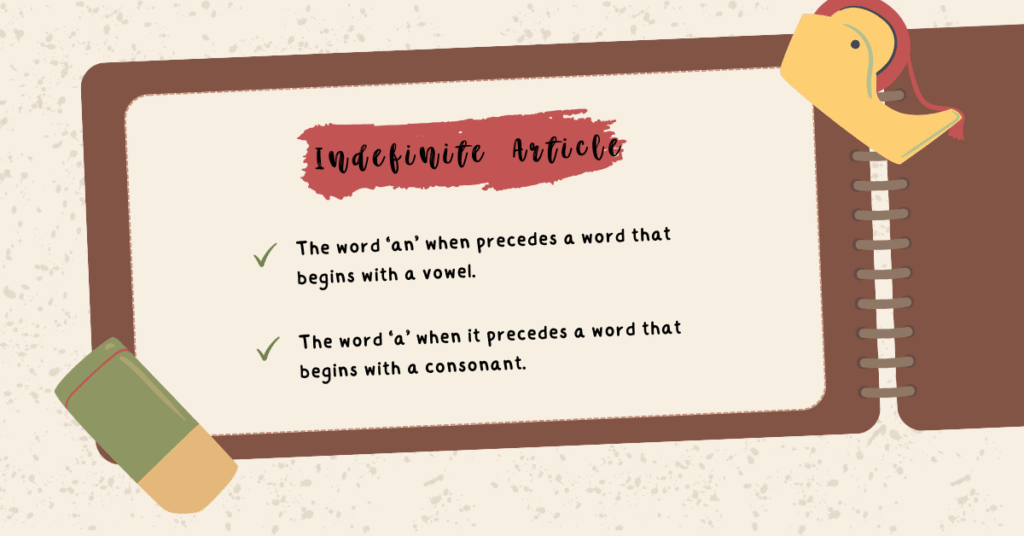
A vs. An: The Real Rule
This is where many learners get it wrong. The rule is NOT about the first letter of the next word — it is about the first sound.
- Use a before a consonant sound: a university, a European, a one-way street
- Use an before a vowel sound: an umbrella, an MBA, an honest mistake
Notice the traps:
| Word | Article | Why |
|---|---|---|
| university | a university | Starts with /j/ sound (“yoo”) |
| hour | an hour | H is silent; starts with /aʊ/ sound |
| European | a European | Starts with /j/ sound |
| MBA | an MBA | Starts with /ɛm/ sound |
| honest | an honest | H is silent; starts with /ɒ/ sound |
| one-eyed | a one-eyed | Starts with /w/ sound |
The key is always to say the word out loud. Your ear will tell you which article sounds natural.
Using A and An for Classification
A and an are also used when you classify or define something:
- “A whale is a mammal.”
- “She is a teacher.”
- “That was an extraordinary achievement.”
-

Gerund and Present Participle: The One Grammar Distinction That Changes Everything

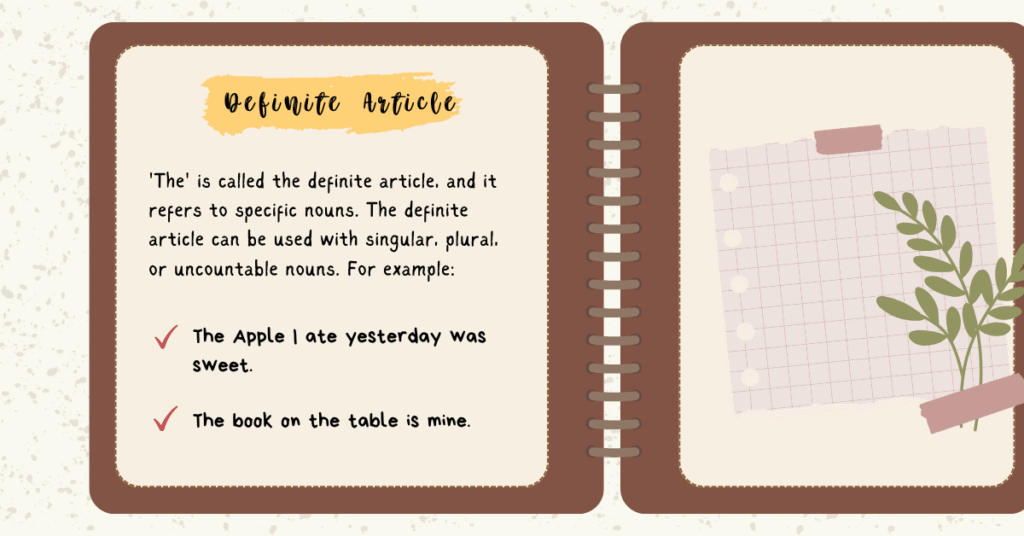
The Definite Article: The
What Makes Something Definite?
The signals that both the speaker and the listener know exactly which thing is being discussed. There are several situations where this shared knowledge exists.
When to Use “The”
1. Second mention Introduce with a, then refer back with the.
“I bought a laptop last week. The laptop arrived damaged.”
2. Unique things When there is only one of something in context, the is natural.
the sun, the moon, the government, the internet
3. Something already understood from context
“Can you pass the salt?” (Both people are at the table; they know which salt.)
4. Superlatives
“She is the most talented writer in the group.”
5. Ordinal numbers
“This is the third time I have called.”
6. Geographic names (see detailed rules below)
Zero Article — When to Use No Article
The zero article means using no article at all. This is common and important, not a mistake.
Use no article before:
- Plural countable nouns used in a general sense: “Dogs are loyal animals.” (Not “The dogs are loyal animals,” which would mean specific dogs.)
- Uncountable nouns used generally: “Water is essential for life.” “She studied music at college.”
- Proper nouns: India, London, Shakespeare (with many exceptions — see next section)
- Abstract nouns in general statements: “Courage defines great leaders.” “Love is patient.”
- Languages, academic subjects: “She speaks French.” “He majored in philosophy.”
- Meals, transport, institutions (in general use): “They had breakfast at noon.” “She goes to school by bus.”
Articles with Proper Nouns
This is one of the most nuanced areas of English article usage.
No Article
Generally, proper nouns do not take an article:
- Names of people: Einstein, Priya
- Most countries: India, France, Brazil
- Cities: Mumbai, Paris, Tokyo
- Single mountains: Mount Everest
- Individual lakes: Lake Victoria
Use “The”
Certain proper nouns always take the:
| Category | Examples |
|---|---|
| Countries with plural or “state/republic” names | the United States, the Netherlands, the Philippines, the United Kingdom |
| Mountain ranges | the Himalayas, the Alps, the Rockies |
| Rivers, canals, seas, oceans | the Ganges, the Nile, the Pacific Ocean, the Suez Canal |
| Groups of islands | the Maldives, the Bahamas |
| Newspapers | the Times of India, the Guardian |
| Historical periods/events | the Renaissance, the French Revolution |
| Deserts | the Sahara, the Gobi |
| Hotels, restaurants, museums | the Taj Mahal Hotel, the Louvre |
| Organizations | the United Nations, the WHO |
Articles with Countable and Uncountable Nouns
Understanding countability is essential to using articles correctly.
Countable Nouns
These have both singular and plural forms.
- Singular indefinite: a chair, an idea
- Singular definite: the chair, the idea
- Plural general: chairs, ideas (zero article)
- Plural specific: the chairs, the ideas
Uncountable Nouns
These have no plural form. Common uncountable nouns include: water, music, advice, knowledge, furniture, information, luggage, equipment.
- General use: zero article — “She gave me advice.”
- Specific use: the — “The advice she gave me was invaluable.”
- NEVER: an advice, a furniture, informations ✗
Partitives Help with Uncountable Nouns
To count uncountable nouns, use a partitive expression:
- a piece of advice
- a bottle of water
- a bit of information
- three items of luggage
Common Mistakes with Articles in English
Mistake 1: Using “a” before a vowel sound word
✗ “She is a honest woman.” ✔ “She is an honest woman.”
Mistake 2: Using “the” before a general plural
✗ “The lions are dangerous animals.” (if you mean lions in general) ✔ “Lions are dangerous animals.”
Mistake 3: Missing article before singular countable nouns
✗ “I need pen.” ✔ “I need a pen.”
Mistake 4: Adding “the” before uncountable nouns used generally
✗ “The music relaxes me.” (if you mean music in general) ✔ “Music relaxes me.”
Mistake 5: Ignoring silent letters for a/an choice
✗ “He is a honest man.” / ✗ “She went to an university.” ✔ “He is an honest man.” / ✔ “She went to a university.”
Mistake 6: Using “the” with most country names
✗ “She lives in the India.” ✔ “She lives in India.”
Comparison Table: A vs. An vs. The vs. Zero Article
| Feature | A | An | The | Zero Article |
|---|---|---|---|---|
| Type | Indefinite | Indefinite | Definite | N/A |
| Specificity | Non-specific | Non-specific | Specific | General |
| First/second mention | First | First | Second or known | General use |
| Before consonant sound | ✔ | ✗ | Both | Both |
| Before vowel sound | ✗ | ✔ | Both | Both |
| Singular countable | ✔ | ✔ | ✔ | ✗ |
| Plural countable | ✗ | ✗ | ✔ (specific) | ✔ (general) |
| Uncountable | ✗ | ✗ | ✔ (specific) | ✔ (general) |
Expert Tips for Mastering Articles in English
Tip 1: Ask yourself “which one?” If the answer is “a specific one you know,” use the. If the answer is “any one,” use a/an. If you are speaking in general, use no article.
Tip 2: Listen before you write Say the noun phrase aloud before choosing a or an. The sound of the first word’s pronunciation is the only test that matters.
Tip 3: Learn uncountable nouns as vocabulary items There is no shortcut for uncountable nouns. When you learn a new noun, note whether it is countable or uncountable. This single habit prevents dozens of article errors.
Tip 4: Read widely and notice patterns Skilled writers use articles instinctively because they have absorbed thousands of examples. Reading newspapers, novels, and essays in English trains your internal article radar without you realizing it.
Tip 5: The “first mention, second mention” rule always works Whenever you write a piece of extended text, introduce a noun with a/an the first time and switch to the from then on. This rule is simple and reliable for most situations.
Key Takeaways
✅ English has two types of articles: indefinite (a/an) and definite (the).
✅ Use a before consonant sounds, an before vowel sounds — regardless of spelling.
✅ Use the when both speaker and listener know exactly which thing is meant.
✅ Use no article before plural and uncountable nouns in general statements.
✅ Proper nouns mostly take no article, but rivers, mountain ranges, and certain countries take the.
✅ When in doubt, ask: Is this specific or general? First mention or second?
Frequently Asked Questions
-
What are articles in English grammar?
Articles are a small group of determiners — a, an, and the — that come before nouns to indicate whether the noun is specific or unspecific. A and an are indefinite articles used for general or first-time references. The is the definite article, used when both the speaker and listener know exactly which thing is being discussed.
-
When should I use “a” instead of “an”?
Use a before words that begin with a consonant sound, and an before words that begin with a vowel sound. This rule is about pronunciation, not spelling. For example, a university (starts with “yoo” sound) and an hour (H is silent, starts with “ow” sound).
-
What is the zero article in English?
The zero article is when no article is used before a noun. It applies to uncountable nouns in general statements (Water is life), plural countable nouns used generally (Books are powerful), most proper nouns (She is from Canada), and abstract concepts (Kindness costs nothing).
-
Do all languages have articles?
No. Many major languages — including Hindi, Russian, Japanese, Mandarin Chinese, and Latin — have no articles at all. This is why article usage is particularly difficult for speakers of these languages learning English. In these languages, context and word order convey the specificity that English articles signal.
-
Can “the” be used with uncountable nouns?
Yes, when you are referring to a specific instance of an uncountable noun. “Water is essential” uses no article (general statement). “The water in this river is polluted” uses the because you mean specific water. The distinction is always general versus specific, not countable versus uncountable.
-
Why do some country names use “the” and others don’t?
Countries with plural names (the United States, the Netherlands, the Philippines) or names containing words like kingdom, republic, union, or states (the United Kingdom, the Czech Republic) take the. Most single-word country names (India, France, Japan) take no article.
-
Is it correct to say “an MBA” or “a MBA”?
An MBA is correct. Even though M is a consonant letter, the name of the letter M is pronounced “em,” which begins with a vowel sound. The same rule applies to: an MRI, an FBI agent, an NGO, an HTML file.
-
How do articles affect meaning in English sentences?
Articles can completely change what a sentence communicates. “She is a teacher” classifies her profession. “She is the teacher” means a specific teacher already known to the conversation. “She is teacher” (no article) sounds incorrect in standard English because singular countable nouns require an article.
-
Are there shortcuts to learning article usage in English?
The most reliable shortcut is the specificity test: if you mean something specific and both people in the conversation know which thing, use the. If you mean any one of something, use a/an. If you are speaking in general, use no article. Reading extensively in English also builds strong article intuition over time.
-
What is the difference between “a” and “one”?
Both a and one indicate a single item, but they are not always interchangeable. A is used as an article for general or indefinite reference. One emphasizes the number or is used for contrast (I need one pen, not two). You would say “I’ll be back in an hour” but “I’ll be back in one hour” if you want to stress the exact time.
Conclusion
Articles in English may be just three words, but they shape meaning in ways few grammar topics match. Knowing when to use a, an, the, or nothing at all is less about memorizing rules and more about understanding the relationship between speaker, listener, and context.
The simplest framework: ask whether your noun is specific or general, singular or plural, countable or uncountable. Then ask whether this is the first or second mention. Those two questions will guide you correctly in most situations.
Mastering articles takes time, especially for speakers whose native languages have no equivalent. But with practice, careful reading, and attention to the examples around you, article usage becomes second nature — and your English writing gains clarity, precision, and polish.
Recommended External Reference
- British Council LearnEnglish — grammar section on articles: learnenglish.britishcouncil.org